Why solfeggio frequencies help with sleep
Falling asleep means shifting from the alert state of the day to a state of rest. Many people who sleep badly are still in day mode late in the evening: still thinking, still tense, still braced for demands that are over.
Calm sound can help with that shift. A Cochrane review of 13 trials with 1,007 people found that listening to music for 25 to 60 minutes a day improved sleep quality, with moderate-certainty evidence, although it found no clear effect on insomnia severity (Jespersen et al., 2022). No study has tested solfeggio tones for sleep specifically, so treat a tone as a calm, steady cue in your wind-down routine, not as a sedative.
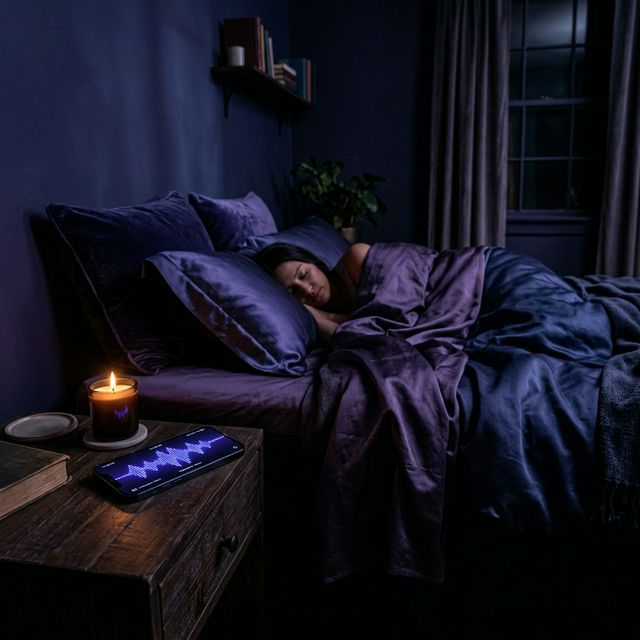
Unlike binaural beats, a solfeggio tone does not need headphones: you can play it from the bedside table with a timer and let it run in the background, which is easier than sleeping with earbuds in. One caveat: phone speakers barely reproduce the lowest tone, 174 Hz, so for that one a small bedside speaker works much better.
The three main candidates
174 Hz is the lowest tone in the solfeggio scale, close to the note F3 and to the pitch of a relaxed speaking voice. Low, steady sounds generally feel calmer than high ones, which is why 174 Hz is the usual choice for the moment of falling asleep, especially when what keeps you awake is physical: tight shoulders, a tense chest, restlessness.
Play it quietly through a small speaker or soft headphones rather than a phone speaker, which reproduces very little at this pitch. Resist turning it up: low tones sound quieter than higher ones at the same level.
396 Hz is traditionally associated with releasing fear and worry. It is a warm, mid-low tone, close to G4, brighter than 174 Hz but still soft. Many people prefer it when the problem is a mind that will not stop: tomorrow's schedule, a conversation replaying, a vague worry.
If you lie awake thinking rather than feeling tense, try 396 Hz before 174 Hz. It also reproduces well on a phone speaker. The traditional link with fear has not been tested.
528 Hz is often recommended for sleep. The only related study found lower cortisol after music tuned to 528 Hz, in nine people, during the day (Akimoto et al., 2018), so it says nothing direct about sleep. 528 Hz is also a clearer, brighter tone, which many people find better for winding down than for the moment of falling asleep.
Use 528 Hz during an evening wind-down session while you are still active, reading, stretching, sitting quietly. Then switch to 174 Hz or 396 Hz when you get into bed.
The recommended protocol
A simple two-stage routine, based on how the tones sound rather than on a tested protocol:
30 minutes before bed: 528 Hz or 396 Hz
During your pre-sleep routine, before getting into bed: 396 Hz if the day was emotionally heavy or you feel anxious, 528 Hz if it was mentally busy but not anxious. Low volume through a speaker; no headphones needed.
In bed: 174 Hz, session timer 45 minutes
When you get into bed, switch to 174 Hz on a bedside speaker and set a 45-minute timer, which is usually long enough to fall asleep. If you prefer sound all night, turn the volume down until it is barely audible.
Does it matter which instruments you use?
For sleep, simpler is usually better. Start with the pure tone or the tuning fork. Tibetan bowls have many shimmering overtones, which are lovely in a waking meditation but can keep attention engaged at night. A steady, predictable sound is easier to stop noticing, and not noticing it is the point.
If you have the Pro version of Solfeggio Sanctuary and want to experiment with bowls in sleep, crystal bowls are better suited than Tibetan bowls for this purpose, they have a strong main tone and fewer overtones.
Combining with binaural beats
Some people add a binaural Delta beat (2 Hz) through soft earbuds when they get into bed, with the solfeggio tone in the room. Evidence for binaural beats and sleep is limited and mixed, and no study has tested the combination, so try it only if earbuds do not keep you awake. The details are in binaural beats for sleep.
What to expect on the first night
Do not expect a dramatic first night. In the Cochrane trials people listened every day for at least three days and often for weeks, and a wind-down routine works through repetition. Give it a week and note whether you fall asleep faster.
For some people the first benefit is simply not lying in silence, which can make worries louder. That alone is a reasonable place to start.
Related articles
- Solfeggio Frequencies: All 9 Explained
- 396 Hz for Anxiety: What the Evidence Shows
- Binaural Beats for Sleep: Best Hz and a 45-Minute Protocol
- Binaural Beats vs. Solfeggio Frequencies: Which Should You Use?
- Solfeggio Frequencies vs. White Noise: What's the Difference?
174 Hz, 396 Hz, and 528 Hz, all free
Solfeggio Sanctuary gives you all 9 frequencies with a session timer. Free download with ads. Pro upgrade for €4.89 removes the ads and unlocks crystal and Tibetan bowls and 60-minute sessions. Used to YouTube videos? See how the two compare.
Scientific references
- Akimoto, K., Hu, A., Yamaguchi, T. & Kobayashi, H. (2018). Effect of 528 Hz music on the endocrine system and autonomic nervous system. Health, 10(9), 1159–1170.
- Jespersen, K.V., Pando-Naude, V., Koenig, J., Jennum, P., & Vuust, P. (2022). Listening to music for insomnia in adults. Cochrane Database of Systematic Reviews, 2022(8), CD010459.