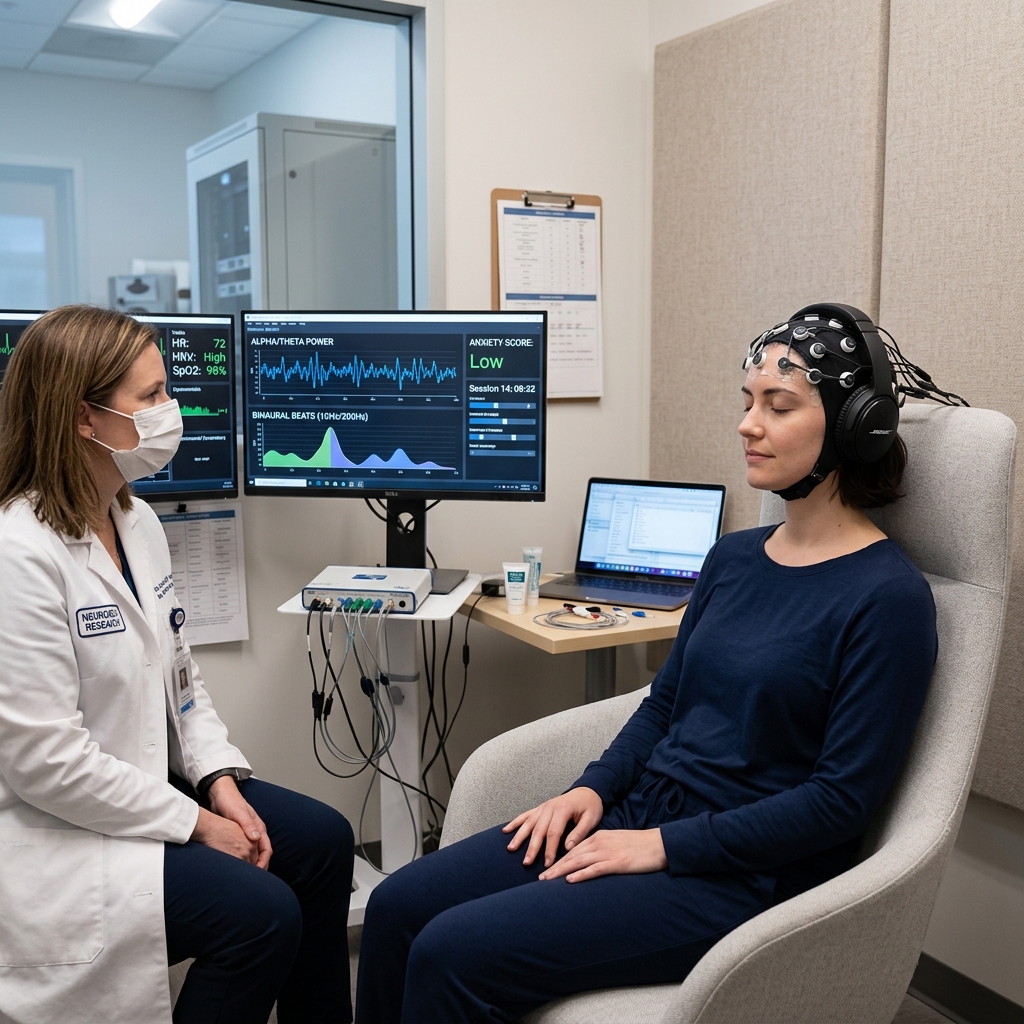
Yes, for acute anxiety. A 2005 randomised controlled trial (Padmanabhan et al., Anaesthesia) found pre-operative anxiety fell 26.3% with binaural beat audio, against 11.1% for the same audio without beats and 3.8% with no audio. A 2019 meta-analysis of 22 studies (Garcia-Argibay et al.) found a medium overall effect across anxiety, memory, attention, and pain. Evidence for chronic anxiety rests on small pilot studies.
Why anxiety is the most-studied application of binaural beats
Anxiety became the main research focus for a practical reason. Patients waiting for surgery, dental treatment or other procedures are anxious in a predictable way at a predictable time, so researchers can give one group binaural beats, another group the same audio without beats, and compare anxiety questionnaires before and after. That makes randomised controlled trials relatively easy to run.
Everyday or chronic anxiety is harder to study this way, so the evidence there is thinner. The strongest results come from short-term anxiety before a specific event. That is still useful, but it does not show that binaural beats help an anxiety disorder.
The key clinical studies
The landmark study. Patients awaiting day-case surgery under general anaesthesia were randomly assigned to binaural beat audio, the identical audio without the binaural tones, or no audio. Anxiety was measured with the State-Trait Anxiety Inventory (STAI) before and after listening.
Anxiety scores fell 26.3% in the binaural beat group, 11.1% in the audio-only group, and 3.8% in the control group. The authors concluded that binaural beat audio has the potential to significantly decrease acute pre-operative anxiety.
Pooled 22 studies (35 effect sizes) on memory, attention, anxiety, and pain perception and found an overall medium, significant effect (g = 0.45).
The direction and size of the effect depended on the frequency used, the time under exposure, and timing: exposure before the task, or before and during it, worked better than exposure only during it, and longer exposure helped. Masking the beats with white or pink noise made no difference.
An earlier review of 20 studies on brainwave entrainment, auditory and photic, not binaural beats alone. It concluded that entrainment is an effective therapeutic tool and that people with cognitive deficits, stress, pain, headache or migraine, PMS, and behavioural problems benefited. The authors also noted that more controlled trials were needed.
Eight healthy adults listened to binaural beats daily for 60 days. Trait anxiety decreased and quality of life improved, alongside changes in some physiological markers. It is one of the few studies of daily use over weeks rather than a single session, but the sample is very small.
What frequency bands are most effective for anxiety
No trial has compared bands head to head for anxiety, and the Garcia-Argibay meta-analysis (2019) found that results depend on the frequency, how long people listen and when. The suggestions below are practical starting points based on the states each band is associated with, not a ranking from the research.
For anxiety before a specific event, a short Alpha session (10 Hz, 10 to 15 minutes) is a sensible choice: Alpha is associated with relaxed but alert states, so it is less likely than Theta or Delta to leave you drowsy when you need to perform.
For background anxiety that you carry through the day, the closest evidence is daily use over weeks: in the Wahbeh pilot (2007), eight people who listened every day for 60 days reported lower trait anxiety. Regular Theta sessions (6 to 7 Hz) are a practical way to try that, keeping in mind how small that study was.
Relaxed but alert, so less likely to make you drowsy. 10 to 15 minutes before a stressful event.
For daily practice rather than quick relief. 20 to 30 minute sessions, every day for at least one to two weeks, then judge whether it helps.
For worry that keeps you awake, as part of the sleep routine after an Alpha wind-down. The evidence for sleep is limited.
Important caveats
The evidence is real, but it comes with limits that marketing usually leaves out.
- Most studies tested short-term anxiety before a specific event. "Reduces anxiety in patients waiting for surgery" does not mean "treats generalised anxiety disorder". Chronic anxiety differs in duration and severity, and it has not been tested in large trials.
- Effects are moderate, not transformative. Binaural beats are not a replacement for evidence-based anxiety treatment. They can be a useful extra: low-cost and low-risk, with no known side effects in healthy adults beyond occasional reports of feeling worse.
- Small studies point in both directions. In a four-person crossover pilot, 30 minutes of 7 Hz binaural beats raised depression scores and lowered verbal recall compared with control (Wahbeh et al., 2007). Results from very small samples, positive or negative, should be read as signals, not conclusions.
- Headphones are required. A binaural beat only exists when each ear hears a different tone. Through speakers the two tones mix in the room before they reach you, so the binaural effect is lost. The trials above all used headphones.
- Anxiety disorders need professional care. If anxiety is seriously affecting your daily life, relationships or work, see a doctor or psychologist. Binaural beats can sit alongside that care, not replace it.
Practical use for anxiety
Based on the evidence, these are the most reasonable ways to use them:
- Before a specific stressful event. A 10 to 15 minute Alpha session (10 Hz) before a presentation, interview, difficult conversation or medical procedure. This is the closest use to what Padmanabhan (2005) tested, with patients waiting for surgery.
- As a daily routine. A 20-minute Theta session (6 Hz) at the same time each day, morning or evening, for one to two weeks. This follows the daily-use design of Wahbeh et al. (2007). In an EEG study of 28 people, a 6 Hz beat increased Theta activity across the cortex within about 10 minutes, in a pattern the authors compared to meditation (Jirakittayakorn & Wongsawat, 2017).
- In combination with solfeggio frequencies. Running 396 Hz through a room speaker while doing a Theta binaural session through earbuds combines a calm, steady background tone (solfeggio) with the tool that has more evidence for anxiety (binaural). No study has tested the two together, so treat it as an option to try; see 396 Hz for Anxiety for the solfeggio side of this.
Related articles
- Binaural Beats: How They Work and What the Research Says
- Delta, Theta, Alpha, Beta, Gamma: A Complete Guide
- 396 Hz for Anxiety: What the Evidence Shows
- What Is Internal Coherence? The Neuroscience of Belief and Action
- A 7-Day Binaural Beats Experiment: Honest Results
- Why Frequency Precision Matters in Binaural Beat Apps
Alpha, Theta, and Delta, all in one app
Binaural Harmonic Beats gives you all five brainwave bands with session timer and harmonically-aligned carriers. €2.49 once. No subscription.
Scientific references
- Padmanabhan, R., Hildreth, A.J. & Laws, D. (2005). A prospective, randomised, controlled study examining binaural beat audio and pre-operative anxiety in patients undergoing general anaesthesia for day case surgery. Anaesthesia, 60(9), 874–877.
- Garcia-Argibay, M., Santed, M.A. & Reales, J.M. (2019). Efficacy of binaural auditory beats in cognition, anxiety, and pain perception: A meta-analysis. Psychological Research, 83(2), 357–372.
- Huang, T.L. & Charyton, C. (2008). A comprehensive review of the psychological effects of brainwave entrainment. Alternative Therapies in Health and Medicine, 14(5), 38–50.
- Wahbeh, H., Calabrese, C. & Zwickey, H. (2007). Binaural beat technology in humans: A pilot study to assess psychologic and physiologic effects. Journal of Alternative and Complementary Medicine, 13(1), 25–32.
- Wahbeh, H., Calabrese, C., Zwickey, H. & Zajdel, D. (2007). Binaural beat technology in humans: A pilot study to assess neuropsychologic, physiologic, and electroencephalographic effects. Journal of Alternative and Complementary Medicine, 13(2), 199–206.
- Jirakittayakorn, N. & Wongsawat, Y. (2017). Brain responses to a 6-Hz binaural beat: Effects on general theta rhythm and frontal midline theta activity. Frontiers in Neuroscience, 11, 365.