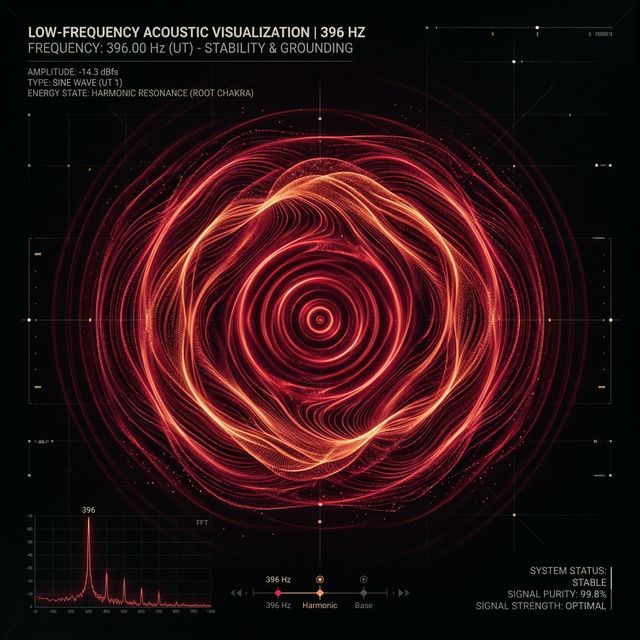
396 Hz at a glance
- Sound. A mid-low tone, warm and settling. Less heavy than 174 Hz, less forward than 417 Hz. Many people find it the easiest solfeggio tone to sit with.
- Tradition. In the modern solfeggio scale it is called "Liberation" and associated with releasing guilt and fear. Like the other solfeggio frequencies, the number comes from the 1990s revival of the scale, not from medieval practice.
- Evidence. No study on 396 Hz specifically. The support for using calm sound against anxiety comes from studies on relaxing audio in general, described below.
- Good fit. Anxiety and fear, morning grounding on high-stress days, unwinding accumulated tension, a first frequency for new users.
- Less suited to. Moments when you need to stay sharp: it is settling and can lower alertness. For focus, 528 Hz or a Beta binaural beat fits better.
Anxiety as a physiological state
Anxiety has two sides: worried thoughts, and a body on alert. The bodily side is driven by the sympathetic nervous system and can include a faster heart rate, quick and shallow breathing, muscle tension, raised stress hormones and narrowed attention. It is the threat-response system doing its job.
The problem is that this system also reacts to things that are not dangerous, such as deadlines, social pressure or uncertainty, and it does not always switch off when they pass. You stay on alert long after the trigger has gone.
Working on thoughts matters: cognitive behavioural therapy is the best-supported treatment for anxiety disorders. Working on the body is a useful complement, especially in the moment. Slow breathing is the most direct tool, and a calm sound practice is a simple way to support it.
The mechanism: sympathetic to parasympathetic
The autonomic nervous system has two branches: the sympathetic (mobilisation, threat response, cortisol release) and the parasympathetic (recovery, digestion, HRV coherence). These are not simply on/off switches, they exist in dynamic balance, with each branch modulating the other continuously.
In anxiety the sympathetic branch tends to run high relative to the parasympathetic one. The aim of calming techniques is not to switch off the sympathetic system but to restore the balance by increasing parasympathetic activity. When parasympathetic activity rises, heart rate decreases, breathing deepens, muscle tension releases, cortisol begins to normalise, and the subjective experience of anxiety diminishes.
Listening to calm, steady audio can help with that shift: in a controlled trial, relaxing audio lowered anxiety before surgery, and more so when binaural beats were embedded in it (see below). Whether a 396 Hz tone does this better than other calm sounds has not been tested. What 396 Hz offers is a warm, low-mid, settling sound and a fixed point to return to in a daily practice. Treat its specific link to anxiety as tradition, and the calming effect of the practice as the part with evidence behind it.
Padmanabhan, Hildreth & Laws (2005), randomised controlled trial in patients awaiting day-case surgery. Anxiety fell 26.3% with binaural beat audio, 11.1% with the same audio without the beats, and 3.8% with no audio. It tested binaural beats, not solfeggio tones, but it shows that a short session of calm audio can lower anxiety measurably. Anaesthesia, 60(9), 874–877.
Akimoto et al. (2018), nine participants listening to music tuned to 528 Hz versus 440 Hz. Lower cortisol and better mood after the 528 Hz version. It did not test 396 Hz, and its result cannot be assumed to apply to other frequencies. Health, 10(9), 1159–1170.
No studies have tested 396 Hz on its own for anxiety.
396 Hz vs. other solfeggio frequencies for anxiety
Within the solfeggio scale, 396 Hz is traditionally the grounding tone. This is how it compares, by sound and traditional use, with the two closest options:
Traditionally the tone for releasing fear. A warm, settling sound close to G4. A good first choice when the main experience is worry, fear or tension you cannot let go of.
The lowest tone in the scale, close to F3. Lower and softer than 396 Hz; some people prefer it when anxiety shows up mainly in the body: tension, agitation in the chest or stomach, restlessness. Use headphones or a proper speaker, as phone speakers barely reproduce it.
A semitone above 396 Hz and slightly brighter. Traditionally linked with change; some people prefer it when anxiety comes with feeling stuck rather than with fear.
How to use 396 Hz for anxiety: practical protocol
- Session timing. Use it early, when you first notice the anxiety building, rather than after an hour of it. It is generally easier to calm a state that is still rising than one that has settled in.
- Posture and environment. Sit or lie down in a position where the body can release muscle tension without effort. A chair with back support, a floor or mat, or lying flat. Let your shoulders and jaw soften as you settle.
- Headphones or speakers. Unlike binaural beats, 396 Hz does not require headphones, the frequency is the same in both ears. A phone speaker at low-to-medium volume works. Headphones help if the room is noisy, because they shut out other sounds.
- Session length. 10 minutes for an acute moment, 20 minutes for a daily practice aimed at background anxiety. Consistency over days matters more than the length of any single session. The free version of Solfeggio Sanctuary gives you three 10-minute sessions a day across all 9 frequencies, with ads.
- Keep the sound simple. Start with the pure tone, then try the tuning fork if you want a softer sound. In the Pro version, the Tibetan bowl adds a rich, shimmering sound that some people find more absorbing; choose by what helps you settle.
- After the session. Do not immediately re-engage with whatever triggered the anxiety. A few minutes of quiet before returning to the situation helps the calmer state carry over.
What 396 Hz does not do
It does not eliminate the source of anxiety. If the anxiety is a response to a genuine ongoing situation, a relationship conflict, financial pressure, a health concern, a frequency session does not resolve that situation. What a calm session can do is help you approach that situation from a steadier state, which makes it easier to respond deliberately rather than react.
For clinical anxiety disorders, generalised anxiety disorder, panic disorder, PTSD, acoustic tools are a complement to professional treatment, not a substitute. If anxiety is significantly impairing daily functioning, the appropriate primary intervention is clinical.
Combining 396 Hz with binaural beats
If you want to add binaural beats, Binaural Harmonic Beats at Alpha (10 Hz) or low Theta (6 to 7 Hz) can run at the same time: 396 Hz through the room and the beat through earbuds. Binaural beats have more evidence for anxiety than solfeggio tones, but no study has tested the two together. See binaural beats for anxiety for that protocol.
Related articles
- Solfeggio Frequencies: All 9 Explained
- 528 Hz: Meaning, Research and How to Use It
- Binaural Beats for Anxiety: What the Clinical Trials Show
- The Morning Frequency Protocol
- What Is Internal Coherence? The Neuroscience of Belief and Action
396 Hz, free in the app
Solfeggio Sanctuary gives you 396 Hz and all 8 other frequencies. Free download with ads, no subscription. Pro, €4.89 once, removes the ads, adds Tibetan and crystal bowls and extends sessions to 60 minutes.
Scientific references
- Padmanabhan, R., Hildreth, A.J. & Laws, D. (2005). A prospective, randomised, controlled study examining binaural beat audio and pre-operative anxiety in patients undergoing general anaesthesia for day case surgery. Anaesthesia, 60(9), 874–877.
- Akimoto, K., Hu, A., Yamaguchi, T. & Kobayashi, H. (2018). Effect of 528 Hz music on the endocrine system and autonomic nervous system. Health, 10(9), 1159–1170.