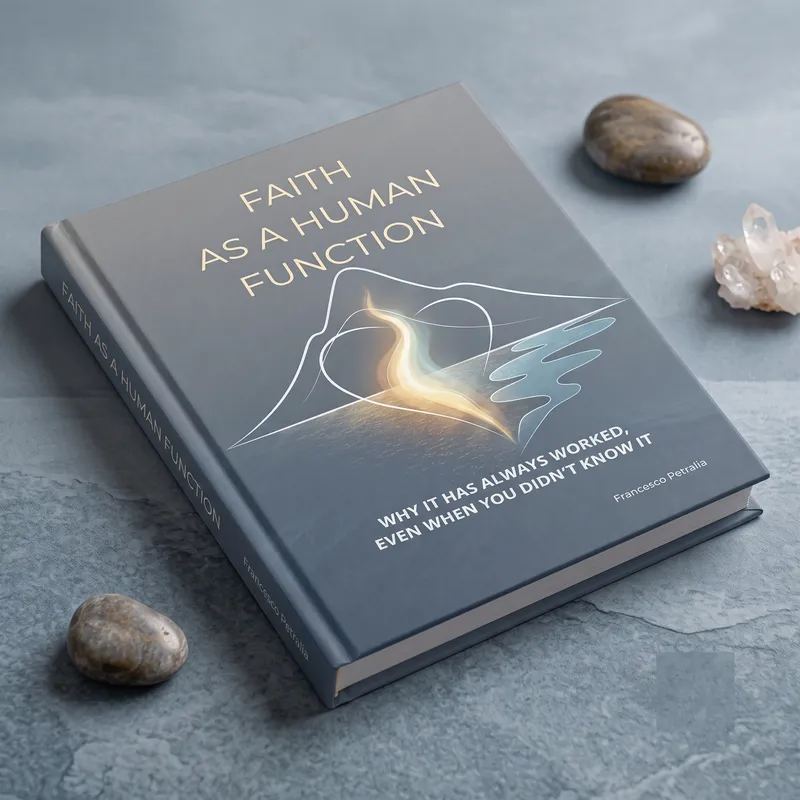
Faith As A Human Function
"Faith is not a theological category. It is a neurophysiological state of total coherence in which the organism ceases to oppose an internally accepted reality."
A historical and neurophysiological deconstruction of faith, from the original Gospel texts to modern neuroscience. Not a religious book. Not self-help. A direct examination of how faith actually works, why it was stripped of its practical meaning, and how to use it now.
Get the Book · $7.99 on Amazon →$7.99 · Digital edition · Instant access
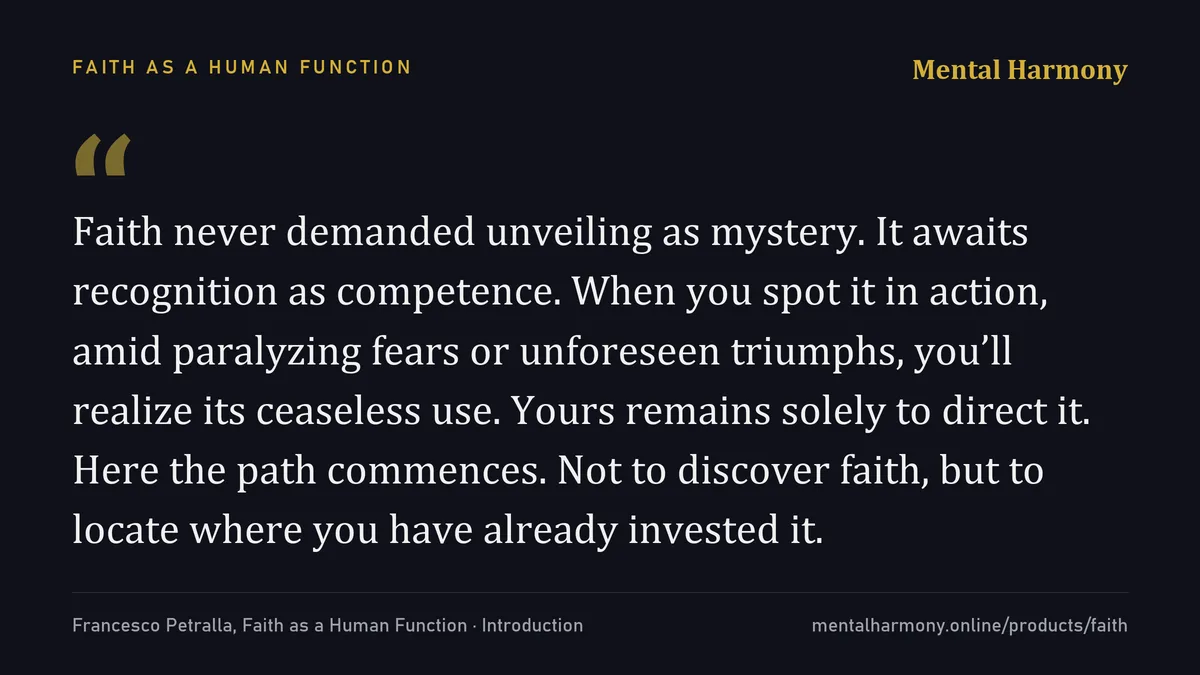
"Faith never demanded unveiling as mystery.
Faith As A Human Function
It awaits recognition as competence."
The mechanism is neutral
Faith as internal coherence
When internal conflict is absent and an outcome is fully accepted, the whole person mobilizes toward it. The book argues that this is not a spiritual gift but the same human state that research describes in other words, as flow and as cardiac coherence.
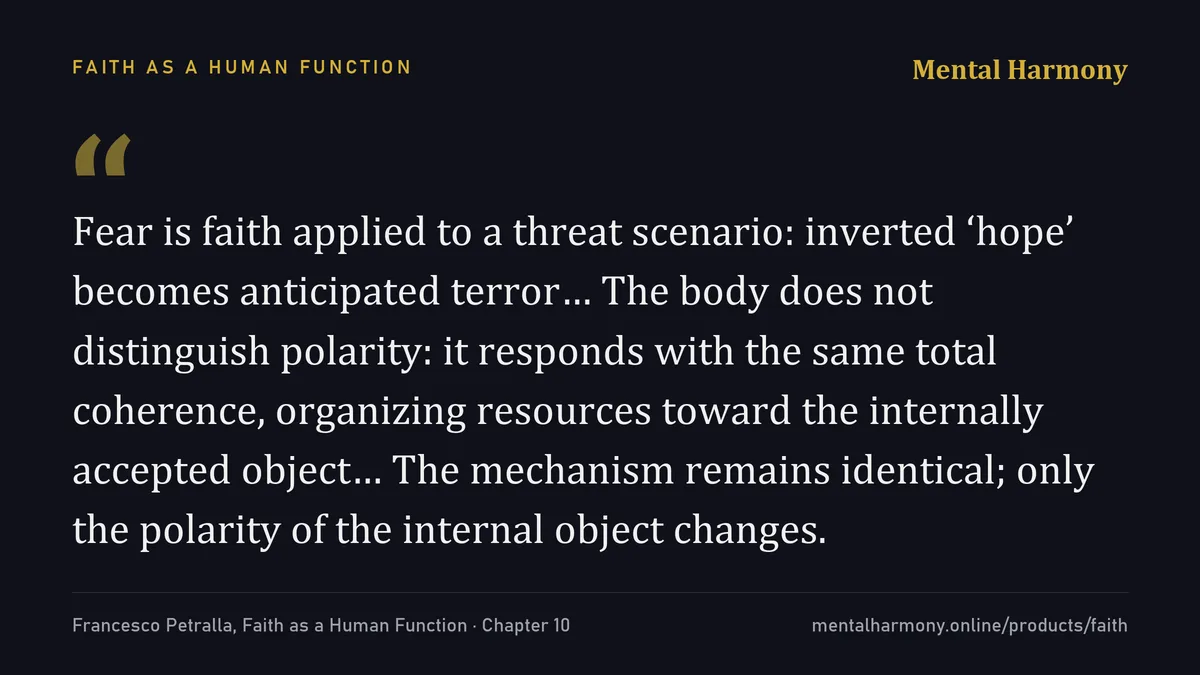
Fear is faith applied negatively
In the book's account, fear is faith applied to a negative scenario: the same capacity, pointed in the opposite direction. Research on worry shows how strongly the body prepares for outcomes that have not happened. Most people use this capacity against themselves daily, without recognizing it.
The observable parameters of faith
The book defines faith not as a belief but as a measurable internal state. These are the characteristics it identifies.
Two phases, twelve chapters
The book moves in two distinct directions: first backward through history to understand how faith was stripped of its practical meaning, then forward into modern neuroscience to restore it.
Historical & textual deconstruction
The book reads the original Gospel texts as describing faith as a direct, reproducible internal state: "as you have believed, so let it be done for you" (Matthew 8:13) read as an operational instruction, not a theological promise. The book traces how this was systematically converted into institutional obedience: from Constantine's absorption of Christianity into imperial power, through medieval illiteracy and fear as governance tools, to the removal of faith's practical mechanism from popular reach.
Modern translation & application
With the historical context established, the final chapters translate the mechanism into modern language (neurophysiology, cardiac coherence, flow state) and address the practical question: how do you use this without religion, without ritual, and without positive thinking? The answer is practical and grounded in everyday experience.
Why ancient symbolic systems worked, and what they were actually doing
These ancient systems are not mystical powers. The book examines them as primitive cognitive structures: tools designed to stabilize internal states in populations that had no access to modern psychology. Understanding what they actually did clarifies why they persisted.
Structural completion
The minimum closed cycle. Used across traditions to signal that a process is finished: beginning, middle, end. A cognitive marker for closure.
Cycle of fullness
Appears hundreds of times in the Bible. Functions as a signal of systematic completion: not magic, but a shared cultural marker for "this is done."
Collective structure
The apostolic and zodiacal architecture. Signals inclusion within a complete ordered system: a belonging marker that removes the psychological cost of isolation.
Transformational period
Used consistently across traditions as the duration of preparation and transition. A temporal frame for identity reorganization.
What you will encounter
Chapters 1–3 · The original protocol
An examination of faith as the Gospel texts actually describe it: not as opinion or hope, but as a concrete internal condition producing observable effects. "According to your faith let it be done to you" read not as theology but as a description of a mechanism. The book strips the ecclesiastical overlay to examine what the original instruction was.
Chapters 4–6 · The institutionalized inversion
How the Roman Empire absorbed Christianity when persecution failed, and what that absorption required: converting a horizontal, non-centralizable practice into a vertical institution. Faith as personal competence became faith as doctrinal obedience. The chapters trace this transformation through Constantine, the Council of Nicaea, medieval illiteracy, and the construction of guilt as a governance tool.
Chapters 7–9 · The symbolic architecture
An analysis of biblical numerology and Kabbalistic structures as cognitive stabilization technologies: not mystical claims, but, in the book's reading, attempts to create predictable internal states in populations without access to modern psychology. The book examines what these systems were actually doing and why they worked.
Chapters 10–11 · Faith in modern language
Faith translated into neurophysiology: the absence of internal conflict, cardiac coherence, the deactivation of the Default Mode Network, flow state. The book also addresses why positive thinking fails: it operates at the cognitive surface while the nervous system continues to signal threat below. And how to apply faith without religion, ritual, or forced conviction.
Chapter 12 · Returning faith to the individual
The final chapter addresses the question the rest of the book builds toward: if faith is a human function and not a divine gift, then it belongs to the individual. Not to an institution, a guru, or a system. The chapter examines what it means to assume that responsibility directly, and what changes when you do.
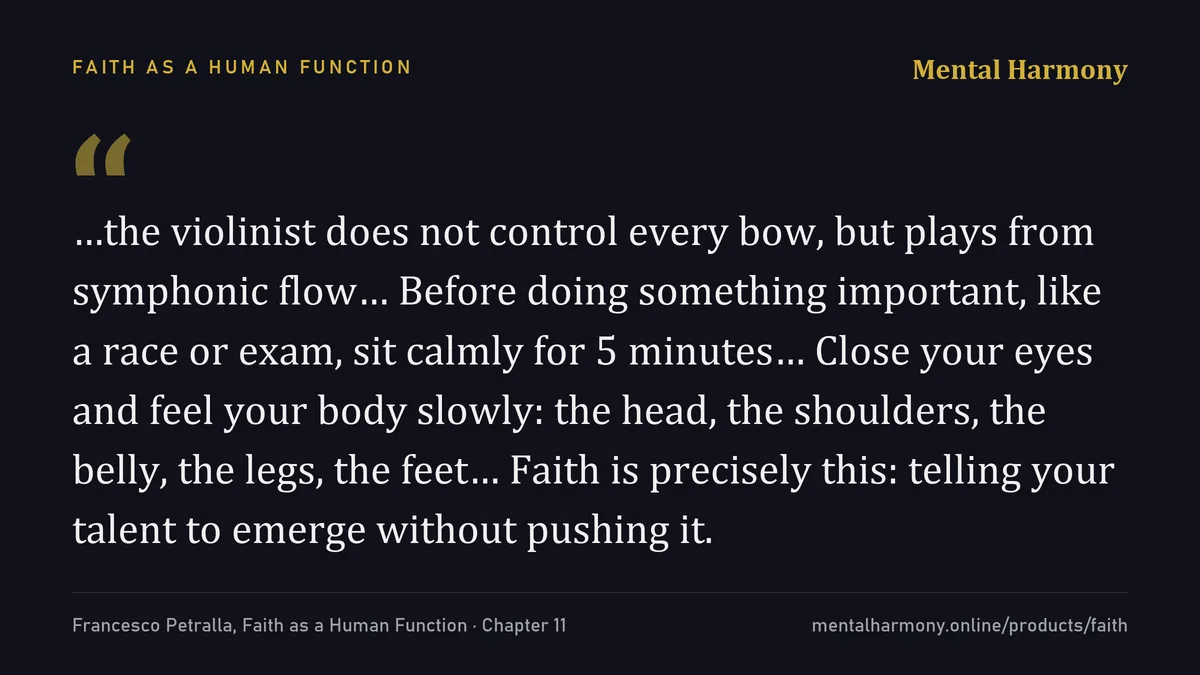
Three passages from the book
- You've left organized religion but the questions didn't leave with you
- You're interested in the neuroscience of peak performance and internal states
- You've tried positive thinking and found it doesn't go deep enough
- You want to understand why you function well sometimes and self-sabotage other times
- You're drawn to the Gospel texts as historical documents, not theological authority
- You're looking for devotional or inspirational reading
- You want confirmation of existing religious beliefs
- You're not interested in the historical or scientific argument
Faith is not a gift.
It is a competence.
And competence can be recognized, practiced, and owned. This book shows where you are already using it, and how to stop using it against yourself.
Get the Book on Amazon · $7.99 →$7.99 · Digital edition · Instant access