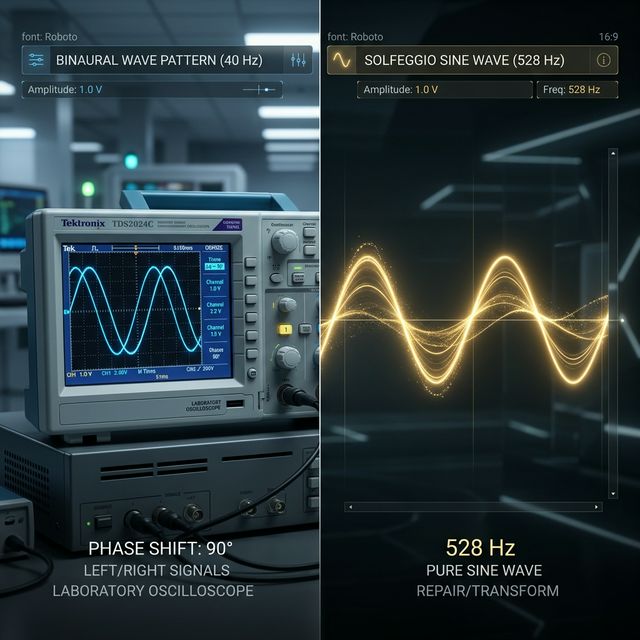
Binaural beats and solfeggio frequencies work differently. A solfeggio frequency is a single steady tone, the same in both ears, that you hear directly; it works through a speaker and is used as a calming sound practice. Binaural beats create an internally perceived beat from two slightly different tones and target brainwave states; they need stereo headphones and have more research behind them. The two can be combined.
The basic difference: one tone versus two
A solfeggio tone is a real sound in the room that you hear as it is. A binaural beat does not exist in the room at all: your brain creates it from two slightly different tones, one in each ear.
A 528 Hz solfeggio tone is a physical sound wave at 528 Hz. Your ear receives it directly, and the auditory brainstem follows its pitch (the frequency-following response), which is simply how you hear it. Any effect on how you feel comes from listening to a calm, steady sound, not from the brain locking onto 528 Hz.
A binaural beat is an auditory illusion. Your left ear receives 200 Hz. Your right ear receives 210 Hz. No 10 Hz sound exists in the room. The brain creates the 10 Hz perception internally, by computing the difference between the two inputs. The idea behind binaural beats is that brain activity then tends to follow this beat, a process called entrainment. The brainstem does respond to the beat; whether the wider cortex follows it is still debated, with mixed EEG results.
The practical consequence: solfeggio tones work through a speaker, while binaural beats need headphones. Through speakers the two tones mix in the air before reaching your ears, and the binaural beat disappears.
Side-by-side comparison
| Criterion | Solfeggio Frequencies | Binaural Beats |
|---|---|---|
| Mechanism | A single tone heard directly; works as a calming sound | Internally generated phantom beat, brain computes the differential |
| Headphones | Not required | Required, stereo isolation essential |
| Target frequencies | 174–963 Hz (solfeggio scale) | 0.9–50 Hz (brainwave bands) |
| Primary effect | A calm, steady background sound; no specific effect of the frequency has been shown | Intended to nudge brainwave activity towards the beat frequency; EEG evidence is mixed |
| Best for | A calm background, an anchor for breathing or meditation, a daily ritual | Goal-specific sessions: anxiety before an event, focus, meditation, winding down |
| Clinical evidence | Limited: one small study on 528 Hz music; most individual frequencies untested | Moderate: randomised trials on anxiety and a meta-analysis of 22 studies; whether beats entrain brainwaves is still debated |
| Session flexibility | Can play through speakers; background use during work or rest | Requires active session with headphones; not ideal as background |
| Layering | Can layer multiple instruments (pure tone, tuning fork, bowls) | Single carrier frequency differential; can combine with solfeggio as base |
What each tool is best at
- A short morning session before the day begins
- A calming moment when you feel tense, with no headphones needed
- Background acoustic environment during rest, reading, or light work
- A ritual for transitions, often with 396 Hz or 417 Hz
- Creating a deliberate sonic environment in a space (home, office)
- Children and people sensitive to headphone discomfort
- Winding down before sleep, from Alpha to Delta (evidence for sleep is limited)
- Focused work sessions in the Beta band
- Meditation, with Theta as a steady cue
- Anxiety before a specific event, the use with the strongest trial evidence
- Sessions with your own affirmations layered over the beat
- Precise control of the beat frequency for experimenting
When to use both together
The two tools can be combined, because they do not get in each other's way: one is a sound in the room, the other plays in your ears. No study has tested the combination, so judge it by whether it helps you settle.
A simple combination: a solfeggio tone (396 Hz or 417 Hz) through a phone speaker at low volume, and an Alpha binaural beat (10 Hz) through earbuds. The tone gives the room a calm background; the beat plays in your ears.
This is the approach used in the Morning Frequency Protocol and the Sleep Protocol.
Which to start with if you are new
Start with solfeggio frequencies. The barrier to entry is lower, no headphones required, no equipment to set up, free in Solfeggio Sanctuary. Run 396 Hz or 417 Hz for 10 minutes in the morning for one week and notice what, if anything, changes in your mornings.
Once you have a baseline experience with solfeggio, add binaural beats for a specific purpose, sleep onset or focused work. Binaural Harmonic Beats is €2.49, one-time. Use Alpha at 10 Hz for 30 minutes before bed for the first week, and compare those nights with your usual ones. Your own comparison is more useful than any general claim.
The precision question
For binaural beats, precision matters more than for solfeggio tones, because the beat is the difference between two tones: any error in either one changes it. An error of 0.5 Hz is 5% of a 10 Hz Alpha beat but 25% of a 2 Hz Delta beat. Both Solfeggio Sanctuary and Binaural Harmonic Beats generate their tones in real time on Google's Oboe audio library with 32-bit floating-point processing, so the frequency you set is the one you hear for the whole session.
Related articles
- Solfeggio Frequencies: All 9 Explained
- Binaural Beats: How They Work and What the Research Says
- Delta, Theta, Alpha, Beta, Gamma: A Complete Guide
- The Morning Frequency Protocol
- Binaural Beats for Sleep: Best Hz and a 45-Minute Protocol
All 9 frequencies. Free download with ads. Ad-free Pro upgrade €4.89 once.
Download FreeScientific references
- Oster, G. (1973). Auditory beats in the brain. Scientific American, 229(4), 94–102.
- Hink, R.F., Kodera, K., Yamada, O., Kaga, K. & Suzuki, J. (1980). Binaural interaction of a beating frequency-following response. Audiology, 19(1), 36–43.
- Padmanabhan, R., Hildreth, A.J. & Laws, D. (2005). A prospective, randomised, controlled study examining binaural beat audio and pre-operative anxiety. Anaesthesia, 60(9), 874–877.
- Akimoto, K., Hu, A., Yamaguchi, T. & Kobayashi, H. (2018). Effect of 528 Hz music on the endocrine system and autonomic nervous system. Health, 10(9), 1159–1170.
- Huang, T.L. & Charyton, C. (2008). A comprehensive review of the psychological effects of brainwave entrainment. Alternative Therapies in Health and Medicine, 14(5), 38–50.
- Garcia-Argibay, M., Santed, M.A. & Reales, J.M. (2019). Efficacy of binaural auditory beats in cognition, anxiety, and pain perception. Psychological Research, 83(2), 357–372.