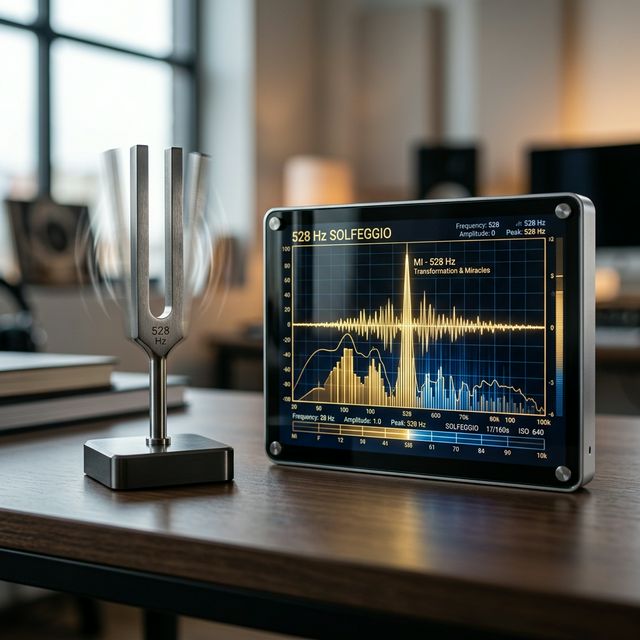
The origin of the solfeggio scale
The solfeggio frequencies are a set of six — later expanded to nine — specific pitches historically associated with Gregorian chant. The original six (396, 417, 528, 639, 741, 852 Hz) were documented by Dr. Joseph Puleo in the 1990s, who identified them in a numerological reading of the Book of Numbers. The system was later expanded to include 174, 285, and 963 Hz, forming the nine-frequency scale used in modern sound therapy.
The historical claims surrounding these frequencies are contested. What is not contested is the acoustic reality: these are specific, measurable pitches that sit at mathematically distinct points in the harmonic spectrum. Whether or not Gregorian monks consciously used them, the frequencies themselves are real, measurable, and can be generated with precision.
The 9 solfeggio frequencies: what each one is
Here is each frequency in the scale, its commonly assigned name, and the primary use cases associated with it. Note that "claimed" effects are distinguished from effects with research support.
Solfeggio frequencies are nine specific acoustic tones — from 174 Hz to 963 Hz — that influence the autonomic nervous system through the frequency-following response (FFR): the brain's tendency to synchronise its neural oscillations with a sustained external acoustic stimulus. 528 Hz is the most researched, with documented cortisol reduction in human subjects.
How solfeggio frequencies interact with the nervous system
The primary mechanism through which acoustic frequencies influence brain states is the frequency-following response (FFR) — first described by Hink et al. in 1980 and subsequently studied at Northwestern University by Kraus and Nicol (2005). The FFR is a brainstem-level auditory response in which neural firing patterns synchronise to the periodicity of an auditory stimulus.
In practical terms: when the brain receives a consistent, precisely delivered acoustic signal, its neural oscillations tend to entrain — to mirror — the pattern of that signal. This is not a mystical process. It is the same phenomenon that causes your foot to tap along with music, scaled down to the level of neural oscillation.
What makes solfeggio frequencies distinct from generic ambient music is specificity. A 528 Hz tone delivered at mathematical precision creates a consistent, repeatable acoustic stimulus. Ambient music shifts constantly in frequency and amplitude — it does not provide the stable signal required to drive entrainment.
Hink et al. (1980) — The foundational paper establishing the FFR as a measurable brainstem response to acoustic stimuli. Audiology, 19(1), 1–14.
Kraus & Nicol (2005) — Extended FFR research establishing the brainstem as the primary site of acoustic entrainment. Trends in Neurosciences, 28(4), 176–181.
Huang & Charyton (2008) — Meta-analysis of 20 peer-reviewed studies on acoustic entrainment. Concluded that brainwave entrainment offers effective interventions for cognitive function and stress reduction. Alternative Therapies in Health and Medicine, 14(5), 38–50.
What the research supports — and what it doesn't
The frequency-following response is documented. The use of specific acoustic frequencies to influence neural oscillation patterns has research support. Where the evidence becomes thinner is in the specific claims attached to individual solfeggio frequencies.
Take 528 Hz. The "DNA repair" claim originates from Rein (1998), who studied the effect of audio frequencies on DNA in vitro — outside a living organism, in controlled laboratory conditions. This work has not been replicated in clinical trials with human subjects. Extrapolating from an in-vitro finding to "528 Hz repairs your DNA through headphones" is a leap the research does not support.
The honest position: solfeggio frequencies are acoustically real, neurologically relevant stimuli. The specific effects attributed to each frequency range from plausible to speculative. Use them as a tool for creating a deliberate acoustic environment, with that distinction in mind.
Why frequency precision matters
If the mechanism is the frequency-following response — neural entrainment to a consistent acoustic signal — then the consistency of that signal is the entire basis of the effect. A tone generated at 527.6 Hz is not 528 Hz. The nervous system, responding at the brainstem level, processes frequency — not perception. The drift matters.
This is why Solfeggio Sanctuary is built on Google's Oboe audio library — a low-latency C++ audio engine with 32-bit floating-point signal processing. The frequencies you hear are mathematically exact. 528 Hz is 528 Hz for the entire duration of your session.
Solfeggio frequencies vs. binaural beats
These two terms are often used interchangeably, but they describe different mechanisms. Solfeggio frequencies are single tones delivered to both ears — the frequency itself is the stimulus. Binaural beats work differently: two slightly different frequencies are played — one per ear — and the brain perceives the difference as a third, phantom beat that drives entrainment.
A full comparison of the two mechanisms and when to use each is in: Binaural Beats vs. Solfeggio Frequencies: Which Should You Use?
How to use solfeggio frequencies effectively
- Choose frequency based on intended state. 396 Hz for grounding and calm. 528 Hz for focus and clarity. 174 Hz for something physically felt, anchoring. The names are mnemonic labels, not guarantees.
- Session length matters. The FFR requires sustained exposure. Ten minutes is enough to begin entrainment. Thirty to sixty minutes allows it to deepen. The free version of Solfeggio Sanctuary provides 10-minute sessions; Pro extends to 60 minutes for €4.89 once.
- Layer instruments intentionally. Start with pure tones as the foundational signal, then add tuning forks for harmonic richness, and crystal or Tibetan bowls for a broader acoustic field.
- Morning sessions have a specific advantage. Cortisol is naturally elevated in the first 30 minutes after waking. A grounding solfeggio session before screen contact intervenes in this window. See the Morning Frequency Protocol.
Related articles in this series
- 528 Hz Benefits: What the Research Actually Says
- 396 Hz for Anxiety: How This Frequency Affects the Nervous System
- The Best Solfeggio Frequency for Sleep
- How to Use Solfeggio Frequencies for Meditation
- Binaural Beats vs. Solfeggio Frequencies: Which Should You Use?
- 174 Hz to 963 Hz: A Complete Guide to All 9 Frequencies
Try all 9 solfeggio frequencies — free
Solfeggio Sanctuary gives you access to all 9 frequencies with pure tones and tuning forks. No subscription. Pro upgrade (€4.89 once) adds crystal and Tibetan bowls and extends sessions to 60 minutes.
Scientific references
- Hink, R.F. et al. (1980). Phase-locked time domain analysis of the auditory frequency-following response. Audiology, 19(1), 1–14.
- Kraus, N. & Nicol, T. (2005). Brainstem origins for cortical 'what' and 'where' pathways. Trends in Neurosciences, 28(4), 176–181.
- Huang, T.L. & Charyton, C. (2008). A comprehensive review of the psychological effects of brainwave entrainment. Alternative Therapies in Health and Medicine, 14(5), 38–50.
- Rein, G. (1998). Effect of Conscious Intention on Human DNA. Proceedings of the International Forum on New Science.
- Oster, G. (1973). Auditory beats in the brain. Scientific American, 229(4), 94–102.