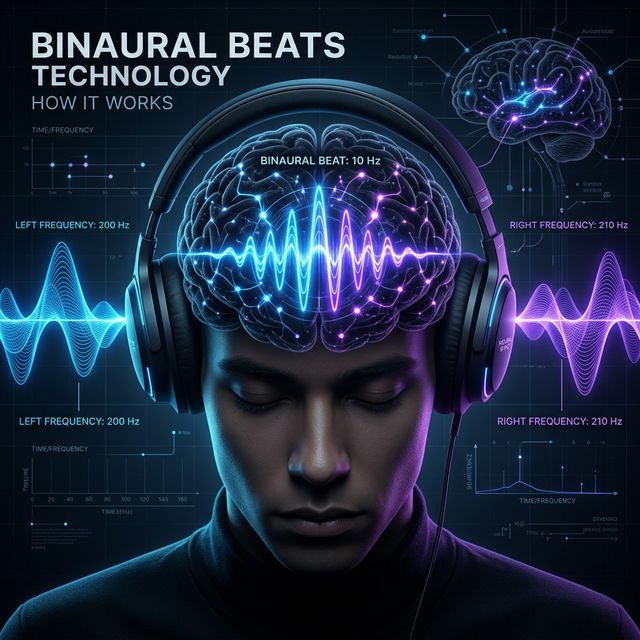
Binaural beats work by presenting two slightly different frequencies to each ear. The brain perceives the mathematical difference as a third, pulsing tone, the binaural beat. This internally generated beat triggers the frequency-following response, guiding neural oscillations toward a target brainwave state. Stereo headphones are required; the effect does not work through speakers.
The mechanism: what binaural beats actually are
Binaural beats are an auditory illusion. When two slightly different frequencies are presented, one to each ear, the brain perceives a third frequency that does not physically exist. This perceived frequency is the arithmetic difference between the two inputs.
A concrete example: if your left ear receives a 200 Hz tone and your right ear receives 210 Hz, your brain perceives a 10 Hz beat. That 10 Hz beat is in the Alpha brainwave range, the frequency associated with relaxed awareness and creative flow. The brain does not just passively perceive this beat; its own neural oscillations tend to synchronise with it. This synchronisation is called the frequency-following response (FFR).
The phenomenon was first systematically described by Heinrich Wilhelm Dove in 1839, who noted that two slightly different tones presented separately to each ear produced a perception of beating. Gerald Oster's landmark 1973 paper in Scientific American, "Auditory Beats in the Brain", brought the effect to broader scientific attention and proposed its potential diagnostic and therapeutic uses.
Binaural beats require each ear to receive a different frequency independently. If you play binaural beat audio through speakers, both ears receive both frequencies simultaneously, the effect collapses entirely. The brain needs the isolation provided by stereo headphones to perceive the differential. This is non-negotiable, not a minor recommendation.
The five brainwave states and what they correspond to
The effectiveness of binaural beats depends on targeting the right frequency differential for your intended state. Each brainwave band corresponds to a distinct cognitive and physiological mode.
Deep dreamless sleep. The state where physical recovery and glymphatic cleansing occur. Nedergaard et al. (2013) demonstrated that the brain's waste-clearance system, the glymphatic network, is most active during Delta sleep.
The edge of sleep and deep meditation. Associated with memory consolidation, hypnagogic imagery, and creative default-mode network activity. Buzsáki (2002) established the role of hippocampal Theta oscillations in memory. Experienced meditators spend deliberate time here.
Relaxed awareness. The creative state, what artists describe as "being in it" rather than forcing it. Associated with reduced cortical arousal and suppression of task-unrelated thought. Jensen et al. (2002) linked Alpha synchrony to an ideal state for absorbing suggestion and new information.
Active, focused thinking. The mode required for analytical work, problem-solving, and sustained attention. High Beta (20–27 Hz) corresponds to intense concentration. Low Beta (14–16 Hz) to focused but less effortful engagement.
Peak performance and insight. Lutz et al. (2004) found high-amplitude Gamma synchrony in long-term meditators during mental practice. Associated with large-scale neural binding, the state where disparate cognitive processes integrate into coherent perception.
What the clinical research supports
Binaural beats have been studied in randomised controlled trials, not just observational research. The evidence is stronger in some areas than others.
Padmanabhan, Hildreth & Laws (2005), a randomised controlled trial in Anaesthesia (60(9):874–877). Pre-operative anxiety fell 26.3% with binaural beat audio, 11.1% with the same audio without the beats, and 3.8% with no audio. One of the most cited trials in the field.
Huang & Charyton (2008), review of 20 studies on auditory and photic brainwave entrainment. Concluded that "BWE is an effective therapeutic tool" and that people with cognitive deficits, stress, pain, headache or migraine, PMS, and behavioural problems benefited, while calling for more controlled trials. Alternative Therapies in Health and Medicine, 14(5), 38–50.
Wahbeh, Calabrese & Zwickey (2007), two small pilots with mixed results. In eight adults, 60 days of daily listening lowered trait anxiety (13(1), 25–32). In a four-person crossover, a single 30-minute 7 Hz session showed no EEG entrainment and raised depression scores (13(2), 199–206). Journal of Alternative and Complementary Medicine.
Garcia-Argibay, Santed & Reales (2019), meta-analysis of 22 studies in Psychological Research (83(2), 357–372) on memory, attention, anxiety, and pain perception. Overall medium, significant effect (g = 0.45), varying with frequency, exposure time, and timing.
The evidence supports binaural beats as a useful tool for anxiety reduction, sleep support, and, more moderately, cognitive enhancement. The evidence does not support the more extreme claims sometimes made in wellness marketing: that binaural beats cure conditions, produce permanent neurological changes from short sessions, or substitute for medical treatment.
The role of carrier frequency
A detail often overlooked in popular binaural beats content: the carrier frequency, the base tone upon which the binaural beat is superimposed, matters.
In the example above (200 Hz left, 210 Hz right), the carrier is 200 Hz. Binaural Harmonic Beats uses harmonically aligned carrier frequencies, not arbitrary base tones, for every band. The studies cited on this page did not test carrier alignment, so treat this as a sound-design choice for a cleaner, more consistent tone rather than a proven effect on the brain.
There is also the question of precision. A target beat of 10 Hz requires an exact 10 Hz differential between your left and right channels. If the audio engine drifts, even by a fraction of a Hz, the brain perceives a different beat frequency and may entrain to the wrong state. Binaural Harmonic Beats runs on Google's Oboe audio library: 32-bit floating-point signal processing, mathematically exact frequency generation, zero drift.
How to use binaural beats: practical protocols
The mechanics are simple. The common mistakes are in the setup, not the listening.
- Stereo headphones are required. Speakers cancel the effect. In-ear earbuds work if the left and right channels are truly isolated.
- Match the frequency to your goal. Delta (2–4 Hz) for sleep. Theta (6–7 Hz) for deep meditation. Alpha (10 Hz) for creative work. Beta (18–20 Hz) for focused analytical work. Gamma (40 Hz) for peak performance, use for no more than 30–40 minutes.
- Volume should be comfortable, not loud. The FFR operates at low stimulus levels. You do not need high volume for the effect. Loud playback introduces distraction that works against the entrainment.
- Allow 10 minutes for onset. The frequency-following response is not instantaneous. Studies typically show measurable EEG effects after 5–15 minutes of sustained exposure. Plan your sessions accordingly.
- Combine with a subliminal affirmation layer strategically. Alpha-range sessions (relaxed, receptive) are the most effective window for subliminal input. Binaural Harmonic Beats includes a subliminal message builder where you write your own affirmations, stored on-device, no pre-loaded content.
Binaural beats vs. solfeggio frequencies
These are different tools for different mechanisms. Solfeggio frequencies are single tones delivered equally to both ears: you hear the frequency itself, and it is used as a calming sound. Binaural beats create a phantom frequency through the differential between two tones, one per ear.
They can be used independently or in combination depending on your goal. A full comparison with specific use-case recommendations is in: Binaural Beats vs. Solfeggio Frequencies: Which Should You Use?
Related articles in this series
- Delta, Theta, Alpha, Beta, Gamma: A Complete Guide to Brainwave States
- Binaural Beats for Sleep: Best Hz and a 45-Minute Protocol
- Binaural Beats for Focus: Best Hz for Concentration and Work
- A 7-Day Binaural Beats Experiment: Honest Results
- Gamma Waves and Peak Performance: The Science
- Why Frequency Precision Matters in Binaural Beat Apps
Five brainwave bands. One purchase.
Binaural Harmonic Beats gives you Delta, Theta, Alpha, Beta, and Gamma, with harmonically-aligned carrier frequencies, a subliminal message builder, and 4 visual themes. €2.49, one-time. No subscription.
Scientific references
- Oster, G. (1973). Auditory beats in the brain. Scientific American, 229(4), 94–102.
- Hink, R.F., Kodera, K., Yamada, O., Kaga, K. & Suzuki, J. (1980). Binaural interaction of a beating frequency-following response. Audiology, 19(1), 36–43.
- Padmanabhan, R., Hildreth, A.J. & Laws, D. (2005). A prospective, randomised, controlled study examining binaural beat audio and pre-operative anxiety in patients undergoing general anaesthesia for day case surgery. Anaesthesia, 60(9), 874–877.
- Wahbeh, H., Calabrese, C. & Zwickey, H. (2007). Binaural beat technology in humans: A pilot study to assess psychologic and physiologic effects. Journal of Alternative and Complementary Medicine, 13(1), 25–32.
- Wahbeh, H., Calabrese, C., Zwickey, H. & Zajdel, D. (2007). Binaural beat technology in humans: A pilot study to assess neuropsychologic, physiologic, and electroencephalographic effects. Journal of Alternative and Complementary Medicine, 13(2), 199–206.
- Huang, T.L. & Charyton, C. (2008). A comprehensive review of the psychological effects of brainwave entrainment. Alternative Therapies in Health and Medicine, 14(5), 38–50.
- Buzsáki, G. (2002). Theta oscillations in the hippocampus. Neuron, 33(3), 325–340.
- Lutz, A. et al. (2004). Long-term meditators self-induce high-amplitude gamma synchrony during mental practice. PNAS, 101(46), 16369–16373.
- Xie, L., Kang, H., Xu, Q., Chen, M.J., Liao, Y., Thiyagarajan, M., et al. & Nedergaard, M. (2013). Sleep drives metabolite clearance from the adult brain. Science, 342(6156), 373–377.
- Jensen, O., Gelfand, J., Kounios, J. & Lisman, J.E. (2002). Oscillations in the alpha band (9–12 Hz) increase with memory load during retention in a short-term memory task. Cerebral Cortex, 12(8), 877–882.
- Garcia-Argibay, M., Santed, M.A. & Reales, J.M. (2019). Efficacy of binaural auditory beats in cognition, anxiety, and pain perception: A meta-analysis. Psychological Research, 83(2), 357–372.