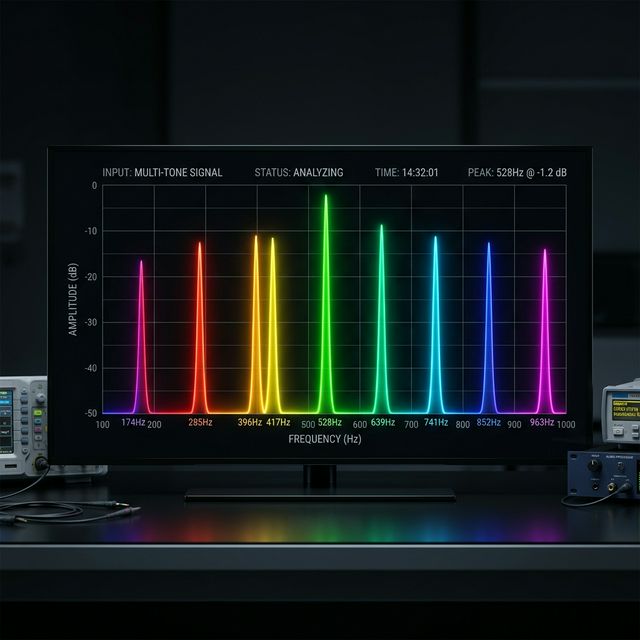
How to use this guide
Each frequency entry covers: its position in the acoustic spectrum, its acoustic character (how it sounds and feels), the historical or claimed associations, any available research basis, and the practical use case. The "research basis" entries are honest — where the evidence is strong, it is stated. Where it is speculative, that is stated too.
All nine frequencies are available free in Solfeggio Sanctuary — pure tones and tuning forks across the full scale, 10-minute sessions. Pro adds crystal and Tibetan bowl layers and extends sessions to 60 minutes.
The lowest frequency in the solfeggio scale. In the sub-bass range — felt in the body as much as heard. Produces a deep, settling vibration with a physically grounding quality. Through quality speakers or headphones, the resonance is tangible.
Associated with pain reduction and physical grounding. Some sound therapy traditions describe it as the frequency of the Earth's natural resonance, though this claim is not precisely supported — the Schumann Resonance is 7.83 Hz, not 174 Hz.
No specific clinical research on 174 Hz. The acoustic FFR mechanism applies as with all solfeggio frequencies. The sub-bass range has been studied in the context of infrasound and physiological response, with some evidence of autonomic nervous system effects at very low frequencies.
Physical tension, somatic anxiety, sleep onset (as a room-fill frequency), and sessions where grounding is the primary goal. Pairs well with the sleep protocol — 174 Hz through a room speaker while Delta binaural runs through earbuds.
Warm, low-mid range tone. Less physically imposing than 174 Hz, with a softer resonance. The harmonic character is rounded rather than sharp — a comfortable mid-register presence.
Associated with tissue regeneration and cellular repair. This is one of the least-evidenced claims in the solfeggio system — the cellular repair attribution is based on the Rein (1998) in-vitro DNA research, which does not directly support claims about specific individual frequencies.
Minimal specific research. The general FFR mechanism applies. 285 Hz is the least studied frequency in the scale.
Recovery sessions — post-illness, post-surgery, or periods of low physical energy. The acoustic character is gentle and non-demanding. A background frequency during rest rather than an active meditation stimulus.
Warm, grounding mid-low range. The most settling frequency in the active portion of the scale — physically anchoring without the extreme sub-bass of 174 Hz. A steady, releasing quality.
Liberation from guilt and fear. Emotional clearing. In the context of acoustic physiology, the association with fear reduction is the most practically relevant.
The FFR mechanism supports its general anxiolytic potential. The parasympathetic activation that accompanies exposure to consistent low-frequency acoustic stimuli is the most plausible mechanism. No specific 396 Hz clinical trials, but the general acoustic entrainment research applies. See 396 Hz for Anxiety for the full analysis.
Anxiety, fear, emotional heaviness, stress carryover from the previous day. The most broadly useful frequency in the scale for general nervous system regulation. Recommended as a starting frequency for new users.
Mid-range, slightly brighter than 396 Hz. More forward and clearing in character — less grounding, more releasing. The transition from 396 to 417 Hz in a session creates a sense of movement, of something shifting.
Clearing destructive influences and facilitating change. Breaking negative patterns. Undoing situations.
General FFR mechanism. No specific clinical research on 417 Hz.
Morning sessions (standard recommendation in the Morning Frequency Protocol). Days when the goal is to clear residual patterns from the previous day and orient toward the current one. Transitional periods.
Mid-range, clear, and harmonically coherent. The most researched frequency in the scale. Its position in the harmonic series gives it clean mathematical relationships with several other significant frequencies. Warm without being heavy; clear without being bright.
The "miracle tone." DNA repair. Love frequency. These are the most widely marketed claims in the solfeggio space — and the ones most in need of qualification. See 528 Hz: What the Research Actually Says for the full analysis.
Akimoto et al. (2018) found significant cortisol reduction after 5 minutes of 528 Hz exposure — the strongest direct clinical evidence for any specific solfeggio frequency. The DNA repair claim is based on in-vitro research (Rein, 1998) that does not directly translate to human clinical effects.
Focus and clarity sessions, pre-performance preparation, cortisol reduction before demanding tasks, creative work sessions where clear-headed presence is the goal.
Upper-mid range with a rich overtone structure. Warmer and more present than 528 Hz. The harmonic complexity gives it a quality that practitioners often describe as expansive or opening.
Harmonious relationships, communication, connection. Reconnection with others after conflict or distance.
General FFR mechanism. No specific clinical trials on 639 Hz.
Sessions focused on openness, receptivity, or preparation for meaningful interactions. Creative sessions where generative rather than analytical thinking is the goal.
Brighter than 639 Hz, with a more pointed character. The upper-mid range begins to feel more activating than settling. 741 Hz has an alert, clarifying quality.
Awakening intuition, expression of authentic truth, cellular detoxification from electromagnetic radiation. The electromagnetic detoxification claim is not supported by evidence.
General FFR mechanism. No specific clinical research.
Sessions requiring clarity and discernment. Less suitable for sleep or deep relaxation due to its more activating character. Use for waking sessions when the goal is sharpness rather than settling.
High-range, bright, and open. The frequency has a spacious quality — less grounded than the lower frequencies, more expansive. Produces a sense of widening rather than settling.
Returning the mind to spiritual order. Awakening inner strength and intuition. Replacing negative thoughts with positive ones.
General FFR mechanism. No specific research on 852 Hz.
Insight-oriented meditation sessions. Open awareness practice where the goal is spaciousness rather than grounding. Use when the practice is already established and the goal is breadth of awareness rather than settling a disturbed state.
The highest frequency in the scale. Bright, clear, and activating. In sessions of significant length, 963 Hz can feel energising rather than settling — it is the most activating frequency in the scale, which limits its usefulness for meditation and sleep contexts.
The "God frequency." Pineal gland activation. Return to Oneness. Divine consciousness. These are the most mystical claims in the solfeggio tradition — and the ones with the least research support. The pineal gland activation claim conflates the gland's known sensitivity to light and electromagnetic stimuli with a specific response to 963 Hz audio, which is not documented.
General FFR mechanism only. No specific clinical research on 963 Hz. The pineal gland activation claim is not supported. The frequency's acoustic character is real; the specific metaphysical claims are speculative. See the honest review of what frequency claims are and are not supported.
Short sessions with a specific intention toward expanded awareness or clarity of purpose. Not recommended for sleep or anxiety contexts — its activating character is counterproductive there. Suitable for experienced practitioners who have already established a settled baseline through lower frequencies.
Choosing a frequency: the decision framework
- Physical tension, somatic anxiety, or sleep: Start with 174 Hz or 396 Hz. Both operate in the lower range with grounding acoustic character.
- Emotional clearing, anxiety, daily stress: 396 Hz is the most broadly applicable choice. It is the default recommendation for new users.
- Morning session, clearing the previous day: 417 Hz. The morning protocol recommendation.
- Focus, clarity, pre-performance: 528 Hz. Supported by the Akimoto (2018) cortisol research.
- Creative work, openness, connection: 639 Hz.
- Alert clarity, discernment: 741 Hz.
- Open awareness meditation, spaciousness: 852 Hz.
- Expanded awareness (short sessions, experienced practitioners only): 963 Hz.
All 9 frequencies — free in the app
Solfeggio Sanctuary gives you the full scale: 174 Hz through 963 Hz with pure tones and tuning forks. Free download. No subscription. Pro adds bowls for €4.89 once.
Scientific references
- Hink, R.F. et al. (1980). Phase-locked time domain analysis of the auditory frequency-following response. Audiology, 19(1), 1–14.
- Kraus, N. & Nicol, T. (2005). Brainstem origins for cortical 'what' and 'where' pathways. Trends in Neurosciences, 28(4), 176–181.
- Akimoto, K. et al. (2018). Effect of 528 Hz music on the endocrine system and autonomic nervous system. Health, 10(9), 1199–1209.
- Rein, G. (1998). Effect of conscious intention on human DNA. Proceedings of the International Forum on New Science.
- Huang, T.L. & Charyton, C. (2008). A comprehensive review of the psychological effects of brainwave entrainment. Alternative Therapies in Health and Medicine, 14(5), 38–50.