Why thinking alone often fails
The usual self-improvement loop goes like this: pick an outcome, convince yourself you can reach it, repeat affirmations, and wait for your behaviour to change. For many people it works for a while and then fades.
One likely reason is that intentions sit on top of a body that runs its own assessment. If your breathing is fast and shallow, your heart is racing and your shoulders are braced, your nervous system is reporting threat, and an affirmation has to compete with that report. Affirmations can even backfire. In two experiments, people with low self-esteem felt worse after repeating "I'm a lovable person", while people with high self-esteem felt only slightly better (Wood, Perunovic & Lee, 2009).
That is the idea behind internal coherence: change comes more easily when body, emotion and intention pull in the same direction, and the most direct way there often starts with the body rather than with the thought.
The physiology: heart rate variability
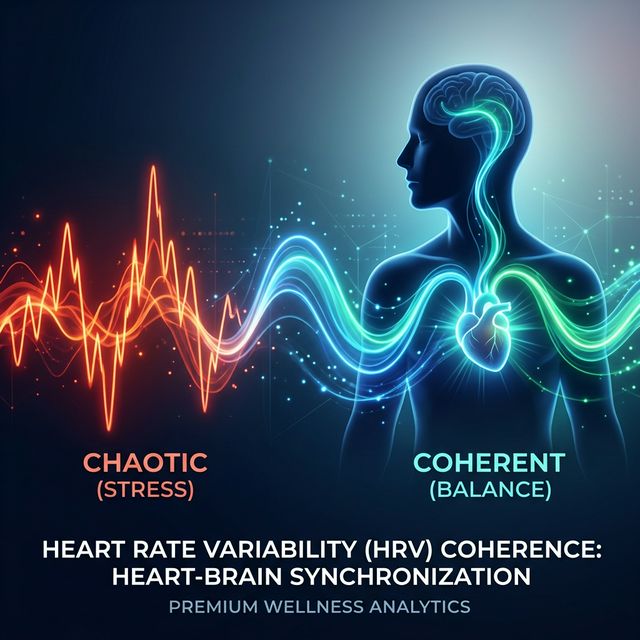
The most practical way to observe this alignment is heart rate variability (HRV), the natural variation in time between heartbeats. When you breathe slowly and evenly, the heart speeds up a little on each in-breath and slows on each out-breath, and the HRV trace becomes a smooth, regular wave. Researchers at the HeartMath Institute call this pattern cardiac coherence; it is explained in more detail in what is cardiac coherence.
The pattern is easiest to produce by breathing at about six breaths a minute, close to the rate at which heart rhythm and blood-pressure reflexes reinforce each other (Lehrer & Gevirtz, 2014). In an early HeartMath study, focusing on a positive feeling such as appreciation produced the same smooth rhythm (McCraty et al., 1995). In a later one, 30 adults who practised the institute's emotional self-management techniques for a month showed 23% lower cortisol and roughly double the DHEA, a hormone that tends to rise as stress falls (McCraty et al., 1998). It was a small study, and hormones were not measured in a comparison group, so it is a promising signal rather than proof.
A broader line of research links higher HRV to better emotional self-regulation. The neurovisceral integration model of Thayer and Lane proposes that the prefrontal networks that help regulate emotion also influence heart rhythm, which would explain why the two tend to move together (Thayer & Lane, 2009). The model is well supported for people with higher resting HRV in general. It does not show that a few minutes of slow breathing rewires those networks, only that heart rhythm and self-regulation are connected.
- Heart rhythm: erratic, irregular
- Breathing: fast, shallow
- Attention: narrow, on the threat
- Behaviour: reactive, effortful
- Heart rhythm: smooth, wave-like
- Breathing: slow, even
- Attention: broad, flexible
- Behaviour: deliberate, unforced
A simplified picture of the two states, not a measured profile.
Coherence and the concept of faith
This is where the book behind this site, Faith as a Human Function, makes its central argument. It is an interpretation, not a research finding, and it is worth keeping the two apart.
In the first three Gospels, healings are repeatedly tied to the person's own faith: "your faith has made you well" (Mark 5:34; Luke 8:48) and "according to your faith let it be done to you" (Matthew 9:29). The book reads these lines not as praise for holding the right belief but as descriptions of an internal state: complete alignment with an outcome, with no part of the person bracing against it.
On that reading, what the Gospels called faith, what HeartMath measures as cardiac coherence and what Mihaly Csikszentmihalyi described as flow are related experiences: absorbed, unconflicted, low in self-monitoring. No study has tested that link directly. Flow is also not simply relaxation: in one experiment it was highest under moderate, not low, physiological stress (Peifer et al., 2014). What the three share is how they feel from the inside and how they change behaviour, and that is the claim the book develops.
McCraty, Atkinson, Tiller, Rein & Watkins (1995), "The effects of emotions on short-term power spectrum analysis of heart rate variability." The American Journal of Cardiology, 76(14), 1089–1093. An early HeartMath study showing that focusing on positive emotions shifts heart rate variability towards a smooth, coherent pattern.
Csikszentmihalyi, M. (1990), Flow: The Psychology of Optimal Experience. Harper & Row. The classic description of flow: absorbed, effortless engagement with little self-consciousness.
Childre & McCraty (2001), "Psychophysiological correlates of spiritual experience." Biofeedback, 29(4), 13–17. An overview by HeartMath's own researchers proposing that heartfelt positive emotions produce psychophysiological coherence, and noting that people often describe feeling spiritually connected in that state.
Why positive thinking struggles to produce coherence
Positive thinking, as it is usually practised, asks the mind to assert something the body has not accepted. When the gap is large, the result is not alignment but a new conflict, which may be why affirmations backfired for the people with low self-esteem in the study above.
The alternative is to work from the body upwards: lower the signals of threat first and let thinking follow. This is covered in depth in Why Positive Thinking Fails, And What Actually Works.
How to build coherence deliberately
These are the most practical entry points. The first has the strongest evidence; the others support it.
- Slow, even breathing. About five seconds in and five seconds out, roughly six breaths a minute, is the pace most often used in HRV biofeedback because it produces the largest, smoothest heart-rhythm waves (Lehrer & Gevirtz, 2014). Most people notice a change within a few minutes.
- Calm sound. A steady sound, such as a low solfeggio tone or an Alpha binaural beat, can help you settle and gives slow breathing a calm background. It supports the practice; it does not create coherence on its own.
- Attention on sensation rather than story. Noticing the breath, the heartbeat or the contact of your body with the chair draws attention away from self-referential rumination. Experienced meditators show lower activity in the brain's default mode network, which is linked to mind-wandering (Brewer et al., 2011).
- Start from where you are. You do not need to pretend things are different. Acknowledge how you feel right now, without arguing with it, and let the breathing work from there.
The connection to the book
Faith as a Human Function argues that the operational meaning of faith, the state the Gospel texts describe, was gradually replaced over seventeen centuries by doctrines that ask for assent instead of a state that can be cultivated.
The book covers Constantine's absorption of Christianity into imperial power (313 AD), the Council of Nicaea's standardisation of doctrine (325 AD), and the medieval illiteracy that locked the original texts away from ordinary access for centuries. It then restates that idea in modern terms, drawing on heart rate variability research and the psychology of flow, and offers a practical framework that needs no religion, no self-help framing and no intermediary.
Related articles in this series
- Why Positive Thinking Fails, And What Actually Works
- Fear Is Faith Applied Negatively: The Neurophysiology
- Overcoming Cognitive Dissonance: The Path to Internal Coherence
- What Is Cardiac Coherence? The HeartMath Research Explained
- How Constantine Changed the Meaning of Faith
- The Gospel Texts on Faith: Reading Them as Operating Instructions
- Flow State and Faith: Csikszentmihalyi and the Gospels
The full history and mechanism, in one book
Faith as a Human Function traces how the concept of internal coherence was buried for 1,700 years and restores it as a practical tool. No religion required. $7.99 on Amazon.
Scientific references
- Brewer, J.A., Worhunsky, P.D., Gray, J.R., Tang, Y.Y., Weber, J., & Kober, H. (2011). Meditation experience is associated with differences in default mode network activity and connectivity. Proceedings of the National Academy of Sciences, 108(50), 20254–20259.
- Lehrer, P.M. & Gevirtz, R. (2014). Heart rate variability biofeedback: How and why does it work? Frontiers in Psychology, 5, 756.
- McCraty, R., Atkinson, M., Tiller, W.A., Rein, G., & Watkins, A.D. (1995). The effects of emotions on short-term power spectrum analysis of heart rate variability. The American Journal of Cardiology, 76(14), 1089–1093.
- McCraty, R., Barrios-Choplin, B., Rozman, D., Atkinson, M., & Watkins, A.D. (1998). The impact of a new emotional self-management program on stress, emotions, heart rate variability, DHEA and cortisol. Integrative Physiological and Behavioral Science, 33(2), 151–170.
- Peifer, C., Schulz, A., Schächinger, H., Baumann, N., & Antoni, C.H. (2014). The relation of flow-experience and physiological arousal under stress: Can u shape it? Journal of Experimental Social Psychology, 53, 62–69.
- Csikszentmihalyi, M. (1990). Flow: The Psychology of Optimal Experience. Harper & Row.
- Childre, D. & McCraty, R. (2001). Psychophysiological correlates of spiritual experience. Biofeedback, 29(4), 13–17.
- Thayer, J.F. & Lane, R.D. (2009). Claude Bernard and the heart-brain connection: Further elaboration of a model of neurovisceral integration. Neuroscience & Biobehavioral Reviews, 33(2), 81–88.
- Wood, J.V., Perunovic, W.Q.E., & Lee, J.W. (2009). Positive self-statements: Power for some, peril for others. Psychological Science, 20(7), 860–866.