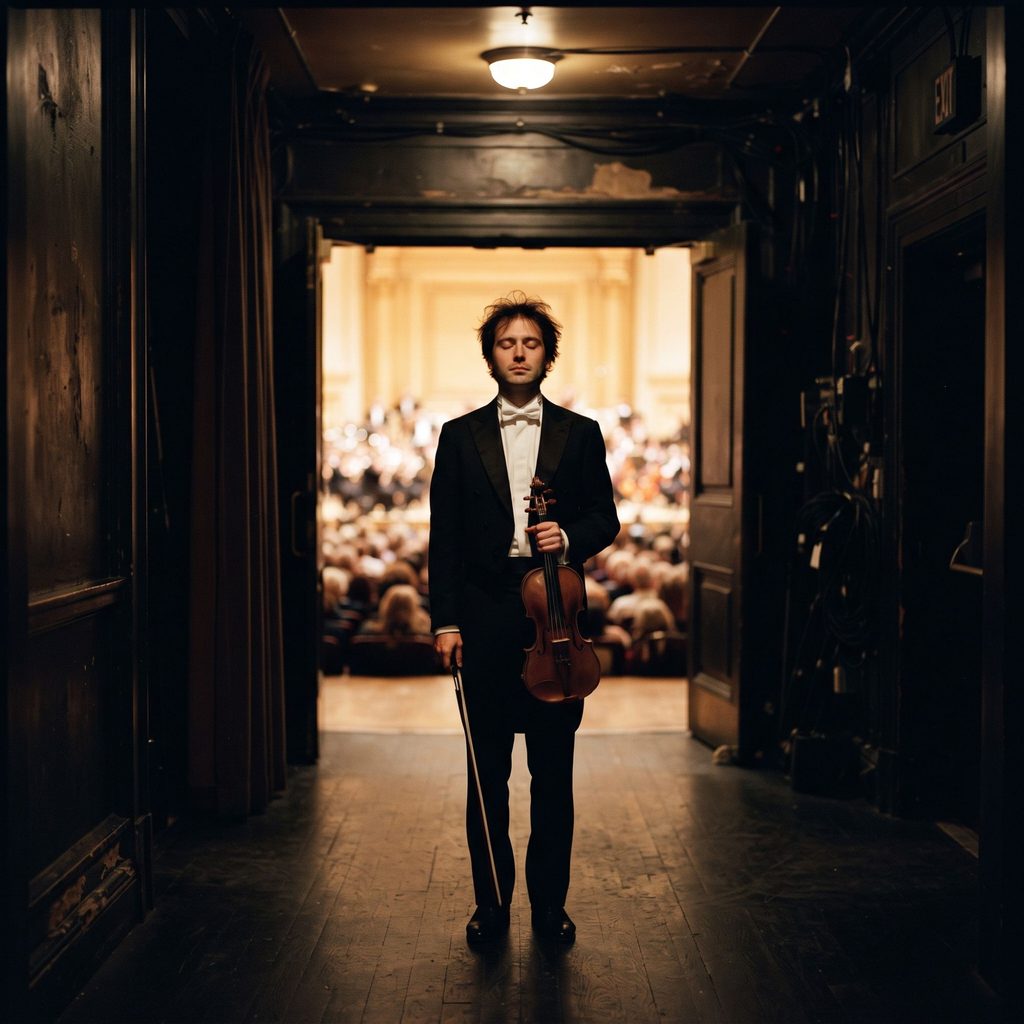
What I do before a concert
Before a concert I practise a 10-minute session of binaural beats through headphones, selecting the frequency that reduces my anxiety. Then, before I walk on stage, I isolate myself with the violin in my hands, but I do not play. I stay in silence with my eyes closed, find my concentration and let the tension loosen. Once I play the first notes, the tension goes away completely and I enter the world of music, where it is possible to share emotions with the audience in a way only music allows.
This is a personal routine built over years of concerts. It is not a tested protocol, and no study I know of has examined this exact ritual. I describe it because a repeated, quiet routine is something many performers find useful, and because the research below fits it better than it fits the usual advice to "just calm down".
Why "calm down" often fails
A 2023 review by Herman and Clark points out that the prevalence of music performance anxiety has not changed since the first large studies of the 1980s, despite many interventions. Their explanation is that most approaches try to remove the symptoms. They argue that relaxation can be unrealistic and even counterproductive at the moment of performance, and that trying to force a change of state can create resistance that increases anxiety. They propose treating performance anxiety as a normal, adaptive response to pressure rather than as a defect to eliminate.
That is a review and a proposal, not a proven treatment. It does help explain why my own routine does not aim at being relaxed. I want to be focused, with the energy still there.
Reframing nervousness as excitement
In a series of experiments, Alison Wood Brooks (2014) compared people who tried to calm down with people who reappraised their anxious arousal as excitement, for example by saying "I am excited" out loud. The excited group felt more excited and performed better. The tasks were karaoke singing, public speaking and a maths test, so the participants were not professional musicians, and the effect on a concert hall performance is untested.
The practical idea is simple: a racing heart and a dry mouth are the same physical state whether you call it fear or readiness. Naming it as readiness costs nothing to try in rehearsal.
Cognitive-behavioural therapy has controlled evidence
Clark and Agras (1991) ran a double-blind, placebo-controlled study of 94 musicians with performance anxiety; all of them met criteria for social phobia. A five-session group cognitive-behavioural programme produced statistically significant reductions in subjective anxiety, improved confidence and better quality of musical performance as rated by blind judges. The anti-anxiety drug buspirone was not effective. The authors concluded that cognitive-behavioural therapy is a viable treatment for performance anxiety in musicians.
If stage fright is stopping you from performing or auditioning, this is the best-supported route among the sources here, and it is best done with a qualified therapist.
Beta-blockers: real, but a medical decision
Many string and wind players know that some colleagues take propranolol before high-pressure performances. The best-known trial is old and small: Brantigan and colleagues (1982) tested propranolol in a double-blind design in two trials with 29 subjects in total. Music critics rated the performances as significantly improved, and the authors reported that the drug removed the physical impediments of stage fright, including dry mouth, without tranquillising the players.
A 2022 review by Szeleszczuk and Frączkowski notes that propranolol is one of very few medications applied to stage fright and that, in most countries, this use is off-label. It blocks the physical effects of adrenaline. It does not address the thoughts behind the anxiety, and it is not suitable for everyone. This is a conversation to have with a doctor, not something to decide from a website.
Binaural beats against pre-performance anxiety
A binaural beat is created when each ear hears a slightly different tone through stereo headphones and the brain perceives the difference as a slow pulse. I am not aware of any trial of binaural beats in musicians before a concert. The closest evidence is in people facing another stressful event, patients waiting for surgery, and it is mixed:
- Padmanabhan and colleagues (2005): patients awaiting day-case surgery under general anaesthesia heard binaural beat audio, the same audio without the beats, or nothing. Anxiety scores fell 26.3% with the beats, 11.1% with the audio alone and 3.8% in the control group.
- Wiwatwongwana and colleagues (2016): 141 cataract-surgery patients heard music with beats, plain music or no music. Anxiety fell in both music groups compared with control, and the difference between music with and without beats was not significant (p = 0.085). Heart rate fell significantly only in the beats group.
- Garcia-Argibay and colleagues (2019): a meta-analysis of 22 studies on memory, attention, anxiety and pain found an overall medium effect (g = 0.45), but results depended on frequency, listening time and whether the listening came before the task.
Put together, calm audio before a stressful event seems to lower anxiety, and it is unclear how much the beats add. Surgery patients are also not performers: they wait passively, while a musician needs to stay sharp.
If you want to try it, the practical choice is Alpha (about 10 Hz), which is associated with a relaxed but alert state and is less likely to make you drowsy than Theta or Delta. Use stereo headphones, listen for 10 to 15 minutes in a quiet place and stop well before you walk on. Test it in rehearsal and in a minor performance first, never for the first time on the day of an important concert, and keep in mind that this is a starting point, not a result from performer trials. The full evidence is in Binaural Beats for Anxiety: What the Clinical Trials Show, and the practical page is Binaural Beats for Anxiety.
In my own routine I use a 10-minute binaural session, choosing by trial the frequency that reduces my anxiety, followed by silence. That is a personal observation, not evidence: the trials above do not show that the beats add anything beyond calm audio, so test your own choice in rehearsal.
Slow breathing
Slow breathing is the most accessible tool: it acts directly on heart rhythm, and I explain the mechanism in the article on cardiac coherence. It can be done discreetly in a corridor, with no headphones.
A routine you can test
- Rehearse the routine, not only the music. Run through the same sequence in the last rehearsals so that it is familiar when the pressure is real.
- Choose a short, repeatable sequence. For example: a few slow breaths, a minute of quiet with the instrument in your hands, then a clear intention for the first phrase.
- Test any sound tool in rehearsal first. If you want to try a 10 to 15 minute Alpha binaural session with stereo headphones, do it on a normal day and stop well before you go on stage.
- Name the arousal as readiness. Say it to yourself in the same words each time.
- Do not fight the symptoms. Aim for focus with energy, not for calm.
- Seek professional help if it blocks you. Cognitive-behavioural therapy has the best evidence here, and any medication is a doctor's decision.
Quick answers
Is stage fright normal for professional musicians?
Yes. Herman and Clark describe music performance anxiety as widespread, and suggest seeing it as an adaptive response to pressure rather than a defect.
What has the strongest evidence for music performance anxiety?
Among the sources here, cognitive-behavioural therapy: the Clark and Agras trial of 94 musicians showed reduced anxiety and better rated performance. Reframing anxiety as excitement has supportive experiments, but not in professional musicians.
Do binaural beats help with stage fright?
There is no trial in performers. In patients waiting for surgery, binaural beat audio lowered anxiety more than the same audio without the beats in one trial (Padmanabhan, 2005), but not significantly more in another (Wiwatwongwana, 2016). I use a 10-minute session myself before concerts; if you try them, start with a short Alpha session in rehearsal, with stereo headphones.
Try a binaural session before your next performance
Binaural Harmonic Beats offers Alpha, Theta and Delta sessions with a timer, so you can test the length and frequency that suit you in rehearsal. Stereo headphones required. €2.49 once. No subscription.
References
- Brantigan CO, Brantigan TA, Joseph N. Effect of beta blockade and beta stimulation on stage fright. The American Journal of Medicine. 1982;72:88-94. PMID 6120650
- Brooks AW. Get excited: reappraising pre-performance anxiety as excitement. Journal of Experimental Psychology: General. 2014;143:1144-1158. PMID 24364682
- Clark DB, Agras WS. The assessment and treatment of performance anxiety in musicians. American Journal of Psychiatry. 1991;148:598-605. PMID 2018160
- Herman R, Clark T. It's not a virus! Reconceptualizing and de-pathologizing music performance anxiety. Frontiers in Psychology. 2023. PMID 38022988
- Garcia-Argibay M, Santed MA, Reales JM. Efficacy of binaural auditory beats in cognition, anxiety, and pain perception: a meta-analysis. Psychological Research. 2019;83:357-372. PMID 30073406
- Padmanabhan R, Hildreth AJ, Laws D. A prospective, randomised, controlled study examining binaural beat audio and pre-operative anxiety in patients undergoing general anaesthesia for day case surgery. Anaesthesia. 2005;60:874-877. PMID 16115248
- Szeleszczuk Ł, Frączkowski D. Propranolol versus other selected drugs in the treatment of various types of anxiety or stress, with particular reference to stage fright and post-traumatic stress disorder. International Journal of Molecular Sciences. 2022. PMID 36077489
- Wiwatwongwana D, Vichitvejpaisal P, Thaikruea L, et al. The effect of music with and without binaural beat audio on operative anxiety in patients undergoing cataract surgery: a randomized controlled trial. Eye. 2016;30:1407-1414. PMID 27740618