Heart rate variability: the basis
Heart rate variability (HRV) is the variation in time between consecutive heartbeats. A healthy heart does not beat like a metronome: the interval between beats changes all the time, shortening a little as you breathe in and lengthening as you breathe out. That variation reflects how flexibly the nervous system adjusts the heart to what you are doing.
In general, higher HRV at rest goes with a nervous system that can shift easily between activation and recovery. Low HRV is associated with cardiovascular disease, depression and anxiety, and with poorer performance on some cognitive tasks. These are associations: low HRV is a marker of strain more than a cause of it.
HRV is measured in milliseconds. A medical ECG in controlled conditions is the reference method, and chest-strap monitors come close. Wrist wearables such as Oura, Garmin or Apple Watch are reasonable for following your own trend at rest, for example overnight, but less reliable during movement.
What cardiac coherence is
Cardiac coherence is a particular pattern of HRV, not just a lot of variability. Heart rate rises and falls in a smooth, regular wave, usually about once every ten seconds (0.1 Hz). It appears most easily when you breathe at around six breaths a minute, because at that pace the rhythm of breathing and the blood-pressure reflexes that adjust heart rate reinforce each other (Lehrer & Gevirtz, 2014). This is why the same pattern is used in HRV biofeedback, a well-studied technique that researchers outside HeartMath call resonance-frequency breathing.
The term "cardiac coherence" itself comes from the HeartMath Institute, a research organisation founded in 1991 in Boulder Creek, California. Its researchers, starting with McCraty and colleagues in the 1990s, have published the largest body of work on the pattern and on techniques for producing it with positive emotions as well as with breathing.
Erratic, irregular. Typical of stress, frustration or worry.
Smooth, wave-like. Typical of slow breathing and calm, positive feeling.
What the research shows
The main studies, and how strong each one is:
McCraty, Atkinson, Tiller, Rein & Watkins (1995), "The effects of emotions on short-term power spectrum analysis of heart rate variability." American Journal of Cardiology, 76(14), 1089–1093. An early HeartMath study: recalling positive emotions such as appreciation shifted HRV towards the smooth, coherent pattern, while anger made it more erratic.
McCraty et al. (1998), "The impact of a new emotional self-management program on stress, emotions, heart rate variability, DHEA and cortisol." Integrative Physiological and Behavioral Science, 33(2), 151–170. After a month of practising HeartMath techniques, 30 adults showed 23% lower cortisol and roughly double the DHEA. A small study, with no comparison group for the hormone measures.
Lehrer & Gevirtz (2014), "Heart rate variability biofeedback: How and why does it work?" Frontiers in Psychology, 5, 756. An independent review of breathing at about six breaths a minute: it maximises heart-rhythm oscillations through the baroreflex and has been studied as a support for anxiety, depression and other conditions.
Thayer & Lane (2009), "Claude Bernard and the heart-brain connection: Further elaboration of a model of neurovisceral integration." Neuroscience & Biobehavioral Reviews, 33(2), 81–88. A model in which prefrontal brain networks that regulate emotion also shape heart rhythm, so that resting HRV works as an index of self-regulation.
The heart-brain connection
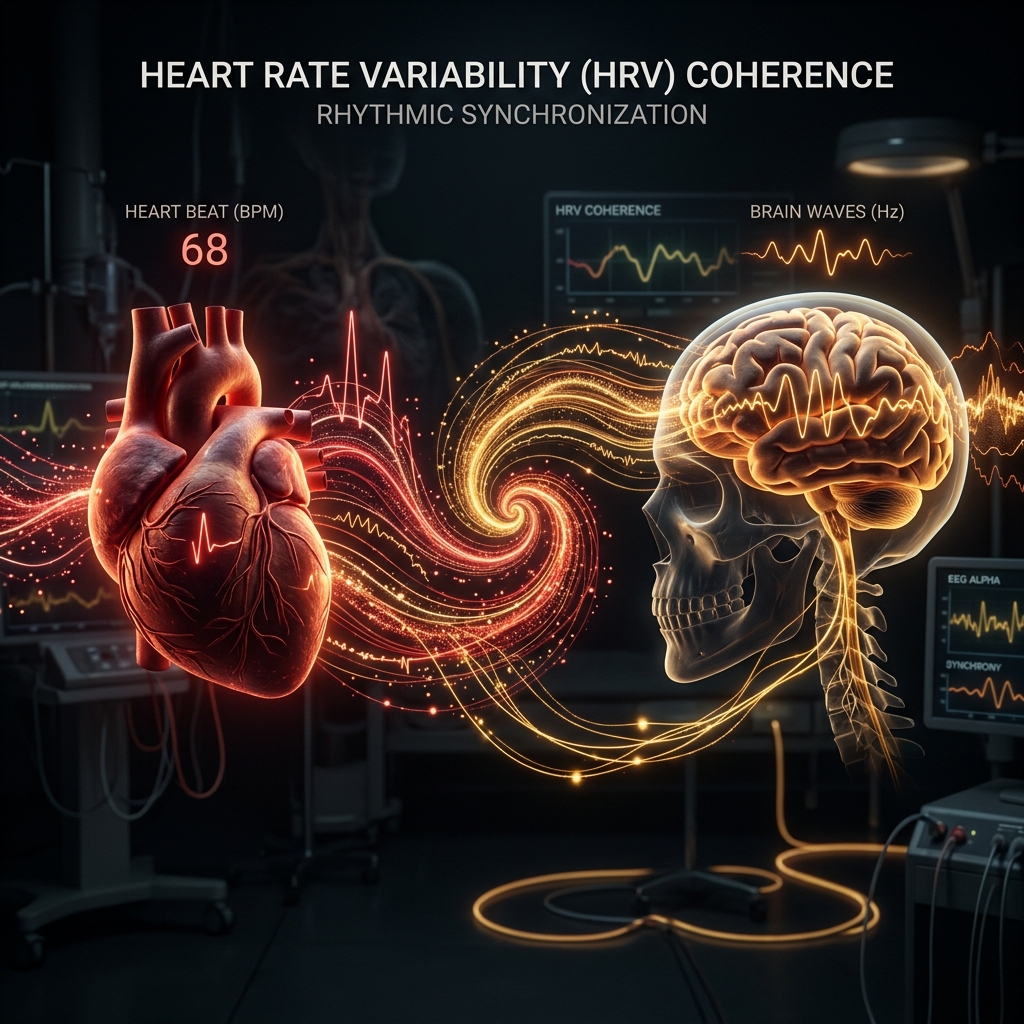
Communication between heart and brain runs in both directions. The brain adjusts heart rate through the sympathetic nerves and the vagus nerve, and the heart also reports back: most fibres in the vagus nerve, often estimated at around 80 per cent, carry signals from the body to the brain rather than the other way (Berthoud & Neuhuber, 2000). Information about heart rhythm and blood pressure therefore reaches the brainstem continuously.
HeartMath goes further and proposes that a coherent heart rhythm sends a more ordered signal upwards that improves prefrontal function, helping people think clearly under pressure. That is an interesting hypothesis, but it has mostly been tested by HeartMath's own researchers. The better established finding runs the other way: in the neurovisceral integration model, people whose prefrontal regulation works well also tend to have higher HRV (Thayer & Lane, 2009). Slow breathing that raises HRV may help regulation, but the direction of cause and effect is not settled.
Cardiac coherence and internal coherence
On this site, cardiac coherence is the measurable side of a broader idea, internal coherence: the state in which thought, emotion and body point the same way. The book Faith as a Human Function goes a step further and argues that what the Gospels call faith, what Csikszentmihalyi described as flow and what HeartMath measures as coherence are closely related experiences.
That is the book's thesis, not a research finding. No study has measured the three together, and they are not identical: flow, for example, tends to peak under moderate stress rather than complete calm. What they share is the sense of acting without inner conflict, and that is what the book explores.
How to produce the coherence pattern
The first method has the strongest evidence; the others are useful additions.
- Slow breathing at about six breaths a minute. Breathe in for about five seconds and out for about five, one full breath every ten seconds. This is the pace used in HRV biofeedback, and most people see a smoother heart-rhythm trace within a few minutes. If five seconds feels forced, start at four and lengthen gradually.
- Attention on the area of the heart. HeartMath's techniques ask you to place attention in the centre of the chest while you breathe slowly. Evidence for this step comes mainly from HeartMath's own studies, but it is a simple way to keep attention on the body.
- A genuinely positive feeling. Recalling something you appreciate, rather than forcing a positive thought, is the other half of HeartMath's method and the condition used in the 1995 study above.
- Calm sound. A steady sound, such as a solfeggio tone or an Alpha binaural beat, can help you settle and gives slow breathing a calm background. See the Morning Frequency Protocol for a combined routine.
Related articles
- What Is Internal Coherence? The Neuroscience of Belief and Action
- Why Positive Thinking Fails, And What Actually Works
- Fear Is Faith Applied Negatively: The Neurophysiology
- 396 Hz for Anxiety: What the Evidence Shows
- Flow State and Faith: Csikszentmihalyi and the Gospels
The full argument, in one book
Faith as a Human Function traces the historical and neurophysiological case for internal coherence as the original operational meaning of faith. $7.99 on Amazon.
Scientific references
- Berthoud, H.R. & Neuhuber, W.L. (2000). Functional and chemical anatomy of the afferent vagal system. Autonomic Neuroscience, 85(1–3), 1–17.
- Lehrer, P.M. & Gevirtz, R. (2014). Heart rate variability biofeedback: How and why does it work? Frontiers in Psychology, 5, 756.
- McCraty, R., Atkinson, M., Tiller, W.A., Rein, G., & Watkins, A.D. (1995). The effects of emotions on short-term power spectrum analysis of heart rate variability. The American Journal of Cardiology, 76(14), 1089–1093.
- McCraty, R., Barrios-Choplin, B., Rozman, D., Atkinson, M., & Watkins, A.D. (1998). The impact of a new emotional self-management program on stress, emotions, heart rate variability, DHEA and cortisol. Integrative Physiological and Behavioral Science, 33(2), 151–170.
- Thayer, J.F. & Lane, R.D. (2009). Claude Bernard and the heart-brain connection: Further elaboration of a model of neurovisceral integration. Neuroscience & Biobehavioral Reviews, 33(2), 81–88.
- Csikszentmihalyi, M. (1990). Flow: The Psychology of Optimal Experience. Harper & Row.