What white noise actually is
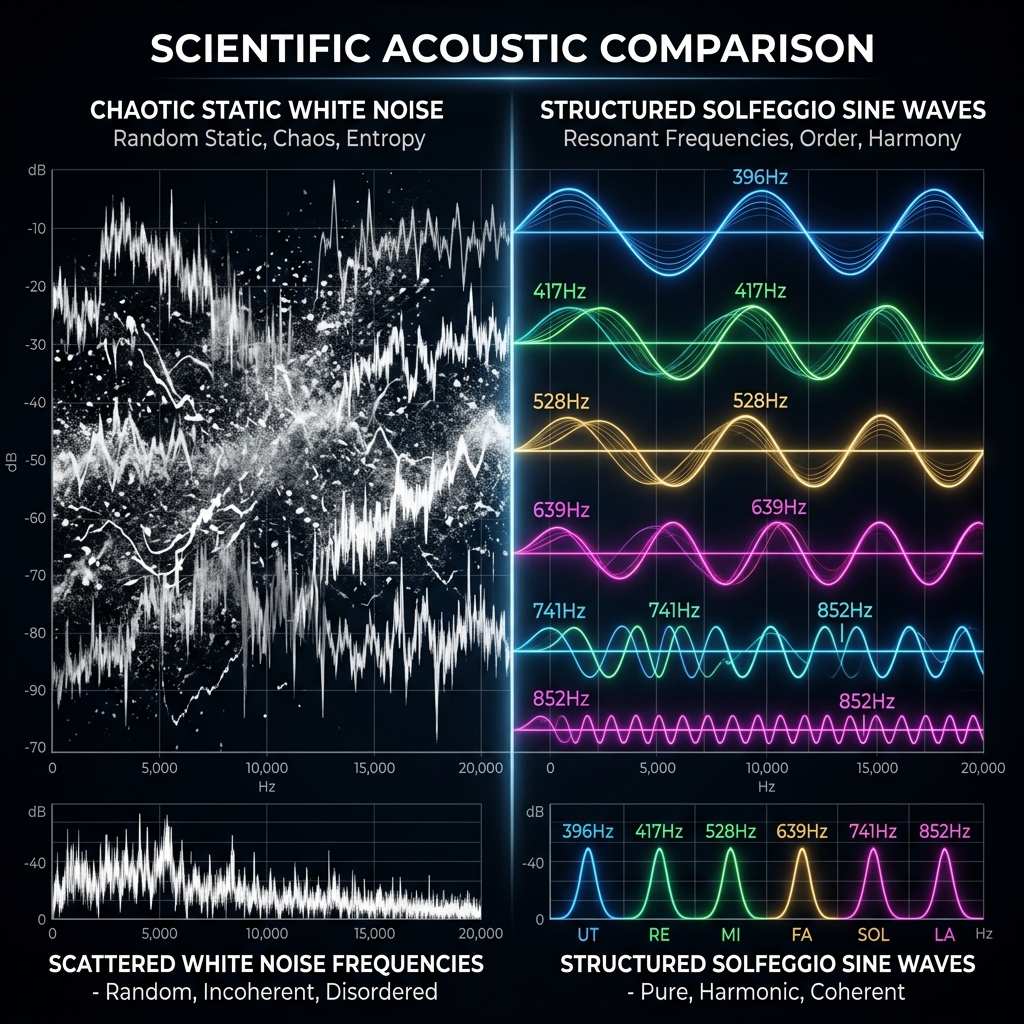
White noise is a random acoustic signal that contains equal energy at every frequency across the audible spectrum — from 20 Hz to 20,000 Hz simultaneously. The name comes by analogy with white light, which contains all visible wavelengths at equal intensity. The result is the characteristic hissing, static-like sound familiar from old televisions, air conditioning units, and dedicated white noise machines.
White noise works primarily through acoustic masking: it raises the ambient noise floor, which reduces the contrast between sudden noises — a door slamming, a car horn, a conversation — and the background. The brain habituates to the consistent white noise signal and stops treating it as a potential threat. Sudden noises that would otherwise trigger an orienting response are partially masked, reducing sleep disruption and attention fragmentation.
This is a real and useful effect. A 2021 study in Sleep Medicine Reviews found that white noise improved sleep onset in sleep-disrupted environments. The mechanism is well understood and not contested.
What solfeggio frequencies are — and how they differ
Solfeggio frequencies are specific, mathematically precise single tones — not a broad-spectrum noise signal, but a single frequency delivered with acoustic exactness. 528 Hz is 528 Hz and nothing else. The acoustic character is completely different from white noise: a pure tone rather than random static.
The mechanism is also entirely different. Solfeggio frequencies work through the frequency-following response (FFR): when the auditory system receives a sustained, consistent acoustic stimulus, the nervous system tends to entrain to it — neural oscillation patterns synchronise with the input frequency. This is an active process, not a masking process. The brain is not ignoring the sound. It is responding to it at the brainstem level.
White noise does not produce FFR effects because it has no consistent frequency to entrain to. Its spectrum is, by definition, random and non-periodic. The brain cannot synchronise its oscillations to a signal that has no regular pattern.
Pink noise and brown noise: what they are
White noise is often compared alongside pink noise (equal energy per octave — softer at high frequencies, closer to rainfall or wind) and brown noise (greater energy at low frequencies — a deep rumble, closer to thunder or ocean waves). These are variations on the masking mechanism, not different mechanisms. Pink and brown noise produce acoustic masking just as white noise does — the difference is in the frequency weighting, which affects the subjective character of the sound.
None of these — white, pink, or brown noise — produce FFR effects. They are masking tools, not entrainment tools. For people whose primary sleep problem is external noise disruption rather than physiological arousal, coloured noise is a practical and well-supported solution.
When to use each
- The problem is physiological — anxiety, stress, inability to settle
- You want an active effect on the nervous system, not just masking
- The environment is already quiet enough that noise is not the issue
- You want a morning grounding session
- You want to shift your baseline over time through consistent practice
- The problem is environmental — a noisy neighbourhood, a snoring partner, traffic
- You need to mask specific intrusive sounds
- You want a neutral acoustic background for focused work without active effects
- Young children's sleep is disrupted by household or environmental sounds
Can you use both together?
Yes — they address different layers of the acoustic environment and do not interfere with each other. A practical combination for sleep in a noisy environment: pink noise at a room-masking level as the background, with 174 Hz solfeggio (or a Delta binaural beat through earbuds) layered over it. The pink noise addresses the external masking need; the solfeggio or binaural beat addresses the internal physiological state.
The solfeggio or binaural layer should be quieter than the masking layer — its mechanism does not require loudness, and running it too loud would defeat the purpose of having a masking background.
What Solfeggio Sanctuary is — and is not
Solfeggio Sanctuary generates pure acoustic tones — it is a frequency tool, not a noise tool. It does not produce white, pink, or brown noise. Its value proposition is the opposite of masking: it delivers a specific, mathematically precise signal that the nervous system can entrain to.
If you are looking for a masking tool for a noisy environment, a dedicated white noise app or machine is the right choice for that specific need. If you are looking for an active tool to shift the physiological state — reduce cortisol, support parasympathetic tone, create a grounding acoustic environment — Solfeggio Sanctuary is built for that purpose.
Related articles
- What Are Solfeggio Frequencies? The Science Behind the Scale
- 396 Hz for Anxiety: How This Frequency Affects the Nervous System
- The Best Solfeggio Frequency for Sleep
- Binaural Beats vs. Solfeggio Frequencies: Which Should You Use?
Precise tones. Not noise. Free download.
Solfeggio Sanctuary gives you all 9 frequencies with mathematically exact generation. Free, no subscription.
Scientific references
- Hink, R.F. et al. (1980). Phase-locked time domain analysis of the auditory frequency-following response. Audiology, 19(1), 1–14.
- Ebben, M.R. et al. (2021). The effects of white noise on sleep and duration in individuals living in a high noise environment in New York City. Sleep Medicine, 83, 256–259.
- Huang, T.L. & Charyton, C. (2008). A comprehensive review of the psychological effects of brainwave entrainment. Alternative Therapies in Health and Medicine, 14(5), 38–50.
- Stanchina, M.L. et al. (2005). The influence of white noise on sleep in subjects exposed to ICU noise. Sleep Medicine, 6(5), 423–428.