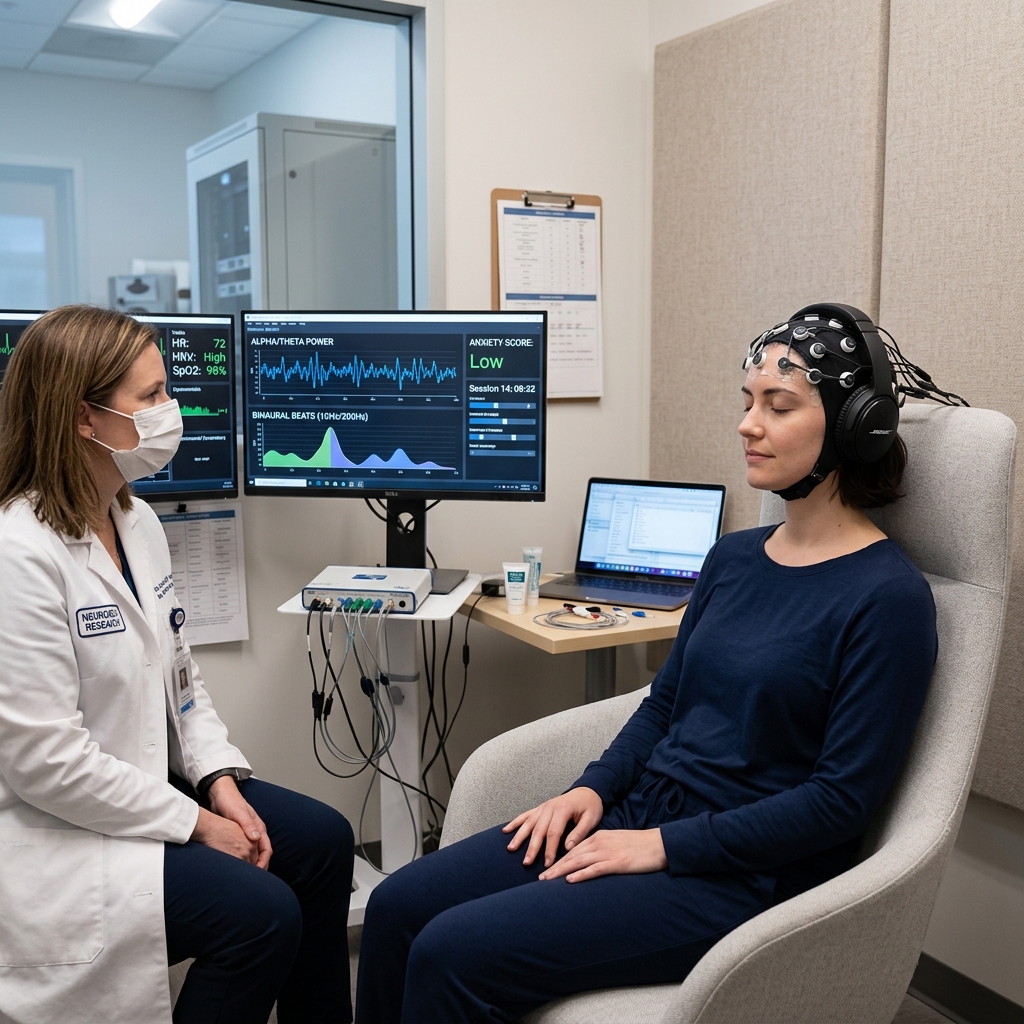
Yes. A 2005 double-blind RCT (Padmanabhan et al., Anaesthesia) found binaural beats reduced pre-operative anxiety to a degree comparable to conventional sedation. A 2019 meta-analysis of 22 studies (Garcia-Argibay et al.) found moderate-to-large effect sizes for anxiety reduction. Delta and Theta bands show the strongest effects.
Why anxiety is the most-studied application of binaural beats
Anxiety reduction became the primary research focus for binaural beats for a straightforward reason: acute, measurable anxiety states in controlled clinical populations (pre-operative patients, dental patients, people undergoing medical procedures) provide an ideal research environment. The anxiety state can be reliably induced, measured objectively via cortisol levels and heart rate, and compared between treatment and control conditions. This allowed researchers to run genuine double-blind RCTs — the gold standard for clinical evidence.
The research base on binaural beats for generalised or chronic anxiety is thinner, because that population is harder to study in controlled conditions. Most of the strongest evidence comes from acute situational anxiety — which is still highly relevant, because the physiological mechanism being studied is identical.
The key clinical studies
The landmark study. 108 patients awaiting elective surgery were randomly assigned to binaural beat audio, conventional relaxation music, or no audio. Anxiety was measured using the validated State-Trait Anxiety Inventory (STAI) before and after the intervention.
The binaural beat group showed significantly greater anxiety reduction than both the music group and the control group. The authors noted that the binaural beat condition produced anxiolytic effects comparable to conventional pre-operative sedation — without pharmacological intervention.
The most comprehensive meta-analysis of binaural beats research to date. Analysed 22 studies across multiple outcomes — anxiety, memory, attention, mood, and pain. Found significant effects of binaural beats on anxiety reduction with a moderate-to-large effect size.
Importantly, the meta-analysis found that the effect on anxiety was consistent across different frequency bands — not limited to a specific band — which suggests the mechanism is robust and not dependent on hitting a precise target frequency. Lower frequency bands (Delta and Theta) showed slightly stronger effects on anxiety than Beta and Gamma.
An earlier comprehensive review covering 20 peer-reviewed studies on brainwave entrainment. Concluded that the evidence supports brainwave entrainment as an effective intervention for stress, anxiety, and pre-operative anxiety specifically. Also found evidence for improvements in cognitive functioning and pain management.
Controlled trial in a pre-operative nursing context. Found that binaural beat audio reduced anxiety scores significantly more than the standard care condition. Nurses reported the intervention was easy to implement and well-accepted by patients.
What frequency bands are most effective for anxiety
The Garcia-Argibay meta-analysis (2019) provides the clearest guidance here. The review found that lower frequency bands — Delta (0.9–4 Hz) and Theta (5–8 Hz) — produced stronger anxiety reduction effects than higher bands. This is consistent with the physiological logic: Delta and Theta are associated with the deepest states of physical rest and the most complete shift toward parasympathetic dominance.
For acute anxiety — the kind that arrives suddenly before a difficult event — a short Alpha session (10 Hz, 10–15 minutes) is often more practical. Alpha is accessible more quickly than Delta or Theta, and its relaxed-awareness character addresses the specific physiological signature of acute anxiety without the risk of producing drowsiness that comes with deep Delta sessions.
For chronic background anxiety — the persistent, low-level activation that many people carry through the day — Theta sessions (6–7 Hz) run consistently over days or weeks show the strongest evidence in the research.
Fast to access, reduces acute sympathetic activation without producing drowsiness. 10–15 minutes before a stressful event.
Strongest evidence for anxiety reduction in meta-analysis. 20–30 minute daily sessions over 1–2 weeks for baseline shift.
Most effective for anxiety that prevents sleep. As part of the sleep protocol — after an Alpha wind-down session.
Important caveats
The evidence is meaningful but comes with necessary qualifications that the wellness industry tends to omit.
- Most studies used acute situational anxiety in controlled populations. The leap from "reduces anxiety in pre-operative surgical patients" to "treats generalised anxiety disorder" is not directly supported by the current evidence base. The mechanism is the same but the chronicity and severity are different.
- Effect sizes are moderate, not transformative. Binaural beats are not a replacement for evidence-based anxiety treatment. They are a useful adjunct — a tool that reduces the physiological arousal that makes anxiety worse, without producing the side effects of pharmacological intervention.
- Headphones are non-negotiable. Every study that found positive effects used headphone delivery. The binaural beat mechanism requires stereo isolation. Studies using speaker delivery show no reliable effect.
- Clinical anxiety disorders require clinical treatment. If anxiety is significantly impairing daily functioning, relationships, or occupational performance, binaural beats are a complement to professional care — not a primary intervention.
Practical use for anxiety
Given the evidence, the most defensible applications are:
- Before specific high-anxiety events. A 10–15 minute Alpha session (10 Hz) before a presentation, interview, difficult conversation, or medical procedure. This is exactly the population studied in Padmanabhan (2005) — and the effect is well-supported.
- As a daily anxiety management tool. A 20-minute Theta session (6 Hz) at a consistent time each day — morning or evening — to gradually shift the autonomic baseline over one to two weeks. This is the application supported by Jirakittayakorn & Wongsawat (2018) and consistent with the Garcia-Argibay meta-analysis findings.
- In combination with solfeggio frequencies. Running 396 Hz through a room speaker while doing a Theta binaural session through earbuds addresses both the acoustic FFR mechanism (solfeggio) and the brainwave entrainment pathway (binaural) simultaneously. The two tools are complementary — see 396 Hz for Anxiety for the solfeggio side of this.
Related articles
- Binaural Beats: How They Work and What the Research Says
- Delta, Theta, Alpha, Beta, Gamma: A Complete Guide
- 396 Hz for Anxiety: How This Frequency Affects the Nervous System
- What Is Internal Coherence? The Neuroscience of Belief and Action
Alpha, Theta, and Delta — all in one app
Binaural Therapy gives you all five brainwave bands with session timer and harmonically-aligned carriers. €2.49 once. No subscription.
Scientific references
- Padmanabhan, R., Hildreth, A.J. & Laws, D. (2005). A prospective, randomised, controlled study examining binaural beat audio and pre-operative anxiety. Anaesthesia, 60(9), 874–877.
- Garcia-Argibay, M., Santed, M.A. & Reales, J.M. (2019). Efficacy of binaural auditory beats in cognition, anxiety, and pain perception. Psychological Research, 83(2), 357–372.
- Huang, T.L. & Charyton, C. (2008). A comprehensive review of the psychological effects of brainwave entrainment. Alternative Therapies in Health and Medicine, 14(5), 38–50.
- Kennel, S. et al. (2010). Binaural beat technology in humans: A pilot study to assess neuropsychologic, physiologic, and electroencephalographic effects. Journal of PeriAnesthesia Nursing, 25(1), 3–7.
- Jirakittayakorn, N. & Wongsawat, Y. (2018). Brain responses to a 6-Hz binaural beat. Frontiers in Human Neuroscience, 12, 387.