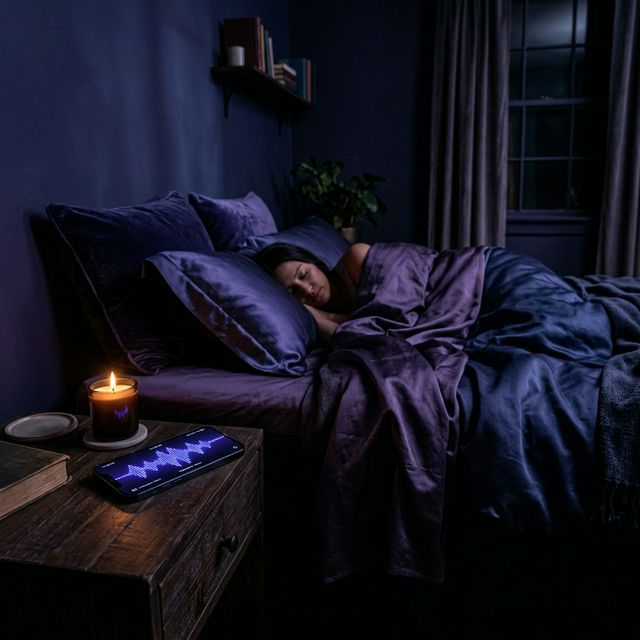
Why solfeggio frequencies help with sleep
Sleep onset requires a transition from sympathetic nervous system dominance (the active, alert mode) to parasympathetic dominance (the recovery, rest mode). Most people who struggle with sleep are stuck in sympathetic mode too late into the evening — the system is still running cortisol, still processing, still braced for demands that are no longer present.
Solfeggio frequencies support this transition through the frequency-following response: sustained exposure to specific acoustic stimuli nudges the nervous system toward the parasympathetic state. The frequency is not putting you to sleep — it is reducing the physiological noise that is keeping you awake.
Unlike binaural beats, solfeggio frequencies do not require headphones. You can play them through a phone speaker on your nightstand, run a session timer, and let the audio work as background — which makes them more practical for the sleep context than tools that require equipment to stay in place while you sleep.
The three main candidates
174 Hz is the lowest frequency in the solfeggio scale and the one with the most physically grounding acoustic character. In the sub-bass range, it is felt in the body as much as heard — a deep, settling vibration that reduces physical tension from the bottom up. This makes it particularly effective for people whose sleep disruption has a strong somatic component: tight shoulders, chest tension, restless legs, physical agitation.
It does not require loud playback to be effective — even at low volume through a phone speaker, the sub-bass character of 174 Hz creates an acoustic anchor that many practitioners find conducive to the physical release required for sleep onset.
396 Hz is the solfeggio frequency most associated with anxiety and fear reduction. Its mid-low acoustic character — warm, grounding, without the extreme sub-bass physicality of 174 Hz — makes it effective for the sleep disruption pattern most people experience: a mind that will not stop, anxiety about tomorrow, the accumulation of the day's unresolved emotional content.
If you find yourself lying awake thinking about conversations, tomorrow's schedule, or vague worries, 396 Hz is usually the more targeted choice than 174 Hz. It addresses the emotional-cognitive layer of sleeplessness rather than the somatic layer.
528 Hz is often recommended for sleep, and the recommendation has some basis — the cortisol reduction documented by Akimoto et al. (2018) is relevant here. However, 528 Hz is a mid-range frequency with a relatively clear, bright character. It is energising as much as calming. It works better as a pre-sleep session (30 minutes before bed) than as a falling-asleep tool.
Use 528 Hz during an evening wind-down session while you are still active — reading, stretching, sitting quietly. Then switch to 174 Hz or 396 Hz when you get into bed.
The recommended protocol
Based on the acoustic properties of each frequency and their relationship to the sleep onset process, the most effective approach is a two-stage sequence:
30 minutes before bed: 528 Hz or 396 Hz
During your pre-sleep routine — not yet in bed. If the day was emotionally heavy or anxiety is present, use 396 Hz. If the day was cognitively heavy (a lot of screen time, analytical work, decisions) but not particularly anxious, 528 Hz is appropriate. Low volume through a room speaker. No headphones required.
In bed: 174 Hz, session timer 45 minutes
When you get into bed, switch to 174 Hz. This is where the physical anchoring quality of the sub-bass frequency is most useful — your body is now horizontal, attempting to release its held tension, and 174 Hz creates an acoustic environment that supports that release. Set a 45-minute timer. By then you should be asleep. If the audio plays all night, turn the volume down to the threshold of audibility.
Does it matter which instruments you use?
For sleep, simpler is better. Pure tone or tuning fork is the recommended starting point. The overtone complexity of Tibetan bowls — while rich and immersive in a waking meditation context — can be too stimulating for sleep onset. The brain needs a simple, consistent, predictable acoustic signal to entrain toward rest. A single pure tone at 174 Hz delivers that more cleanly than a complex bowl overtone series.
If you have the Pro version of Solfeggio Sanctuary and want to experiment with bowls in sleep, crystal bowls are better suited than Tibetan bowls for this purpose — their overtone profile is simpler and more focused.
Combining with binaural beats
For a more complete sleep protocol, solfeggio frequencies through the room can be combined with a binaural Delta beat (2 Hz) through earbuds when you get into bed. The solfeggio addresses the autonomic state from the acoustic environment; the binaural guides neural oscillations toward Delta through entrainment. The full version of this combined protocol is in the Sleep Protocol: Alpha to Delta in 45 Minutes.
What to expect on the first night
Do not expect a dramatic first-night result. The frequency-following response is cumulative — consistent use over several nights produces more reliable results than a single session. Track whether you fall asleep faster over a week of use, not whether the first session feels significantly different from your baseline.
The most common feedback from new users is that the acoustic environment is pleasant and reduces the sense of lying in silence — which itself can be anxiety-amplifying for some people. That alone is a meaningful starting point.
Related articles
- What Are Solfeggio Frequencies? The Science Behind the Scale
- 396 Hz for Anxiety: How This Frequency Affects the Nervous System
- Binaural Beats for Sleep: The Complete Protocol
- The Sleep Protocol: Alpha to Delta in 45 Minutes
- Binaural Beats vs. Solfeggio Frequencies: Which Should You Use?
174 Hz, 396 Hz, and 528 Hz — all free
Solfeggio Sanctuary gives you all 9 frequencies with a session timer. Free download. Pro upgrade for €4.89 unlocks crystal and Tibetan bowls and 60-minute sessions.
Scientific references
- Akimoto, K. et al. (2018). Effect of 528 Hz music on the endocrine system and autonomic nervous system. Health, 10(9), 1199–1209.
- Hink, R.F. et al. (1980). Phase-locked time domain analysis of the auditory frequency-following response. Audiology, 19(1), 1–14.
- Huang, T.L. & Charyton, C. (2008). A comprehensive review of the psychological effects of brainwave entrainment. Alternative Therapies in Health and Medicine, 14(5), 38–50.
- McCraty, R. & Shaffer, F. (2015). Heart rate variability: New perspectives on physiological mechanisms. Global Advances in Health and Medicine, 4(1), 46–61.
- Clow, A. et al. (2010). The awakening cortisol response: Methodological issues and significance. Stress, 13(4), 293–304.