Unlock the power of 40 Hz binaural beats for improved memory and brain health.
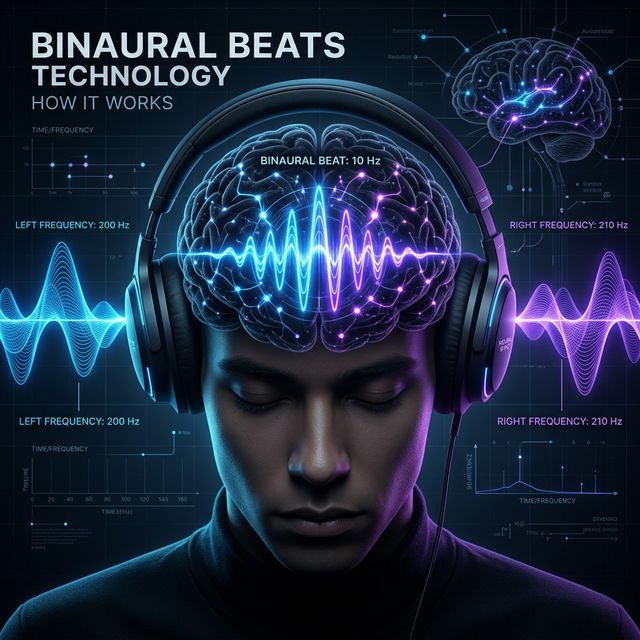
The human brain is a complex and dynamic entity, capable of reorganizing itself in response to new experiences and learning. One of the key frequencies associated with this process is 40 Hz, a gamma brainwave frequency that has been linked to attention, working memory, and cognitive processing. But what exactly are 40 Hz binaural beats, and how can they be used to improve memory and brain health? To answer this question, we need to delve into the world of brainwave entrainment and explore the science behind this fascinating frequency. Brainwave entrainment is a phenomenon where the brain’s natural frequencies are influenced by external stimuli, such as sound or light, to synchronize with a specific frequency. This can be achieved through the use of binaural beats, which are created by playing two slightly different tones in each ear. For example, if a 400 Hz tone is played in the left ear and a 440 Hz tone is played in the right ear, the brain perceives the difference between the two frequencies as a 40 Hz beat.
Introduction to Brainwave Frequencies
To understand the significance of 40 Hz binaural beats, it’s essential to have a basic understanding of brainwave frequencies. Brainwaves are typically divided into five categories: delta, theta, alpha, beta, and gamma. Each category is associated with specific states of consciousness and cognitive processes. Delta brainwaves, for instance, are associated with deep sleep and relaxation, while theta brainwaves are linked to meditation, creativity, and dreaming. Alpha brainwaves are associated with relaxation and calm focus, beta brainwaves with active thinking and concentration, and gamma brainwaves with high-level cognitive processing. You can learn more about the different brainwave states in our article Delta, Theta, Alpha, Beta, Gamma: A Complete Guide to Brainwave States.
The Science Behind 40 Hz Binaural Beats
40 Hz binaural beats fall within the gamma brainwave range, which is associated with focused attention, working memory, information processing, and learning. This frequency is unique in that it is not typically associated with relaxation or sleep, but rather with an active, engaged mind. The theory behind binaural beats is that exposure to specific frequencies encourages the brain to synchronize with those frequencies, influencing mental states and cognitive performance. In the case of 40 Hz binaural beats, the target frequency falls within the gamma brainwave range, which is associated with high-level cognitive processing. You can learn more about how binaural beats work in our article Binaural Beats: How They Work and What the Research Says.
Benefits of 40 Hz Binaural Beats
So, what are the benefits of using 40 Hz binaural beats? Research has shown that this frequency can have a positive impact on attention, working memory, and cognitive processing. One study published in 2017 found that 40 Hz binaural beats produced measurable gamma-band responses in the brain and improved working memory performance (Jirakittayakorn & Wongsawat, 2017). Another study published in 2015 reported improvements in attentional focusing following gamma-frequency binaural beat stimulation (Colzato et al., 2015). These findings suggest that 40 Hz binaural beats may be a useful tool for improving cognitive function, particularly in individuals with attention-deficit/hyperactivity disorder (ADHD). You can learn more about using binaural beats for focus in our article Binaural Beats for Focus: Which Frequency and How Long.
The Role of Gamma Brainwaves in Memory Formation
Much of the excitement surrounding 40 Hz binaural beats stems from the role that gamma brainwaves appear to play in memory formation. Scientists believe that gamma oscillations help coordinate communication between different regions of the brain, allowing information to be processed, integrated, and stored more efficiently. Research has linked gamma activity to working memory, learning and retention, attention, recall, and information processing speed. This connection may help explain why several 40 Hz studies have reported improvements in memory-related tasks and cognitive performance. You can learn more about the role of gamma brainwaves in peak performance in our article Gamma Waves and Peak Performance: The Science.
Using 40 Hz Binaural Beats for Studying and Information Retention
40 Hz binaural beats have become popular among students, writers, researchers, and programmers due to their potential to improve attention and information processing. By listening to 40 Hz binaural beats while studying or working, individuals may be able to improve their ability to focus and retain information. This can be especially useful for individuals who struggle with attention-deficit/hyperactivity disorder (ADHD) or those who need to learn new skills quickly. You can learn more about using binaural beats for anxiety in our article Binaural Beats for Anxiety: What the Clinical Trials Show.
Practical Takeaways
So, how can you use 40 Hz binaural beats to improve your memory and brain health? Here are some practical takeaways:
- Listen to 40 Hz binaural beats while studying or working to improve focus and attention
- Use 40 Hz binaural beats to improve working memory and cognitive processing
- Experiment with different volumes and durations to find what works best for you
- Combine 40 Hz binaural beats with other cognitive training techniques, such as meditation or exercise, to enhance their effects
- Consult with a healthcare professional before using 40 Hz binaural beats, especially if you have a history of neurological disorders or are taking medication.
Conclusion
In conclusion, 40 Hz binaural beats are a fascinating frequency that has been linked to improved memory and brain health. By understanding the science behind brainwave entrainment and the role of gamma brainwaves in cognitive processing, individuals can harness the power of 40 Hz binaural beats to improve their focus, attention, and information retention. Whether you’re a student looking to improve your grades, a professional seeking to enhance your cognitive abilities, or simply an individual looking to improve your overall brain health, 40 Hz binaural beats may be a useful tool to add to your arsenal. Remember to always consult with a healthcare professional before using binaural beats, especially if you have a history of neurological disorders or are taking medication. With the right approach and a commitment to consistent practice, you can unlock the full potential of 40 Hz binaural beats and achieve improved memory and brain health.
Five brainwave bands. One purchase.
Binaural Harmonic Beats gives you Delta, Theta, Alpha, Beta, and Gamma — with harmonically-aligned carrier frequencies and a subliminal message builder. €2.49, one-time.