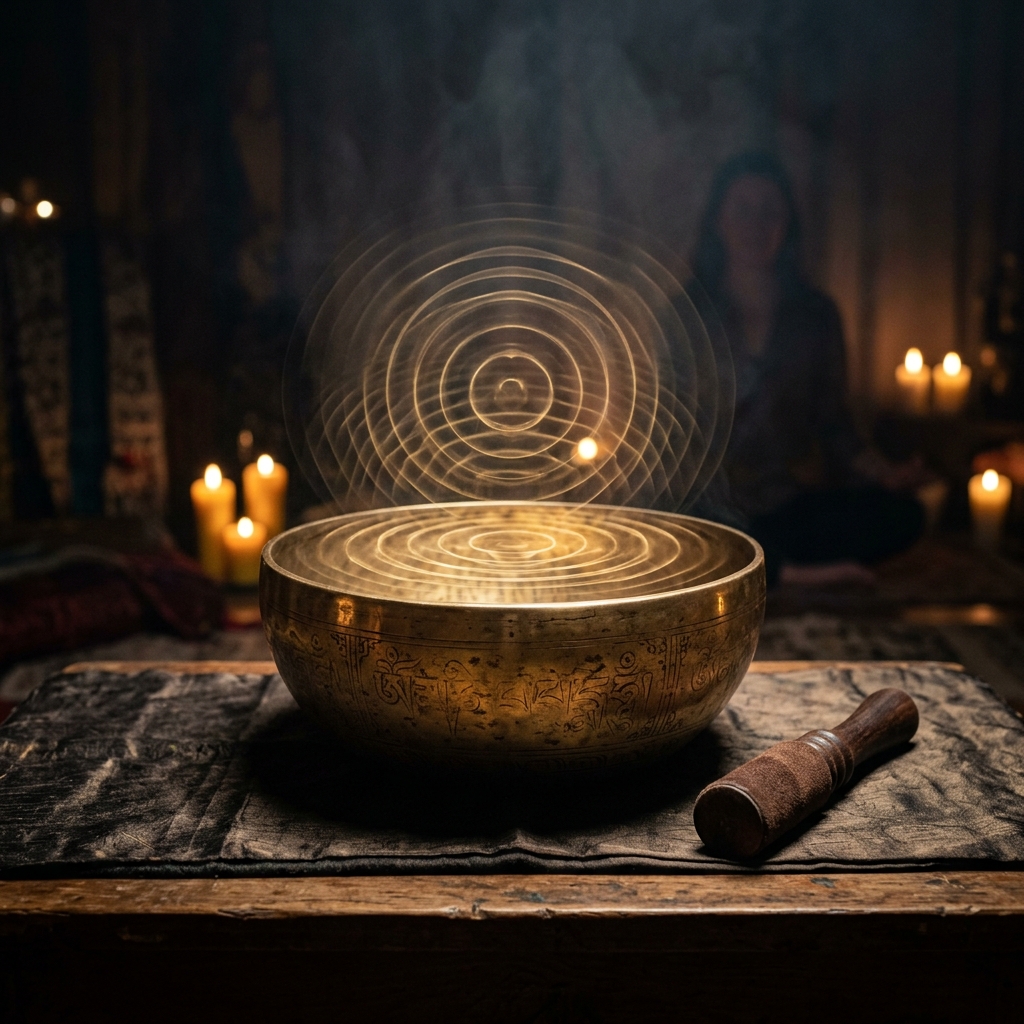
What a singing bowl actually produces acoustically
When a singing bowl is struck or played with a mallet around its rim, it does not produce a single frequency. It produces a complex series of frequencies simultaneously — a fundamental note plus a cascade of overtones (also called harmonics or partials) at mathematically related higher frequencies.
The fundamental is the lowest, loudest pitch you hear. The overtones are the higher frequencies that give the bowl its characteristic rich, sustained, shimmering quality. They are not noise or distortion — they are the bowl's natural resonance pattern, determined by its shape, mass, material composition, and the way energy is distributed through its structure when struck.
This is the same physics that gives a violin its tone. Two violins playing the same A4 (440 Hz) sound different because they produce different overtone series — the fundamental is identical, but the harmonic structure above it differs. The overtone pattern is the acoustic fingerprint of the instrument.
Tibetan bowls: the alloy overtone structure
Traditional Tibetan singing bowls are made from an alloy of five to seven metals — typically including copper, tin, zinc, iron, silver, gold, and lead in varying proportions. The multi-metal composition produces an unusually complex and rich overtone series compared to single-metal instruments. Where a tuning fork or pure tone generator produces essentially one frequency, a Tibetan bowl simultaneously produces the fundamental plus multiple overtone partials, often extending well into the upper audible range.
The practical consequence is that when a Tibetan bowl is layered over a solfeggio frequency, the acoustic environment becomes significantly more complex. A 528 Hz pure tone layered with a Tibetan bowl tuned near that frequency creates a multi-layered harmonic field: the precise 528 Hz fundamental is present and intact, but it is now surrounded by related overtone frequencies that extend the acoustic presence of the 528 Hz signal throughout the harmonic series.
This is not sonic muddiness — it is harmonic enrichment. The bowl's overtones are mathematically related to the fundamental, so they reinforce rather than contradict the central frequency. The nervous system receives a broader, richer acoustic stimulus rather than a single isolated tone.
Crystal bowls: quartz purity and focus
Crystal singing bowls are made from quartz sand (silicon dioxide) that has been processed into a near-pure crystalline structure — typically 99.99% pure quartz. The crystalline structure produces a very different overtone profile from the multi-metal Tibetan bowl.
Where a Tibetan bowl has a diffuse, complex overtone cascade, a crystal bowl has a much cleaner overtone structure — a strong, clear fundamental with relatively few overtone partials, each of which decays more quickly than in the metal bowl. The result is a tone that is more focused, more transparent, and closer in character to a pure sine wave than the Tibetan bowl.
When layered over a solfeggio frequency, a crystal bowl adds warmth and presence to the pure tone without the complex multi-partial cloud of the Tibetan bowl. The acoustic environment is enriched but remains relatively clean — the 528 Hz (or whichever frequency) remains clearly identifiable in the overall sound, with the crystal bowl acting as a resonant amplifier rather than a harmonic expander.
Why layering matters — the coherent acoustic field
The frequency-following response works most effectively when the nervous system receives a consistent, unambiguous acoustic signal to entrain to. A single pure tone is the most acoustically clean input — mathematically precise, no competing frequencies. But the acoustic environment it creates is thin and potentially fatiguing over extended sessions.
Layering a bowl over the pure tone addresses this without compromising the entrainment signal — as long as the bowl's fundamental is tuned to the same frequency (or a harmonically related one). The overtones above the fundamental are mathematically predictable extensions of the same signal, not contradictory inputs. The nervous system receives a richer, more immersive acoustic environment while the primary entrainment frequency remains clear and stable.
The practical layering recommendation in Solfeggio Sanctuary reflects this: start with pure tone as the foundational signal, add tuning fork for initial harmonic enrichment, then add crystal bowl for a cleaner expansion, and finally add Tibetan bowl if maximum immersion is the goal. The sequence moves from most precise to most complex — each layer adding acoustic richness while the fundamental solfeggio frequency remains present throughout.
Historical context: why bowls were used
Tibetan singing bowls have been used in Buddhist monastic practice for at least several centuries — though their precise origin and the specific traditions surrounding their use are more diverse and less standardised than popular wellness content suggests. The bowls appear in contexts of ritual, meditation, and ceremonial practice across the Himalayan region, with usage varying significantly between traditions.
The acoustic reason for their use in meditative contexts is consistent with what the spectral analysis above suggests: the complex overtone structure of the metal bowl creates an immersive acoustic field that is difficult to ignore or habituate to, which may support the kind of sustained, focused attention that meditation practice requires. This is an empirical observation about acoustic properties, not a mystical claim.
Crystal bowls are a 20th-century development. They were first produced commercially in the 1980s in the United States and became associated with New Age sound healing practices. Their acoustic properties — the clean, focused, long-sustaining fundamental — make them practically suited for use in sound therapy contexts where clarity and directness of acoustic signal are valued over the complexity of traditional metal bowls.
How to choose between them in practice
- For meditation sessions requiring depth: Add Tibetan bowl. The complex overtone field is more immersive and harder to habituate to over long sessions — it continues to hold attention in a way that a pure tone alone may not after extended exposure.
- For sessions requiring clarity and focus: Crystal bowl. Its cleaner overtone profile adds warmth without diffusing the fundamental signal. Better for sessions where you want the primary frequency to remain clearly perceptible.
- For sleep onset: Pure tone or tuning fork only. The complex overtone cascades of the bowls can be stimulating rather than settling for sleep onset. Simplicity is the goal here.
- For short sessions (under 15 minutes): Start with pure tone only. The layers add value over longer sessions where acoustic variety matters. For a 10-minute focused session, the pure tone is sufficient.
Related articles
- What Are Solfeggio Frequencies? The Science Behind the Scale
- How to Use Solfeggio Frequencies for Meditation
- 174 Hz to 963 Hz: A Complete Guide to All 9 Frequencies
- The Best Solfeggio Frequency for Sleep
Tibetan and crystal bowls in the Pro version
Solfeggio Sanctuary Pro (€4.89 once) adds both bowl types as layerable instruments over any of the 9 frequencies. Free version includes pure tones and tuning forks.
Scientific references
- Rossing, T.D. (1992). Acoustics of the singing bowl. Journal of the Acoustical Society of America, 92(4), 2517. Analysis of the vibration modes and overtone structure of metal singing bowls.
- Hink, R.F. et al. (1980). Phase-locked time domain analysis of the auditory frequency-following response. Audiology, 19(1), 1–14.
- Huang, T.L. & Charyton, C. (2008). A comprehensive review of the psychological effects of brainwave entrainment. Alternative Therapies in Health and Medicine, 14(5), 38–50.