The physiological logic
Sleep onset is a descent, not a switch. The brain moves through distinct brainwave states as it transitions from waking to deep sleep: Beta (active) → Alpha (relaxed) → Theta (drowsy, hypnagogic) → Delta (deep sleep). A binaural beat protocol that mirrors this sequence works with the brain's existing architecture.
The most common mistake is skipping directly to Delta. Delta (0.9–4 Hz) is the frequency of deep dreamless sleep — not the frequency of relaxation. Presenting a Delta beat to a waking Beta brain does not immediately produce Delta. The brain needs the intermediate steps. Alpha provides the first deceleration. It shifts the autonomic nervous system from sympathetic toward parasympathetic and reduces the cortisol that accumulates during active daytime processing.
10 Hz · 30 minutes before intended sleep · While still upright
2 Hz · When you get into bed · Timer: 45 minutes
Session timer ends · You should be asleep or nearly there
Phase 1 in detail: Alpha at 10 Hz
Begin 30 minutes before your intended sleep time. You should still be in your pre-sleep environment — not in bed yet. Reading, stretching, or sitting quietly all work. The Alpha session is not a passive background process: it requires you to be relatively still and away from active stimulation.
The physiological target of Phase 1 is parasympathetic activation: the reduction of cortisol, the normalisation of heart rate, and the beginning of melatonin production. These are the conditions required for Phase 2 to work efficiently. The Alpha binaural beat supports this by guiding neural oscillations toward the 8–13 Hz range — the brainwave state associated with relaxed, open awareness.
Phase 2 in detail: Delta at 2 Hz
When you get into bed, switch from Alpha to Delta. The transition should be smooth — within 2–3 minutes of lying down. You are now horizontal, lights off or very dim, no screens.
The 45-minute timer is not arbitrary. Sleep architecture consists of 90-minute cycles. The first cycle includes the deepest Delta sleep of the night — achieved approximately 30–45 minutes after sleep onset. After that, the cycle moves toward REM and lighter sleep. Delta binaural beats playing during REM (which operates in a Theta/Alpha range) create a frequency mismatch and can fragment sleep. Set the timer and let it stop.
Equipment: what actually works for sleep
This is the practical detail that determines whether the protocol is sustainable or abandoned after three nights.
- Flat sleep earbuds (e.g., Musicozy, Perytong, or similar sleep-specific in-ear designs). These sit flush with the ear canal and do not protrude — you can lie on your side without discomfort. Standard over-ear headphones are impractical. Standard earbuds with protruding stems are uncomfortable on a pillow.
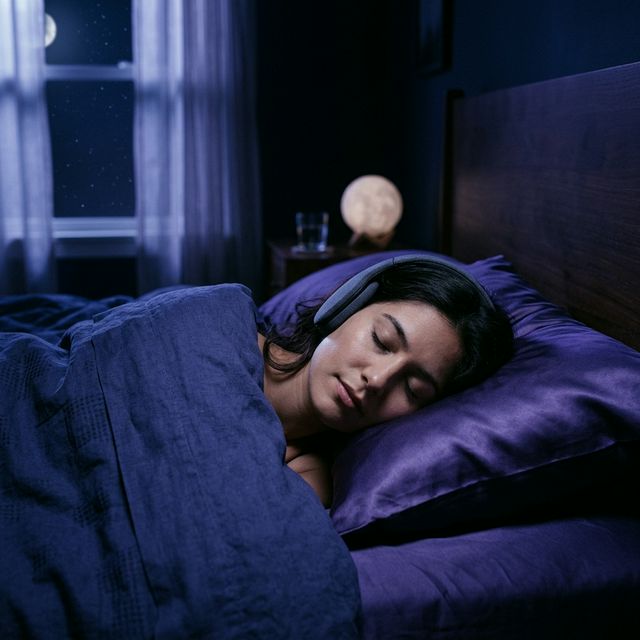
- Sleep headband with embedded speakers — an alternative to earbuds. A fabric headband with thin flat speakers inside, worn like a sleep mask. Both ears receive separate audio through the fabric. Less precise isolation than earbuds but more comfortable for side sleepers who move during the night.
- Bone conduction headphones do not work for binaural beats. Bone conduction bypasses the outer ear and delivers sound through the skull. The binaural beat effect requires each ear canal to receive its specific frequency in isolation. Bone conduction delivers both frequencies to both cochleae simultaneously — the binaural differential collapses.
Why the timer must stop at 45 minutes
This point is important enough to restate. A full night of Delta binaural beats does not produce a full night of Delta sleep — it produces disrupted sleep. The brain's natural sleep architecture cycles through Delta, Theta, and Alpha (REM) states across the night. Later cycles have proportionally more REM and less deep Delta.
If Delta binaural beats are playing during a REM cycle, the brain is receiving an acoustic signal pulling toward Delta while it is naturally in a Theta/Alpha-dominant state. The resulting frequency mismatch can cause partial arousal — the brief wakings that fragment sleep quality without being remembered in the morning.
45 minutes covers the sleep onset window and the first deep Delta cycle. After that, the audio should be silent. The natural sleep architecture takes over.
Adding a solfeggio layer
An optional addition: run Solfeggio Sanctuary at 174 Hz through a phone speaker at very low volume during Phase 1 (Alpha wind-down). 174 Hz is the sub-bass Foundation frequency — its acoustic character is physically grounding. Through the room rather than through headphones, it creates an acoustic environment that complements the Alpha binaural without competing with it. Keep the solfeggio volume low enough that it is barely audible from across the room.
Related articles
- Binaural Beats for Sleep: The Complete Protocol — overview version
- Delta, Theta, Alpha, Beta, Gamma: A Complete Guide
- Binaural Beats: How They Work and What the Research Says
- The Morning Frequency Protocol — the complementary morning practice
Alpha and Delta. Both in the app. €2.49 once.
Binaural Therapy includes all five bands, a session timer, and harmonically-aligned carriers. Set the 45-minute timer tonight.
Scientific references
- Nedergaard, M. et al. (2013). Sleep drives metabolite clearance from the adult brain. Science, 342(6156), 373–377.
- Jirakittayakorn, N. & Wongsawat, Y. (2018). Brain responses to a 6-Hz binaural beat. Frontiers in Human Neuroscience, 12, 387.
- Padmanabhan, R., Hildreth, A.J. & Laws, D. (2005). A prospective, randomised, controlled study examining binaural beat audio and pre-operative anxiety. Anaesthesia, 60(9), 874–877.
- Dijk, D.J. & Czeisler, C.A. (1995). Contribution of the circadian pacemaker and the sleep homeostat to sleep propensity, sleep structure, EEG slow waves, and sleep spindle activity. Journal of Neuroscience, 15(5), 3526–3538.