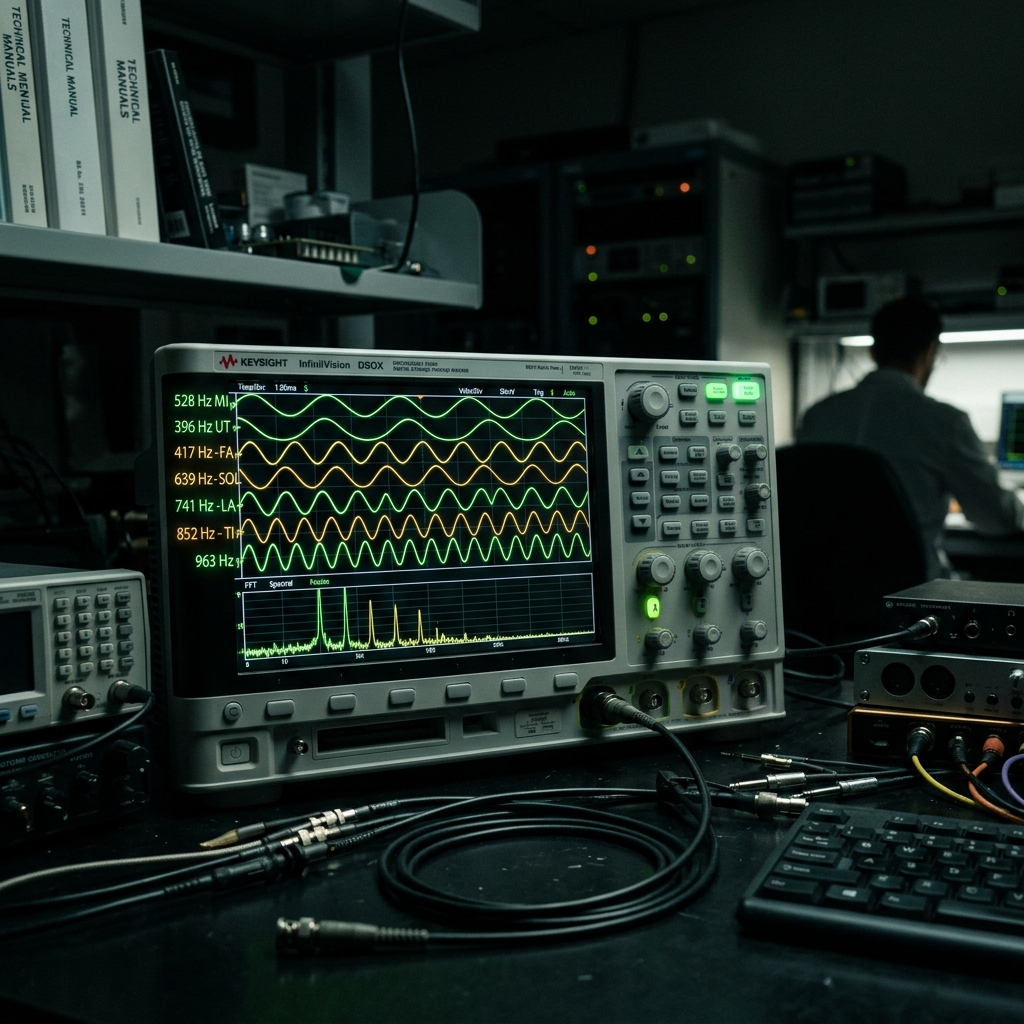
Solfeggio frequencies produce measurable effects on the autonomic nervous system through the frequency-following response (FFR). Research by Akimoto et al. (2018) found significant cortisol reduction from 528 Hz exposure. Effects are real but modest — nervous system regulation, not cellular healing. Claims about DNA repair are not clinically supported.
The question behind the question
"Do solfeggio frequencies work?" is a question that contains several more specific questions: Work for what? Compared to what? By what mechanism? With what kind of evidence?
The wellness industry tends to collapse all of these into a single claim: yes, they work, they heal everything, here is the frequency for each condition. The skeptic community tends to collapse them in the opposite direction: no evidence, therefore placebo, therefore useless. Both positions are inaccurate. The honest answer requires distinguishing between what is well-supported, what is plausible but unproven, and what is simply invented.
What is well-supported
The frequency-following response (FFR) is real. When the auditory system receives a consistent, sustained acoustic stimulus, the brain tends to synchronise its neural oscillations with the frequency of that stimulus. This is documented in peer-reviewed research going back to Hink et al. (1980) and extensively studied at Northwestern University by Kraus and Nicol (2005). The mechanism is not contested.
Sustained acoustic stimuli influence the autonomic nervous system. Research on acoustic entrainment consistently shows effects on heart rate variability, cortisol levels, and the sympathetic/parasympathetic balance. These effects are not large enough to replace medical intervention but they are measurable and reproducible.
528 Hz specifically reduces cortisol in humans. Akimoto et al. (2018) conducted a study on human subjects (not in vitro) finding significant cortisol reduction after five minutes of 528 Hz music exposure compared to control. This is the strongest direct evidence for a specific solfeggio frequency effect in a human population.
What is plausible but not yet clinically proven
Specific frequencies for specific emotional states. The associations between particular frequencies and particular psychological states (396 Hz for anxiety, 417 Hz for clearing, 852 Hz for intuition) are consistent with acoustic theory and reported practitioner experience. They have not been tested in randomised controlled trials with those specific frequencies. The general mechanism that would support these effects is established; the frequency-specific version is extrapolated.
Long-term baseline shifts from consistent use. The research on brainwave entrainment suggests that consistent practice over weeks produces more durable physiological changes than single sessions. The long-term effect of regular solfeggio use on the autonomic baseline has not been studied directly, but it is consistent with what the general entrainment literature would predict.
What is not supported
DNA repair. The claim that 528 Hz repairs DNA originates from Rein's in-vitro research — isolated DNA in a test tube, not living human cells. The leap from that finding to "listening through headphones repairs your DNA" is not supported.
Pineal gland activation. The claim that 963 Hz activates or "decalcifies" the pineal gland has no clinical research support. The pineal gland responds to light via the retinohypothalamic tract — it is not known to respond to audio frequencies in the manner claimed.
Cellular healing and organ repair. The specific organ-level healing claims attached to individual frequencies (285 Hz "restructures damaged cellular fields", 741 Hz "cleanses cells of electromagnetic radiation") are not supported by any clinical research.
Frequencies as a substitute for medical treatment. Solfeggio frequencies are a tool for nervous system regulation and acoustic environment management. They are not a treatment for any medical condition.
The honest answer to "do they work?"
Yes — within the limits of what "work" actually means in this context.
Solfeggio frequencies produce measurable effects on the nervous system through a documented mechanism. Those effects are real but modest: shifts in autonomic tone, reductions in cortisol, changes in the subjective quality of attention and rest. They are more accurately described as tools for nervous system regulation than as healing technologies.
The value of using them honestly — with accurate expectations — is higher than using them with inflated ones. Someone who expects cortisol reduction and a quieter nervous system baseline will find that solfeggio frequencies consistently deliver. Someone who expects DNA repair will be disappointed, and will probably dismiss the genuine effects along with the fictional ones.
The placebo question
A common objection: "Isn't this just placebo?" The objection deserves a direct answer. Placebo effects are real physiological effects — they involve genuine changes in neurochemistry, immune function, and pain perception. "It's placebo" is not a dismissal; it is a description of one possible mechanism.
However, the FFR operates at the brainstem level — below the threshold of conscious processing. Acoustic entrainment does not require belief in the mechanism to function. Studies on infants and animals (who cannot engage in expectation-based placebo responses) show acoustic entrainment effects. This does not eliminate the contribution of expectation in human studies, but it does suggest the mechanism is not purely expectation-dependent.
The honest position: both the direct acoustic mechanism and the expectation effect probably contribute to the outcomes people experience. Disentangling them precisely would require blinded trials where participants do not know whether they are receiving an active frequency or a control — which is technically possible but rarely done with solfeggio frequencies specifically.
How to use solfeggio frequencies with accurate expectations
- Use them for nervous system regulation, not healing. The strongest evidence supports effects on cortisol, HRV, and autonomic tone. These are worth having — they affect mood, sleep quality, stress resilience, and cognitive function. They do not cure disease.
- Consistent use matters more than any single session. The cumulative effect of daily 10–20 minute sessions over weeks is where the baseline shift becomes meaningful. A single session produces a temporary effect; consistent practice produces a durable one.
- Precision matters. The FFR mechanism depends on a stable, consistent acoustic signal. If the app you are using does not deliver the stated frequency precisely, the entrainment effect is degraded. Solfeggio Sanctuary uses Google's Oboe audio library for 32-bit floating-point precision — the frequency you set is the frequency delivered.
- Start with 396 Hz or 417 Hz. These are the most broadly applicable frequencies for general nervous system regulation. The most dramatic claims are attached to 528 Hz and 963 Hz — the frequencies at the extremes of the marketing spectrum. The most reliable effects for most people come from the mid-lower range.
Related articles
- What Are Solfeggio Frequencies? The Science Behind the Scale
- 528 Hz Benefits: What the Research Actually Says
- 396 Hz for Anxiety: How This Frequency Affects the Nervous System
- 174 Hz to 963 Hz: A Complete Guide
Try it with accurate expectations
Solfeggio Sanctuary gives you all 9 frequencies free. Ten minutes a day for a week is enough to form your own assessment.
Scientific references
- Hink, R.F. et al. (1980). Phase-locked time domain analysis of the auditory frequency-following response. Audiology, 19(1), 1–14.
- Kraus, N. & Nicol, T. (2005). Brainstem origins for cortical 'what' and 'where' pathways. Trends in Neurosciences, 28(4), 176–181.
- Akimoto, K. et al. (2018). Effect of 528 Hz music on the endocrine system and autonomic nervous system. Health, 10(9), 1199–1209.
- Rein, G. (1998). Effect of conscious intention on human DNA. Proceedings of the International Forum on New Science.
- Huang, T.L. & Charyton, C. (2008). A comprehensive review of the psychological effects of brainwave entrainment. Alternative Therapies in Health and Medicine, 14(5), 38–50.