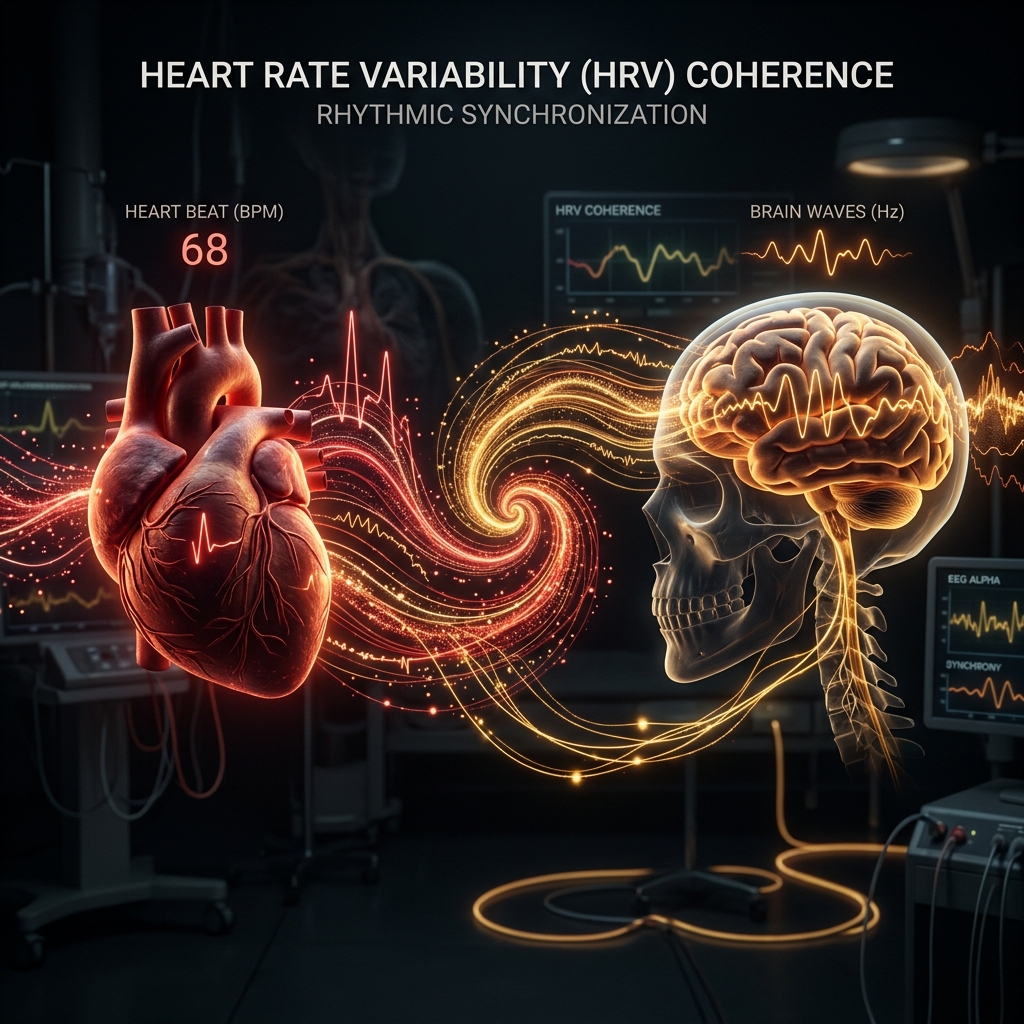
Heart rate variability: the basis
Heart rate variability (HRV) is the variation in time between consecutive heartbeats. A healthy heart does not beat with metronomic regularity — the interval between beats fluctuates continuously, accelerating slightly on the inhale and decelerating slightly on the exhale. This variation is not noise in the system. It is a signal of the system's adaptability.
High HRV — large variability between beats — indicates a nervous system with strong adaptive capacity: able to shift between sympathetic and parasympathetic modes quickly and efficiently. Low HRV indicates a nervous system with reduced flexibility — often stuck in sympathetic dominance. Chronic low HRV is associated with cardiovascular disease, depression, anxiety, and reduced cognitive performance.
HRV is measured in milliseconds. Modern wearables (Oura, Garmin, Apple Watch) provide daily HRV averages. The clinical gold standard remains ECG-based measurement in controlled conditions, but consumer-grade HRV monitoring is now accurate enough for practical self-monitoring.
What cardiac coherence is
Cardiac coherence is a specific pattern of HRV — not just high variability, but variability with a particular rhythmic character. In the coherence state, the heart rate accelerates and decelerates in a smooth, regular, sine-wave-like oscillation, typically at a rate of 0.1 Hz (one cycle every 10 seconds). This pattern reflects the synchronisation of the heart, the respiratory system, and the vascular system into a single, coordinated rhythm.
The HeartMath Institute, a research organisation founded in 1991 in Boulder Creek, California, has produced the most extensive body of research on cardiac coherence. Their work — begun by McCraty, Atkinson, and Tiller in the early 1990s and continuing through decades of clinical and laboratory studies — established cardiac coherence as a distinct physiological state with measurable cognitive, emotional, and behavioural correlates.
Erratic, irregular. Sympathetic dominance. Cortisol elevated. Cognitive narrowing.
Smooth, rhythmic. Parasympathetic tone. Cortisol normalised. Broad cognitive access.
What cardiac coherence produces — the research findings
The HeartMath research programme has documented a consistent set of correlates with the cardiac coherence state. The key findings across two decades of work:
McCraty, Atkinson & Tiller (1995) — The effects of emotions on short-term power spectrum analysis of heart rate variability. American Journal of Cardiology, 76(14), 1089–1093. Foundational paper establishing the link between emotional state and HRV pattern. Positive emotions produce the coherence pattern; negative emotions produce incoherence.
McCraty et al. (1998) — The impact of a new emotional self-management program on stress, emotions, heart rate variability, DHEA, and cortisol. Integrative Physiological and Behavioral Science, 33(2), 151–170. Found that coherence training produced significant reductions in cortisol and significant increases in DHEA — a counter-regulatory hormone. The ratio shift suggests a sustained change in the stress-recovery balance.
McCraty & Shaffer (2015) — Heart rate variability: New perspectives on physiological mechanisms, assessment of self-regulatory capacity, and health risk. Global Advances in Health and Medicine, 4(1), 46–61. Comprehensive review establishing cardiac coherence as a measure of self-regulatory capacity — the brain's ability to modulate its own emotional and cognitive processing.
Thayer & Lane (2009) — Claude Bernard and the heart-brain connection: Further elaboration of a model of neurovisceral integration. Neuroscience & Biobehavioral Reviews, 33(2), 81–88. Established the bidirectional heart-brain communication pathway: the heart's HRV pattern directly influences prefrontal cortex function.
The heart-brain connection
The most significant finding in the HeartMath research — and the one most relevant to understanding internal coherence — is the discovery that the heart is not simply a pump responding to brain signals. It is a bidirectional communicator.
The heart sends more neural signals to the brain than the brain sends to the heart. The vagus nerve, the primary conduit of this communication, carries information about the heart's rhythm directly to the brainstem and from there to the cortex. The HRV pattern — ordered or disordered — influences the brain's processing before conscious awareness has time to intervene.
When the heart is in a coherent pattern, it sends a smooth, ordered signal to the brainstem. This signal propagates to the prefrontal cortex, enhancing its regulatory function — its ability to moderate the amygdala's threat responses, broaden attentional scope, and support deliberate decision-making. When the heart is incoherent, it sends a disordered signal that has the opposite effect: amygdala dominance increases, prefrontal regulation decreases, cognitive narrowing follows.
This is the physiological mechanism behind what practitioners experience as "thinking clearly under pressure" or its absence. It is not a matter of willpower. It is a matter of what signal the heart is sending to the prefrontal cortex at the moment of the demand.
Cardiac coherence and internal coherence
The connection to the internal coherence concept — explored in depth in Faith as a Human Function — is direct. What the Gospel texts describe as faith in its operational sense, and what the HeartMath research measures as cardiac coherence, are descriptions of the same physiological state from different angles and different centuries.
The state in which thought, emotion, and body are aligned — in which the nervous system is not running a counter-narrative to conscious intent — is precisely the state of cardiac coherence. The heart-brain signal is ordered. The prefrontal cortex is operating without amygdala interference. Resources deploy toward action rather than toward self-opposition.
This is not a metaphor. It is a measurable physiological condition with documented behavioural consequences. The alignment described in the Gospels as faith, in Csikszentmihalyi's research as flow, and in the HeartMath data as cardiac coherence — these are the same state, named in different languages, arrived at through different paths of inquiry.
How to access the coherence state
The HeartMath research identifies several reliable entry points:
- Rhythmic breathing at 0.1 Hz. A 5-second inhale and 5-second exhale — ten breaths per minute — is the respiratory rate that most reliably produces cardiac coherence. The heart follows the breath's rhythm. Within 90 seconds of beginning this pattern, measurable coherence typically appears in the HRV trace.
- Heart-focused attention. Directing attention to the area of the heart — not analysing it, just placing attention there — has been shown to enhance the coherence response. The mechanism is likely related to the afferent vagal pathway that connects heart sensation to brainstem regulation.
- Positive affect without forcing. The coherence state is associated with genuine positive affect — appreciation, care, calm. Forced positive thinking produces a different HRV pattern from genuine coherence. The distinction matters: coherence requires actual physiological alignment, not cognitive performance of a positive state.
- Acoustic entrainment. Solfeggio frequencies and binaural beats — through the frequency-following response — support the parasympathetic activation that is a prerequisite for cardiac coherence. They address the autonomic baseline from the acoustic pathway, reducing the sympathetic dominance that prevents coherence from establishing. See the Morning Frequency Protocol for a combined approach.
Related articles
- What Is Internal Coherence? The Neuroscience of Belief and Action
- Why Positive Thinking Fails — And What Actually Works
- Fear Is Faith Applied Negatively: The Neurophysiology
- 396 Hz for Anxiety: How This Frequency Affects the Nervous System
The full argument — in one book
Faith as a Human Function traces the historical and neurophysiological case for internal coherence as the original operational meaning of faith. $4.99 on Amazon.
Scientific references
- McCraty, R., Atkinson, M. & Tiller, W.A. (1995). The effects of emotions on short-term power spectrum analysis of heart rate variability. The American Journal of Cardiology, 76(14), 1089–1093.
- McCraty, R. et al. (1998). The impact of a new emotional self-management program on stress, emotions, heart rate variability, DHEA and cortisol. Integrative Physiological and Behavioral Science, 33(2), 151–170.
- Thayer, J.F. & Lane, R.D. (2009). Claude Bernard and the heart-brain connection. Neuroscience & Biobehavioral Reviews, 33(2), 81–88.
- McCraty, R. & Shaffer, F. (2015). Heart rate variability: New perspectives on physiological mechanisms, assessment of self-regulatory capacity, and health risk. Global Advances in Health and Medicine, 4(1), 46–61.
- Csikszentmihalyi, M. (1990). Flow: The Psychology of Optimal Experience. Harper & Row.