The brainwave band boundaries are narrow
The five brainwave bands are defined by specific frequency ranges. The boundaries between them are meaningful — crossing from one band into another is crossing from one cognitive state into a different one. Here are the ranges, with their boundaries made explicit:
| Band | Frequency Range | Primary State |
|---|---|---|
| Delta | 0.9 – 4 Hz | Deep sleep, recovery |
| Theta | 5 – 7.83 Hz | Meditation, memory |
| Alpha | 8 – 13 Hz | Relaxed awareness |
| Beta | 14 – 27 Hz | Active focus |
| Gamma | 33 – 50 Hz | Peak performance |
Notice the gaps at the boundaries. 4.1 Hz is not Delta — it is low Theta. 13.2 Hz is not Alpha — it is low Beta. 7.9 Hz sits right at the Theta-Alpha boundary. If you are targeting deep meditation with a 7 Hz Theta session, and the app delivers 7.5 Hz, you are getting mid-Theta rather than deep Theta. If it delivers 8.2 Hz, you are in Alpha — a meaningfully different state.
A frequency drift of less than 1 Hz can move you across a band boundary entirely. This is not a theoretical concern about decimal precision. It is the difference between the state you are targeting and a different state.
How frequency drift happens in audio apps
Digital audio processing introduces several sources of frequency error. The most common in mobile apps are:
- Floating-point precision. Audio frequency generation involves continuous mathematical computation. If the computation uses single-precision floating-point arithmetic (32-bit) or less, rounding errors accumulate over time and the output frequency drifts from the target. The drift is small per cycle but compounding over a 20-minute session.
- Audio buffer management. Mobile operating systems share audio processing resources between apps. When the system is under load — other apps running, notifications arriving — the audio buffer may be interrupted and restarted. Each restart introduces a potential phase discontinuity and frequency micro-drift.
- Hardware latency variation. The time between a sound being generated by software and reaching the hardware speaker or headphone output varies with device state. Variable latency produces variable effective frequency in time-sensitive applications.
- Compression artifacts. If the app streams pre-recorded audio files rather than generating tones in real time, lossy audio compression (MP3, AAC) introduces harmonic distortion. The stated frequency is correct; the delivered sound contains additional unwanted harmonics.
What the Oboe audio library provides
Google's Oboe audio library is a C++ library designed specifically for low-latency, high-precision audio on Android. It was developed for professional audio production applications — games requiring frame-perfect audio synchronisation, music production apps, real-time DSP — where audio imprecision produces audible artifacts.
For binaural beat generation, the relevant properties of Oboe are:
| Specification | Implementation Detail |
|---|---|
| Processing precision | 32-bit floating-point signal processing — the highest available on consumer hardware |
| Latency | Low-latency audio path — bypasses Android's standard audio mixer, which introduces variable latency |
| Buffer management | Direct hardware buffer access — reduces interruption-related frequency discontinuities |
| Generation method | Real-time tone synthesis — no pre-recorded files, no compression artifacts, no approximation |
| Frequency accuracy | The frequency generated is the frequency delivered, for the full duration of the session |
Both Binaural Therapy and Solfeggio Sanctuary are built on Oboe. The practical consequence: when you set 6 Hz Theta, the brain receives a 6 Hz binaural differential. When you set 528 Hz, the nervous system receives 528 Hz. Not 527.8 Hz. Not a drifting approximation.
How to evaluate any binaural beat app
Most apps do not publish their audio engine specifications. There are a few practical evaluation methods:
- Check if the app uses real-time synthesis or pre-recorded files. Apps that offer a frequency slider — where you can set a specific Hz value — are more likely to be generating tones in real time. Apps that offer only preset tracks are likely streaming pre-recorded audio with the precision limitations that implies.
- Look for the audio engine in the app description. "Powered by Oboe" or "built with Google Oboe" is a specific, verifiable claim. Vague claims about "studio quality" or "scientifically calibrated frequencies" are marketing language, not technical specifications.
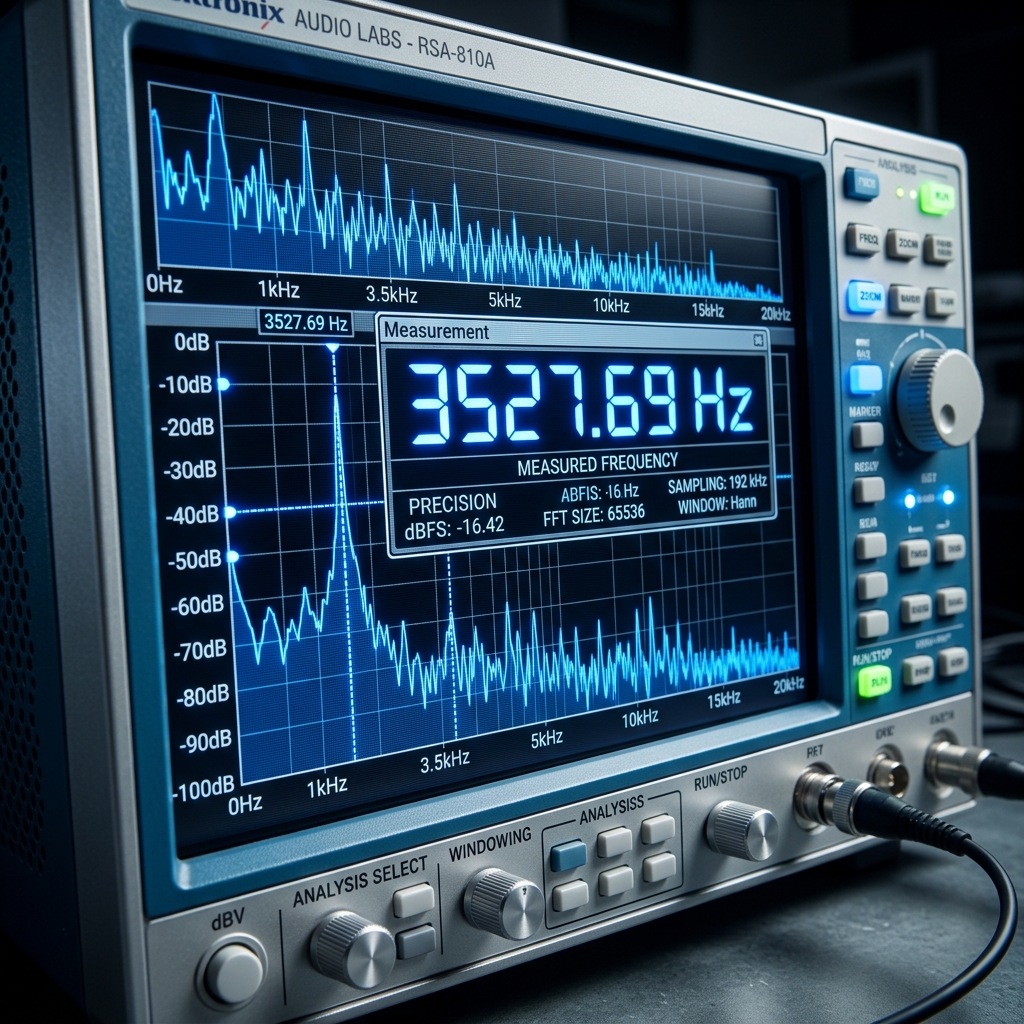
- Test with a spectrum analyser. Free spectrum analyser apps (Spectroid, Spectral) will show you the actual output frequency of any audio playing through your phone. If an app claims to play 10 Hz binaural beats, you should see two closely spaced peaks in the carrier frequency range (e.g., 200 Hz and 210 Hz for a 10 Hz beat) in the spectrum analyser. If those peaks are drifting or imprecisely positioned, the app is not delivering what it claims.
Why this matters for solfeggio frequencies too
The precision argument applies equally to solfeggio frequencies. 528 Hz is at a mathematically distinct point in the harmonic series. 527.6 Hz is a slightly mistuned tone. The frequency-following response that makes solfeggio frequencies effective depends on the nervous system receiving a stable, consistent signal. A drifting or imprecise signal does not provide the consistent stimulus the FFR requires.
This is the core acoustic argument for precision — not precision for its own sake, but precision as the technical requirement for the mechanism to function as intended.
Related articles
- Binaural Beats: How They Work and What the Research Says
- Delta, Theta, Alpha, Beta, Gamma: A Complete Guide
- What Are Solfeggio Frequencies? The Science Behind the Scale
- Binaural Beats vs. Solfeggio Frequencies: Which Should You Use?
Built on Oboe. Mathematically exact.
Both Mental Harmony apps generate frequencies with 32-bit floating-point precision on Google's Oboe library. The Hz you set is the Hz delivered.
Scientific references
- Oster, G. (1973). Auditory beats in the brain. Scientific American, 229(4), 94–102.
- Hink, R.F. et al. (1980). Phase-locked time domain analysis of the auditory frequency-following response. Audiology, 19(1), 1–14.
- Wahbeh, H., Calabrese, C. & Zwickey, H. (2007). Binaural beat technology in humans: A pilot study to assess neuropsychologic, physiologic, and electroencephalographic effects. Journal of Alternative and Complementary Medicine, 13(2), 199–206.
- Google LLC (2022). Oboe audio library documentation. Android Open Source Project. Developer technical reference.