Anxiety as a physiological state
Anxiety is not primarily a thought problem. It is a physiological state — a sustained activation of the sympathetic nervous system characterised by elevated cortisol, increased heart rate, shallow and rapid breathing, muscle tension, and a narrowing of attentional focus. These are the outputs of the threat-detection system doing exactly what it is designed to do.
The difficulty is that in the modern environment, the threat-detection system is often activated by inputs that are not life-threatening — deadlines, social pressure, uncertainty, ambient digital stimuli — and it does not automatically de-activate when those inputs are removed. The nervous system remains in sympathetic dominance: alert, defensive, consuming resources, producing the physiological signature we experience as anxiety.
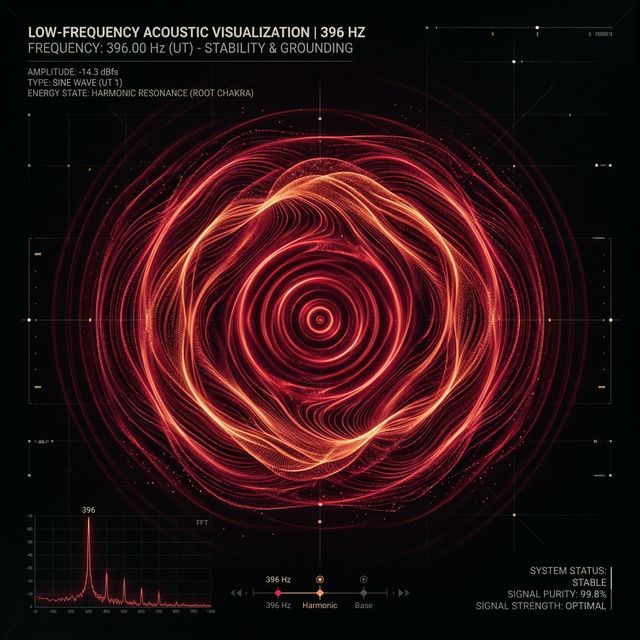
Addressing anxiety at the cognitive level — telling yourself to calm down, reframing the situation, practicing gratitude — works partially and temporarily, because it addresses the interpretation layer while leaving the physiological substrate unchanged. A more direct approach targets the physiological state itself. 396 Hz is one of the most consistent acoustic tools for doing that.
The mechanism: sympathetic to parasympathetic
The autonomic nervous system has two branches: the sympathetic (mobilisation, threat response, cortisol release) and the parasympathetic (recovery, digestion, HRV coherence). These are not simply on/off switches — they exist in dynamic balance, with each branch modulating the other continuously.
The key variable in anxiety is sympathetic dominance: the sympathetic branch is running too high relative to parasympathetic tone. The physiological target for anxiety relief is not eliminating sympathetic activity — it is restoring the balance by increasing parasympathetic tone. When parasympathetic activity rises, heart rate decreases, breathing deepens, muscle tension releases, cortisol begins to normalise, and the subjective experience of anxiety diminishes.
Consistent acoustic stimuli in the low-to-mid frequency range — particularly those that interact with the frequency-following response (FFR) — support a shift toward parasympathetic dominance. 396 Hz sits in this range. Its acoustic character — warm, low-mid, with a settling quality — creates an acoustic environment that the nervous system tends to read as non-threatening. Sustained exposure supports the parasympathetic shift that symptomatic anxiety requires.
Hink et al. (1980) / Kraus & Nicol (2005) — Foundational frequency-following response research. Establishes the mechanism by which sustained acoustic stimuli influence neural oscillation patterns — the basis for 396 Hz's effect on the nervous system. See What Are Solfeggio Frequencies? for the full mechanism.
Padmanabhan, Hildreth & Laws (2005) — Double-blind RCT demonstrating that acoustic frequency exposure significantly reduces anxiety in pre-operative patients. Though using binaural Delta frequencies rather than solfeggio, the study confirms that acoustic stimuli can produce clinically measurable anxiety reduction. Anaesthesia, 60(9), 874–877.
Akimoto et al. (2018) — Study on 528 Hz and cortisol reduction. Relevant here because the cortisol-reduction mechanism identified — acoustic stimuli influencing the endocrine and autonomic systems — applies across the solfeggio range, not exclusively to 528 Hz.
396 Hz vs. other solfeggio frequencies for anxiety
Within the solfeggio scale, 396 Hz is the most grounding frequency. Here is how it compares to the two most closely related options:
Primary anxiety frequency. Grounding, settling, releasing quality. Use when the primary experience is anxiety, fear, or a sense of being unable to release accumulated tension.
Sub-bass range. More physically anchoring than 396 Hz — felt in the body as much as heard. Use when anxiety has a strong somatic component: physical tension, agitation in the chest or stomach, restlessness.
Slightly higher than 396 Hz, with a more forward, clearing quality. Use when anxiety is accompanied by stuckness — the sense of being unable to move forward or release a pattern. Closer to action than grounding.
How to use 396 Hz for anxiety: practical protocol
- Session timing. The most effective window for acute anxiety is the moment you notice the state — not after it has built for an hour. A 10-minute session when anxiety first becomes noticeable is more effective than a 30-minute session after the state has entrenched. Use it as an early intervention, not a last resort.
- Posture and environment. Sit or lie down in a position where the body can release muscle tension without effort. A chair with back support, a floor or mat, or lying flat. The frequency does not work against physical bracing — it works better when the body is given permission to soften.
- Headphones or speakers. Unlike binaural beats, 396 Hz does not require headphones — the frequency is the same in both ears. A phone speaker at low-to-medium volume works. However, headphones reduce external stimuli and create a more focused acoustic environment, which tends to deepen the effect.
- Session length. A minimum of 10 minutes for the frequency-following response to establish. 20 minutes is more effective for chronic or entrenched anxiety states. The free version of Solfeggio Sanctuary provides 10-minute sessions across all 9 frequencies.
- Layer instruments deliberately. Start with the pure tone as the foundational signal. Add a tuning fork layer if you want to enrich the harmonic environment. For the Pro version: the Tibetan bowl adds a complex overtone series that extends the acoustic field beyond the single frequency — useful for deeper or more persistent anxiety states.
- After the session. Do not immediately re-engage with whatever triggered the anxiety. Allow 5 minutes of quiet before returning to the situation. The post-session window is when the physiological shift consolidates.
What 396 Hz does not do
It does not eliminate the source of anxiety. If the anxiety is a response to a genuine ongoing situation — a relationship conflict, financial pressure, a health concern — a frequency session does not resolve that situation. What it does is change the physiological state from which you approach the situation: from sympathetic dominance (defensive, reactive, narrowed) to a more balanced autonomic baseline (broader, more regulated, more capable of deliberate response).
For clinical anxiety disorders — generalised anxiety disorder, panic disorder, PTSD — acoustic tools are a complement to professional treatment, not a substitute. If anxiety is significantly impairing daily functioning, the appropriate primary intervention is clinical.
Combining 396 Hz with binaural beats
For a more layered approach to anxiety reduction, Binaural Therapy at Alpha (10 Hz) or low Theta (6–7 Hz) can run simultaneously. The Alpha state supports parasympathetic dominance through the brainwave entrainment mechanism. 396 Hz through the room plus Alpha binaural through earbuds creates a dual-mechanism approach: the solfeggio frequency addressing the autonomic baseline directly, the binaural beat influencing the brainwave state from the entrainment pathway.
Related articles
- What Are Solfeggio Frequencies? The Science Behind the Scale
- 528 Hz Benefits: What the Research Actually Says
- Binaural Beats for Anxiety: What the Clinical Trials Show
- The Morning Frequency Protocol
- What Is Internal Coherence? The Neuroscience of Belief and Action
396 Hz — free in the app
Solfeggio Sanctuary gives you 396 Hz and all 8 other frequencies. Free download, no subscription. Pro adds Tibetan and crystal bowls and extends sessions to 60 minutes.
Scientific references
- Hink, R.F. et al. (1980). Phase-locked time domain analysis of the auditory frequency-following response. Audiology, 19(1), 1–14.
- Kraus, N. & Nicol, T. (2005). Brainstem origins for cortical 'what' and 'where' pathways. Trends in Neurosciences, 28(4), 176–181.
- Padmanabhan, R., Hildreth, A.J. & Laws, D. (2005). A prospective, randomised, controlled study examining binaural beat audio and pre-operative anxiety. Anaesthesia, 60(9), 874–877.
- Akimoto, K. et al. (2018). Effect of 528 Hz music on the endocrine system and autonomic nervous system. Health, 10(9), 1199–1209.
- McCraty, R. & Shaffer, F. (2015). Heart rate variability: New perspectives on physiological mechanisms. Global Advances in Health and Medicine, 4(1), 46–61.