The problem with thinking your way to change
Here is the standard self-improvement loop: identify a desired outcome, build the belief that you can achieve it, repeat affirmations or visualisations that reinforce that belief, and expect behaviour to shift accordingly. For many people, it does not work — or it works briefly and then erodes.
The reason is structural. The cognitive layer — the part of you that can formulate intentions, repeat affirmations, and consciously believe things — operates on top of a physiological substrate that runs its own assessment independently. If that substrate is signalling threat, scarcity, or past failure through elevated cortisol, disrupted heart rate variability, and defensive muscle tone, the cognitive layer's affirmations are running against the grain of the system.
This is not a motivational problem. It is an architecture problem. The solution is not more willpower at the cognitive level. It is coherence at the physiological level — the state in which the body, the emotional system, and the mind are all pointed in the same direction. When that alignment is present, effortful self-regulation decreases. Behaviour changes not by force but by the removal of internal friction.
What internal coherence is — the physiology
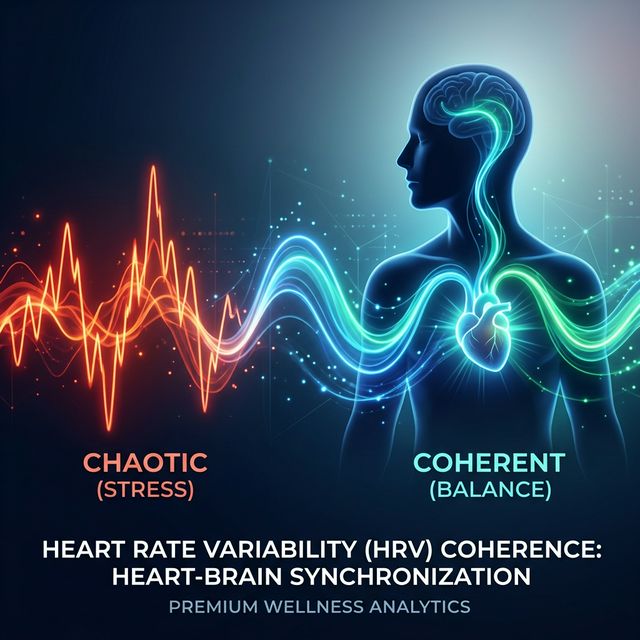
Internal coherence has a measurable physiological signature. The most robust metric is heart rate variability (HRV) — specifically the pattern of variation between heartbeats. A high-coherence state is characterised by a smooth, rhythmic HRV pattern: the heart accelerates slightly on the inhale and decelerates slightly on the exhale, in a regular, wave-like oscillation. This pattern — called cardiac coherence — reflects the synchronisation of the autonomic nervous system, the respiratory system, and the vascular system into a single, coordinated rhythm.
The HeartMath Institute has produced the most systematic body of research on cardiac coherence, beginning with McCraty et al. (1995) and extending through two decades of clinical and laboratory work. Their findings consistently show that the cardiac coherence state is associated with: reduced cortisol, increased DHEA (a counter-regulatory hormone to cortisol), improved cognitive performance, reduced anxiety, and — critically — a measurable influence on the activity of the brain's prefrontal cortex, the region most associated with executive function, long-range planning, and the inhibition of fear responses.
In a coherent state, the prefrontal cortex receives clearer input from the body and exerts greater regulatory influence over the amygdala — the brain's threat-detection centre. In an incoherent state (high stress, low HRV), the amygdala dominates: threat signals override the prefrontal cortex's moderating influence. This is the physiological basis for the well-documented phenomenon of stress-induced cognitive narrowing — the inability to think clearly under pressure.
- HRV pattern: erratic, irregular
- Cortisol: elevated
- Amygdala: dominant
- Prefrontal cortex: suppressed
- Cognitive range: narrow, reactive
- Behaviour: defensive, effortful
- HRV pattern: smooth, rhythmic
- Cortisol: normalised
- Amygdala: modulated
- Prefrontal cortex: active
- Cognitive range: broad, flexible
- Behaviour: directed, unforced
Coherence and the concept of faith
The word faith has been so thoroughly absorbed into religious and motivational language that its original operational meaning has become almost inaccessible. But the primary texts that first used the word in a technical sense were describing something very specific — and it maps precisely onto the coherence state.
The Gospel phrase that appears most consistently — in Matthew, Mark, Luke, and John — is variants of "according to your faith, let it be done to you." This is not a theological statement about the virtue of belief. It is a proportional statement about a mechanism: the outcome corresponds to the internal state. The text describes faith not as an opinion held about something absent, but as a state of complete internal alignment with an accepted reality. The body is not signalling threat. The nervous system is not running a counter-narrative. Resources are deploying toward the accepted outcome rather than defending against a feared one.
That is the coherence state. What the Gospels called faith, the HeartMath Institute calls cardiac coherence, and Csikszentmihalyi documented as flow. The language changes across two thousand years and across disciplines. The phenomenon is the same.
McCraty, Atkinson & Tiller (1995) — The effects of emotions on short-term power spectrum analysis of heart rate variability. The American Journal of Cardiology, 76(14), 1089–1093. Foundational study establishing the link between emotional state and HRV coherence pattern.
Csikszentmihalyi, M. (1990) — Flow: The Psychology of Optimal Experience. Harper & Row. Documents the state of absorbed, effortless high performance — characterised by the absence of self-monitoring, internal conflict, and effort. What Csikszentmihalyi called flow is physiologically a coherence state.
Childre & McCraty (2001) — Psychophysiological correlates of spiritual experience. Biofeedback, 29(4), 13–17. Links cardiac coherence to states commonly described in spiritual traditions as faith, presence, or grace.
Why positive thinking fails to produce coherence
Positive thinking as typically practised — repeating affirmations, visualising desired outcomes, cultivating optimistic beliefs — operates entirely at the cognitive layer. It asks the mind to assert something the body has not accepted. The result is not coherence. It is a new form of internal conflict: the mind saying one thing while the nervous system signals another.
The friction is not a sign of insufficient effort. It is the system accurately reporting that alignment has not been achieved. Forcing the mind to believe something the body contradicts does not resolve the contradiction — it adds cognitive load to a system already spending resources on self-opposition.
Internal coherence is not achieved by insisting on a different belief. It is achieved by reducing the signals of threat and opposition at the physiological level — which changes the information the body sends to the brain, which in turn changes the cognitive and emotional processing that is possible. The direction of change is bottom-up, not top-down. This is covered in depth in Why Positive Thinking Fails — And What Actually Works.
How to build coherence deliberately
The HeartMath research identifies several reliable entrances to the cardiac coherence state. They share a common feature: they all shift the input signal the heart sends to the brain before attempting to change the content of thought.
- Rhythmic breathing. A 5-second inhale and 5-second exhale — the pattern that produces the strongest cardiac coherence response — directly entrains the heart's rhythm into the smooth wave-like pattern characteristic of coherence. The effect is measurable within 90 seconds. This is not metaphor. It is the autonomic nervous system responding to a consistent mechanical input.
- Acoustic entrainment. Consistent, precise acoustic stimuli — solfeggio frequencies and binaural beats — create a frequency-following response in the nervous system that supports a shift toward parasympathetic dominance. Parasympathetic activation is the physiological prerequisite for cardiac coherence. The two tools are complementary: sound establishes the baseline state, breathing deepens it.
- Attention placed on physiological sensation, not narrative. The default mode network — the brain's self-referential processing system — maintains the internal conflict that prevents coherence. Directing attention to physical sensation (breath, heartbeat, body contact with the chair) reduces DMN activity and creates the space in which coherence can establish.
- Acceptance of the present state as the starting point. Coherence does not require that you pretend the current reality is different from what it is. It requires that you stop spending resources opposing it. The practical entry point is acknowledging the current state completely — without narrative, without judgment — and allowing the physiological baseline to reset from there.
The connection to the book
Faith as a Human Function traces the full history of how the operational meaning of internal coherence — the state the Gospel texts described as faith — was systematically replaced over seventeen hundred years of institutional history with a set of doctrinal propositions requiring assent rather than a physiological state requiring cultivation.
The book covers Constantine's absorption of Christianity into imperial power (313 AD), the Council of Nicaea's standardisation of doctrine (325 AD), and the medieval illiteracy that locked the original texts away from ordinary access for centuries. It then translates the recovered mechanism into modern language — the neuroscience, the HRV research, the psychology of flow — and provides the practical framework for using it without religion, without self-help framing, and without the need for any intermediary between the individual and the state.
Related articles in this series
- Why Positive Thinking Fails — And What Actually Works
- Fear Is Faith Applied Negatively: The Neurophysiology
- Overcoming Cognitive Dissonance: The Path to Internal Coherence
- What Is Cardiac Coherence? The HeartMath Research Explained
- How Constantine Changed the Meaning of Faith
- The Gospel Texts on Faith: Reading Them as Operating Instructions
The full history and mechanism — in one book
Faith as a Human Function traces how the concept of internal coherence was buried for 1,700 years and restores it as a practical tool. No religion required. $4.99 on Amazon.
Scientific references
- McCraty, R., Atkinson, M. & Tiller, W.A. (1995). The effects of emotions on short-term power spectrum analysis of heart rate variability. The American Journal of Cardiology, 76(14), 1089–1093.
- Csikszentmihalyi, M. (1990). Flow: The Psychology of Optimal Experience. Harper & Row.
- Childre, D. & McCraty, R. (2001). Psychophysiological correlates of spiritual experience. Biofeedback, 29(4), 13–17.
- McCraty, R. & Shaffer, F. (2015). Heart rate variability: New perspectives on physiological mechanisms, assessment of self-regulatory capacity, and health risk. Global Advances in Health and Medicine, 4(1), 46–61.
- Thayer, J.F. & Lane, R.D. (2009). Claude Bernard and the heart-brain connection: Further elaboration of a model of neurovisceral integration. Neuroscience & Biobehavioral Reviews, 33(2), 81–88.