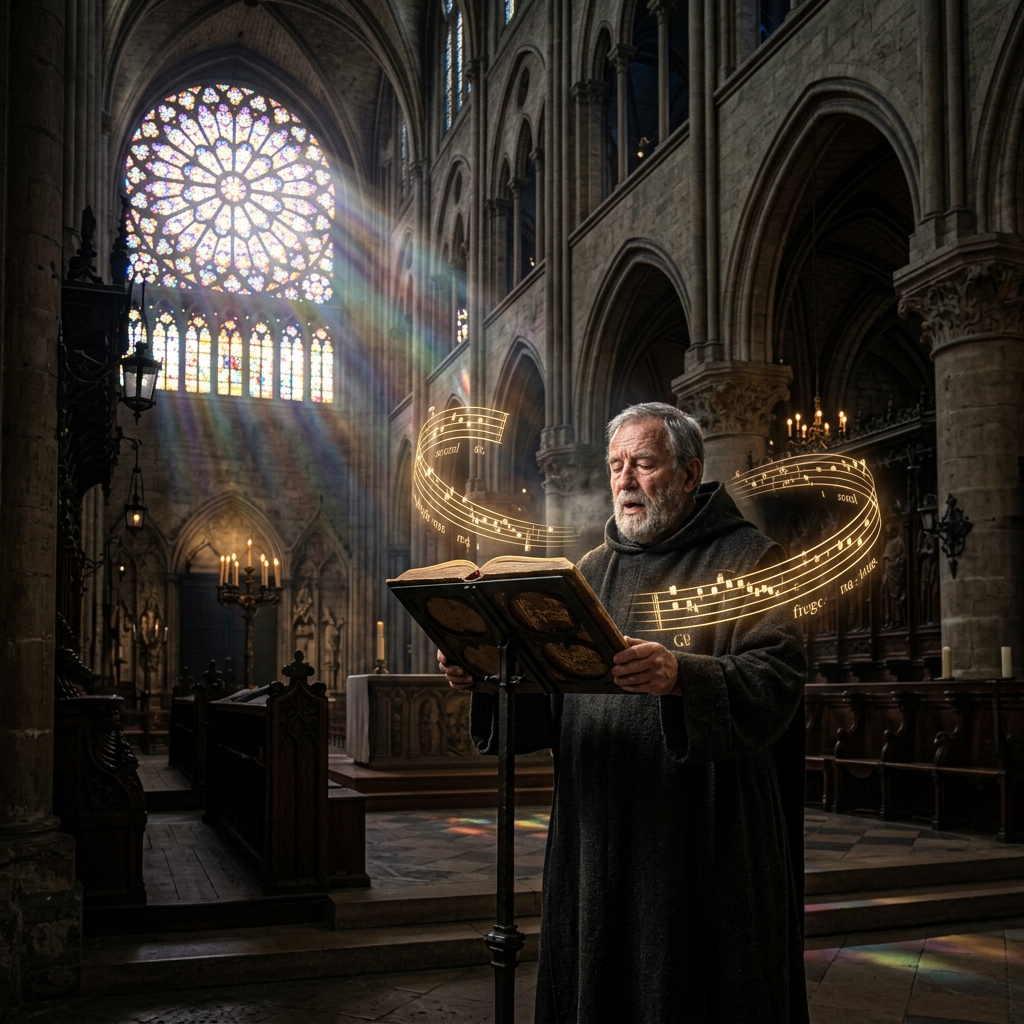
The medieval origin: Guido d'Arezzo and solfège
The term "solfeggio" derives from solfège — the pedagogical system for teaching pitch and sight-singing using syllables. Its origins are attributed primarily to Guido d'Arezzo, an 11th-century Italian Benedictine monk and music theorist. Around 1025–1030 AD, Guido developed a system of hexachords — six-note scales — with syllable names taken from the first syllables of each line of the hymn Ut queant laxis, a Vespers hymn for the feast of John the Baptist.
The syllables were: Ut, Re, Mi, Fa, Sol, La — later modified to Do, Re, Mi, Fa, Sol, La, Ti when the modern seven-note scale was standardised. This is the origin of the "do-re-mi" solmisation system still taught in music education globally.
Guido's system was a pedagogical tool for choral training — it made sight-reading accessible to monks who needed to learn large amounts of liturgical music. Its relationship to specific Hz frequencies as currently described in sound therapy is a later interpretation. The Hz values were not part of Guido's system, because the standardisation of A4 = 440 Hz did not occur until the 20th century. Medieval pitch references were relative, not absolute.
The popular claim that solfeggio frequencies were "used in ancient Gregorian chant" is imprecise. Gregorian chant predates Guido's hexachord system, and the chants were not composed with specific Hz values in mind. The association between the solfège syllables and specific Hz frequencies is a 20th-century interpretation, not a documented medieval practice.
The "lost frequencies" narrative
The modern solfeggio frequencies story begins in the 1990s with Dr. Joseph Puleo, a physician and herbalist who claimed to have found a pattern of frequencies embedded in the Book of Numbers in the Bible using a process he called "Pythagorean skipping." He identified six frequencies — 396, 417, 528, 639, 741, 852 Hz — which he attributed to the original six solfège syllables and claimed had been deliberately suppressed or forgotten by the medieval Church.
Puleo's work was popularised through the 1999 book Healing Codes for the Biological Apocalypse, co-authored with Leonard Horowitz. The book made the claim — repeated extensively in subsequent wellness content — that these frequencies were the original sacred tones of the Gregorian chant tradition and that their rediscovery had healing significance.
The historical claim is not well-supported by musicological scholarship. The connection between Puleo's numerologically derived Hz values and the actual Gregorian chant tradition requires several speculative steps. What Puleo identified were mathematical relationships between specific numbers — not a documented historical practice of using those precise acoustic frequencies in liturgical music.
This does not make the frequencies themselves acoustically uninteresting. The Hz values Puleo identified do have mathematical properties worth examining — their relationships within the harmonic series, their positions relative to standard tuning systems, the research on their effects on the autonomic nervous system. The acoustic and neurological arguments can stand independently of the historical claims.
The expanded nine-frequency scale
The original Puleo/Horowitz system described six frequencies. The expanded nine-frequency scale now in common use — adding 174, 285, and 963 Hz — appears in later developments of the sound therapy tradition, primarily in the early 2000s. The addition of 174 Hz (the lowest) and 963 Hz (the highest) created a more comprehensive scale with a wider acoustic range.
The basis for these additions is less clear than the original six. 174 Hz and 285 Hz complete the mathematical progression implied by the numerological method. 963 Hz — the "God frequency" associated with the pineal gland — became culturally significant as wellness content around these frequencies spread through early social media and YouTube.
The 432 Hz tuning controversy
A related and frequently confused element of solfeggio history is the 432 Hz tuning controversy. Standard Western music is tuned to A4 = 440 Hz — a standard adopted by the International Organization for Standardization in 1955. A significant strand of alternative music theory argues that A4 = 432 Hz is more "natural" or harmonically coherent than 440 Hz, citing various mathematical and metaphysical arguments.
The solfeggio frequencies and the 432 Hz tuning controversy are separate issues, though they are often discussed together. The solfeggio scale was not derived from 432 Hz tuning — the six frequencies Puleo identified have specific Hz values independent of any reference pitch standard. 528 Hz is 528 Hz in both 440 Hz and 432 Hz tuning systems.
The 432 Hz claim — that tuning to 432 Hz rather than 440 Hz produces measurably different physiological or psychological effects — has not been demonstrated in controlled research. It remains a claim with significant cultural traction in the alternative music and wellness communities but without the acoustic or clinical evidence base that would make it actionable.
The 21st-century proliferation
The explosion of solfeggio frequency content in the 2010s was driven by YouTube, where hours-long audio tracks of 528 Hz, 432 Hz, and binaural beat combinations accumulated hundreds of millions of views. The format required no special equipment — anyone with a basic audio software and a YouTube channel could generate and publish solfeggio frequency content.
This democratisation of access came with a corresponding problem: the proliferation of frequency content with no quality standard, no precision verification, and an increasingly elaborate mythology of specific healing claims. By the mid-2010s, the solfeggio frequency market had become saturated with content making claims that no research supported.
The current moment — in which apps like Solfeggio Sanctuary deliver mathematically precise frequencies through professional audio engines — represents a different approach: stripping away the mythology while retaining the genuine acoustic and neurological mechanisms that make the frequencies useful tools.
What the history tells us
The honest summary of the solfeggio frequencies' history is this: the specific Hz values were not used in ancient Gregorian chant as currently claimed. They were identified in the 1990s through a numerological interpretation of biblical text. The historical claim underlying most solfeggio content is shaky.
What is not shaky: the frequencies have real acoustic properties. The frequency-following response is a documented neurological mechanism. Consistent exposure to specific, precise acoustic stimuli influences the autonomic nervous system. The cortisol reduction from 528 Hz has been measured in human subjects.
The value of the solfeggio frequencies as practical tools for nervous system regulation does not depend on the historical claims. It depends on the acoustic and neurological evidence — which is more limited than the marketing suggests, but more substantial than the skeptics claim.
Related articles
- What Are Solfeggio Frequencies? The Science Behind the Scale
- Do Solfeggio Frequencies Actually Work? An Honest Review
- 528 Hz Benefits: What the Research Actually Says
- 174 Hz to 963 Hz: A Complete Guide to All 9 Frequencies
The frequencies — without the mythology
Solfeggio Sanctuary delivers all 9 frequencies with mathematical precision. Free download, no claims that exceed the evidence.
Historical and scientific references
- Guido of Arezzo (c. 1026). Micrologus. The primary source on Guido's hexachord system and the origins of solfège.
- Hiley, D. (1993). Western Plainchant: A Handbook. Oxford University Press. Authoritative reference on the history and practice of Gregorian chant.
- Puleo, J. & Barber, M.L. (1999). Healing Codes for the Biological Apocalypse. Tetra Books. The primary source for the modern solfeggio frequency claims.
- Akimoto, K. et al. (2018). Effect of 528 Hz music on the endocrine system and autonomic nervous system. Health, 10(9), 1199–1209.
- Hink, R.F. et al. (1980). Phase-locked time domain analysis of the auditory frequency-following response. Audiology, 19(1), 1–14.