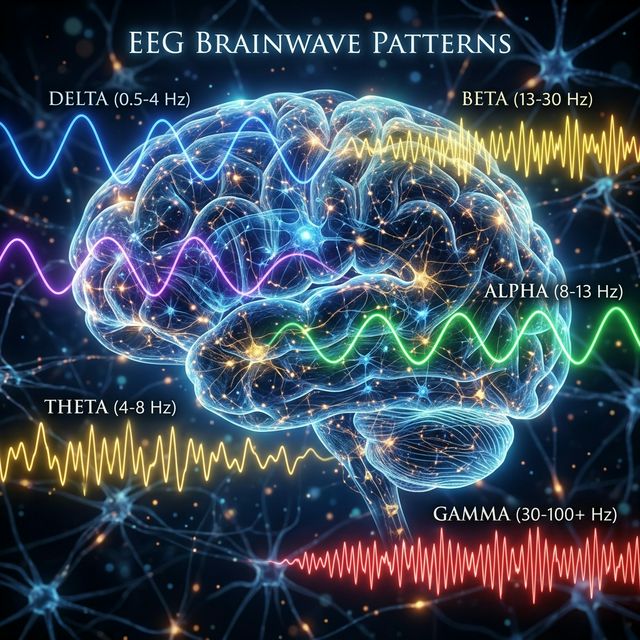
What brainwaves actually are
Brainwaves are rhythmic electrical oscillations produced by the synchronised firing of neurons across the cortex. They are measured using electroencephalography (EEG) — electrodes placed on the scalp that detect voltage fluctuations at the cellular level. The frequency of these oscillations, measured in Hertz, determines which cognitive and physiological state predominates.
The five main frequency bands were identified through decades of EEG research. Each band is not a discrete switch — brainwave activity is continuous, with multiple bands present simultaneously. When we say someone is "in Alpha", we mean Alpha oscillations are dominant, not that Delta or Beta are absent. The dominant band shapes the character of the current state.
Binaural beats work by presenting a frequency differential between the ears that the brain perceives as a tone — and then tends to synchronise with, through the frequency-following response (FFR). Understanding the five bands tells you which differential to target for which goal. The full mechanism is covered in How Binaural Beats Work.
Delta — 0.9 to 4 Hz
Delta is the slowest brainwave band and the signature of deep, dreamless sleep. During Delta, consciousness is effectively suspended — you are not aware of the external environment, not processing emotional content, not forming explicit memories. What you are doing is recovering.
Research by Nedergaard et al. (2013) in Science demonstrated that the brain's glymphatic system — which clears metabolic waste including amyloid-beta proteins linked to neurodegeneration — is most active during slow-wave Delta sleep. The brain is not resting during Delta sleep. It is performing critical maintenance that cannot happen while conscious.
Delta oscillations are also associated with the production of human growth hormone, immune system regeneration, and physical tissue repair. This is why consistently poor sleep — whether from insomnia, sleep apnea, or simply inadequate hours — accumulates as measurable cognitive and physical impairment.
Deep dreamless sleep. No awareness of self or environment.
Physical recovery, immune function, glymphatic clearance, sleep onset.
2–4 Hz differential. Use 30–45 minutes before or during sleep onset. Stereo headphones required.
Nedergaard et al. (2013) — glymphatic system activity during slow-wave sleep. Science 342(6156).
Theta — 5 to 7.83 Hz
Theta is the brainwave state at the threshold between waking and sleep — the hypnagogic zone. It appears during REM sleep, in the moments just before sleep onset, in deep meditation, and in states of absorbed creative flow where the boundary between self and activity dissolves.
Buzsáki (2002) established the central role of hippocampal Theta oscillations in memory consolidation — the process by which experiences are transferred from short-term to long-term storage. This is why you sometimes solve a problem just before falling asleep, or wake with a solution you didn't have the night before: Theta processing integrates and reorganises memory in ways that waking Beta cognition cannot.
Experienced meditators spend deliberate time in Theta. It is the state most associated with vivid hypnagogic imagery, insight, and the kind of creative access that is difficult to engineer consciously. Most people only enter Theta accidentally — in the shower, during long drives, just before sleep. Binaural beats in the 6–7 Hz range are among the most reliable methods for deliberately extending time in this state.
The edge of sleep. Vivid imagery. Ideas arriving without effort. Deep meditation.
Deep meditation, memory consolidation, creative insight, accessing unconscious material.
6–7 Hz differential. Seated or reclined, eyes closed, quiet environment. 20–40 minute sessions.
Buzsáki (2002) — hippocampal Theta and memory consolidation. Neuron 33(3).
Alpha — 8 to 13 Hz
Alpha is the brainwave state of relaxed, open awareness — what athletes call being "in the zone" and artists describe as "flow". It sits between the effortful processing of Beta and the drowsiness of Theta. Conscious, but not striving.
Jensen et al. (2002) demonstrated that Alpha synchrony is associated with suppression of task-unrelated thought — the internal chatter of the default mode network — creating a mental environment that is receptive rather than reactive. This is why Alpha is particularly effective for absorbing new information, creative work, and intentional suggestion.
The morning shower insight, the idea that comes during a walk, the creative solution that appears when you stop forcing it — these are Alpha states. They are not mystical. They are what happens when the noise of Beta processing reduces and the broader associative network of the brain is given room to operate.
Calm, open, unhurried. Present without effort. Ideas arriving sideways.
Creative work, learning, meditation entry, subliminal input, transitioning out of stress.
10 Hz differential. Run for 10 minutes before creative work, not during it. Also the optimal carrier band for subliminal affirmations.
Jensen et al. (2002) — Alpha synchrony and suppression of task-unrelated thought. NeuroImage 15(4).
Beta — 14 to 27.3 Hz
Beta is the default state of the waking, active mind. When you are solving a problem, writing, analysing, debating, or responding to the demands of the day, you are in Beta. It is the most familiar of the five states — most adults spend the majority of their waking hours here.
Beta is not a single state. Low Beta (14–16 Hz) is relaxed but engaged — the mode of a productive, unhurried work session. Mid Beta (16–20 Hz) is active focus — solving a specific problem, writing under mild pressure. High Beta (20–27 Hz) corresponds to intensity, urgency, and — at its extreme — anxiety. When the nervous system is chronically in high Beta, the physiological cost accumulates as elevated cortisol, disrupted sleep architecture, and impaired recovery.
For most people, the goal is not to eliminate Beta but to use it intentionally: to enter Beta for focused work and to deliberately exit it — into Alpha or Theta — for recovery and creative processing. Binaural beats in the 18–20 Hz range support the entry into focused Beta without the hyperarousal of the high end.
Alert, focused, engaged. At the high end: tense, reactive, pressured.
Analytical work, focused study, active problem-solving, productive task execution.
18–20 Hz for focused analytical work. 14–16 Hz for relaxed productivity. Avoid high Beta (22+ Hz) — use Alpha instead if anxiety is present.
Engel & Singer (2001) — Beta oscillations and active sensorimotor processing. Trends in Cognitive Sciences 5(1).
Gamma — 33.8 to 50.57 Hz
Gamma is the fastest brainwave band and the least well-understood. It is associated with peak performance states — the kind of heightened clarity, pattern recognition, and integrative processing that athletes describe as "the zone" and surgeons report during complex procedures. It is also the signature of advanced meditative states.
Lutz et al. (2004) found high-amplitude Gamma synchrony in long-term meditators during mental practice — specifically in the 25–42 Hz range. The effect was not present in novice meditators, suggesting that sustained Gamma access is a cultivated capacity, not a default state. The 40 Hz Gamma frequency has attracted particular research interest for its association with neural binding — the process by which the brain integrates information across different cortical regions into coherent perception.
An important caution: Gamma is activating, not calming. Sessions beyond 30–40 minutes tend to produce mental fatigue rather than enhanced performance. It is a state for specific high-demand windows — a presentation, a complex problem, a performance — not for continuous background use.
Heightened clarity. Fast, integrated thinking. "The zone." Peak cognitive performance.
High-stakes performance situations, complex problem-solving, advanced meditation practice.
40 Hz differential. Maximum 30–40 minutes per session. Not for sleep, not for recovery, not for continuous use.
Lutz et al. (2004) — high-amplitude Gamma in long-term meditators. PNAS 101(46).
Summary: The Five Brainwave States
| Band | Frequency | State | Primary Use Case |
|---|---|---|---|
| Delta | 0.9 – 4 Hz | Deep Sleep | Physical recovery, sleep onset |
| Theta | 5 – 7.83 Hz | Hypnagogic | Meditation, creative insight |
| Alpha | 8 – 13 Hz | Flow State | Relaxed focus, learning |
| Beta | 14 – 27 Hz | Active Focus | Analytical work, problem solving |
| Gamma | 33 – 50 Hz | Peak Clarity | High-stakes performance |
How to choose the right band
The decision is simpler than it looks. Match the state to the need:
- Sleep onset or deep recovery: Delta (2–4 Hz). Run the session as you get into bed, timer set to 45 minutes.
- Deep meditation or creative insight: Theta (6–7 Hz). Seated or reclined, eyes closed, 20–40 minutes before creative work — not during it.
- Creative work, learning, subliminal input: Alpha (10 Hz). 10 minutes before the session, then let the audio fade into the background.
- Focused analytical work: Beta (18–20 Hz). Run alongside a Pomodoro block. Headphones, low volume.
- High-performance window: Gamma (40 Hz). Before the event, not during. 20–30 minutes maximum.
All five bands are available in Binaural Therapy — with harmonically-aligned carrier frequencies, a session timer, and a subliminal message builder. €2.49, one-time purchase.
Related articles
- Binaural Beats: How They Work and What the Research Says — the full mechanism
- Binaural Beats for Sleep: The Complete Protocol — Delta in practice
- Binaural Beats for Focus: Which Frequency and How Long — Beta in practice
- How to Use Theta Waves for Deep Meditation — Theta in depth
- Gamma Waves and Peak Performance: The Science — Gamma in depth
All five bands. One app. €2.49 once.
Binaural Therapy gives you Delta, Theta, Alpha, Beta, and Gamma with harmonically-aligned carrier frequencies and a session timer. No subscription.
Scientific references
- Nedergaard, M. et al. (2013). Sleep drives metabolite clearance from the adult brain. Science, 342(6156), 373–377.
- Buzsáki, G. (2002). Theta oscillations in the hippocampus. Neuron, 33(3), 325–340.
- Jensen, O. et al. (2002). Oscillations in the alpha band increase with memory load during retention in human short-term memory. NeuroImage, 15(4), 817–827.
- Engel, A.K. & Singer, W. (2001). Temporal binding and the neural correlates of sensory awareness. Trends in Cognitive Sciences, 5(1), 16–25.
- Lutz, A. et al. (2004). Long-term meditators self-induce high-amplitude gamma synchrony during mental practice. PNAS, 101(46), 16369–16373.
- Hink, R.F. et al. (1980). Phase-locked time domain analysis of the auditory frequency-following response. Audiology, 19(1), 1–14.