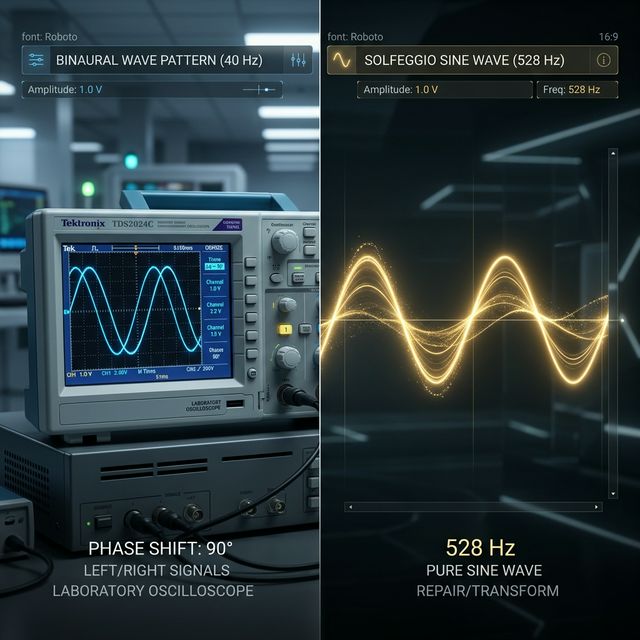
Binaural beats and solfeggio frequencies work through different mechanisms. Solfeggio are precise acoustic tones that influence the autonomic nervous system through FFR — no headphones required. Binaural beats create an internally generated beat via a stereo frequency differential, directly targeting brainwave states — stereo headphones required. Both are complementary; they address different physiological pathways.
The fundamental difference: where the effect is generated
This is the core distinction that clarifies everything else. Solfeggio frequencies generate their effect in the acoustic environment — in the air, before the sound reaches the ear. Binaural beats generate their effect inside the brain, after the sound reaches each ear separately.
A 528 Hz solfeggio tone is a physical acoustic wave at 528 Hz. Your ear receives it directly. Your nervous system responds to the frequency through the frequency-following response (FFR) — neural oscillations tend to synchronise with the sustained acoustic input. The effect is direct, external-to-internal.
A binaural beat is an auditory illusion. Your left ear receives 200 Hz. Your right ear receives 210 Hz. No 10 Hz sound exists in the room. The brain creates the 10 Hz perception internally — by computing the difference between the two inputs. The entrainment effect comes from this internally generated beat, which the brain then tends to synchronise with. The effect is internal from the start.
This distinction has one immediate practical consequence: solfeggio frequencies do not require headphones. Binaural beats require headphones — without stereo isolation, the binaural mechanism does not function. This is not a minor technical point. It is the entire basis of how the tool works.
Side-by-side comparison
| Criterion | Solfeggio Frequencies | Binaural Beats |
|---|---|---|
| Mechanism | Acoustic FFR — direct frequency stimulus to the auditory system | Internally generated phantom beat — brain computes the differential |
| Headphones | Not required | Required — stereo isolation essential |
| Target frequencies | 174–963 Hz (solfeggio scale) | 0.9–50 Hz (brainwave bands) |
| Primary effect | Autonomic nervous system — parasympathetic activation, cortisol regulation | Brainwave entrainment — direct influence on dominant neural oscillation frequency |
| Best for | Grounding, anxiety reduction, emotional clearing, daily acoustic baseline | Targeted state management: sleep onset, deep focus, meditation access |
| Clinical evidence | Moderate — FFR mechanism well-documented; specific frequency effects variable | Strong — multiple RCTs on anxiety, sleep, and cognitive performance |
| Session flexibility | Can play through speakers; background use during work or rest | Requires active session with headphones; not ideal as background |
| Layering | Can layer multiple instruments (pure tone, tuning fork, bowls) | Single carrier frequency differential; can combine with solfeggio as base |
What each tool is best at
- Morning grounding session before the day begins
- Acute anxiety reduction — no headphones needed, can use anywhere
- Background acoustic environment during rest, reading, or light work
- Emotional clearing — particularly 396 Hz and 417 Hz
- Creating a deliberate sonic environment in a space (home, office)
- Children and people sensitive to headphone discomfort
- Sleep onset — Alpha wind-down → Delta sleep induction
- Focused analytical work — Beta band with minimal distraction
- Deep meditation — Theta access without years of practice
- Pre-performance preparation — targeted Gamma activation
- Subliminal affirmation delivery during Alpha receptive state
- Brainwave state verification — precise frequency targeting
When to use both together
The two tools are complementary, not competitive. Solfeggio frequencies address the autonomic nervous system from the bottom up — they shift the physiological baseline. Binaural beats address the brainwave state from the entrainment pathway. Used together, they engage both mechanisms simultaneously.
A practical combined protocol: run a solfeggio frequency (396 Hz or 417 Hz) through a phone speaker at low volume in the room while running a binaural beat (Alpha at 10 Hz) through earbuds. The solfeggio creates an acoustic field that supports parasympathetic activation. The binaural guides neural oscillations toward the Alpha state. The two layers work on different systems and do not interfere with each other.
This is the approach used in the Morning Frequency Protocol and the Sleep Protocol.
Which to start with if you are new
Start with solfeggio frequencies. The barrier to entry is lower — no headphones required, no equipment to set up, free in Solfeggio Sanctuary. Run 396 Hz or 417 Hz for 10 minutes in the morning for one week. Observe what, if anything, changes in the quality of your mornings.
Once you have a baseline experience with solfeggio, add binaural beats for a specific purpose — sleep onset or focused work. Binaural Therapy is €2.49, one-time. Use Alpha at 10 Hz for 30 minutes before bed for the first week. The comparison between binaural-assisted nights and baseline nights is typically the most persuasive argument for the tool.
The precision question
For binaural beats, frequency precision is the non-negotiable technical requirement. A 10 Hz binaural beat requires an exact 10 Hz differential. Drift of even 0.5 Hz shifts you into a different brainwave sub-band. Both Solfeggio Sanctuary and Binaural Therapy run on Google's Oboe audio library — 32-bit floating-point signal processing, zero frequency drift. The frequency you set is the frequency delivered, for the entire session.
Related articles
- What Are Solfeggio Frequencies? The Science Behind the Scale
- Binaural Beats: How They Work and What the Research Says
- Delta, Theta, Alpha, Beta, Gamma: A Complete Guide
- The Morning Frequency Protocol
- The Sleep Protocol: Alpha to Delta in 45 Minutes
Scientific references
- Oster, G. (1973). Auditory beats in the brain. Scientific American, 229(4), 94–102.
- Hink, R.F. et al. (1980). Phase-locked time domain analysis of the auditory frequency-following response. Audiology, 19(1), 1–14.
- Padmanabhan, R., Hildreth, A.J. & Laws, D. (2005). A prospective, randomised, controlled study examining binaural beat audio and pre-operative anxiety. Anaesthesia, 60(9), 874–877.
- Akimoto, K. et al. (2018). Effect of 528 Hz music on the endocrine system and autonomic nervous system. Health, 10(9), 1199–1209.
- Huang, T.L. & Charyton, C. (2008). A comprehensive review of the psychological effects of brainwave entrainment. Alternative Therapies in Health and Medicine, 14(5), 38–50.
- Garcia-Argibay, M., Santed, M.A. & Reales, J.M. (2019). Efficacy of binaural auditory beats in cognition, anxiety, and pain perception. Psychological Research, 83(2), 357–372.