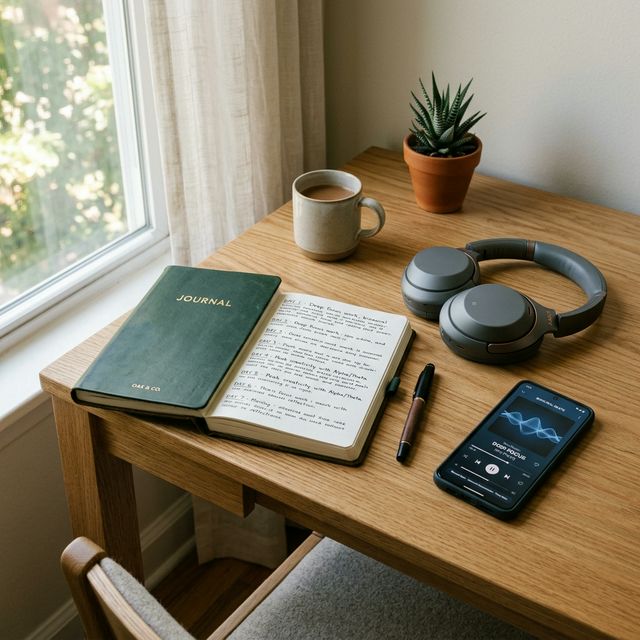
The setup
One session per day for seven days. 25 minutes each. Same time each morning — within 30 minutes of waking, before coffee and before screens. Stereo headphones. Binaural Therapy app.
I alternated between two bands across the week: Theta (6 Hz) on odd days, Alpha (10 Hz) on even days. The logic was that Theta would give me access to the deeper, more meditative state I was curious about, while Alpha would provide the relaxed-but-aware quality useful for the creative work that typically follows my morning routine.
I tracked three things: how the session itself felt, how the first two hours of the day felt, and whether I noticed anything different at the end of the day compared to my baseline. I did not change anything else in my routine — no dietary changes, no other new practices.
Day 1: nothing remarkable
Theta, 6 Hz, 25 minutes. The first thing I noticed was how active my mind was. The binaural beat was barely perceptible — a low, pulsing undercurrent beneath the carrier frequency. I spent the first 10 minutes tracking whether I could feel it working. I could not identify any distinct shift.
The rest of the morning felt normal. No increased clarity, no dramatic relaxation. I questioned whether the app was generating the frequency correctly, checked the settings, confirmed it was. The session was unremarkable.
This is worth stating clearly: if you expect the first session to produce a noticeable effect, you will likely be disappointed. The frequency-following response is not an acute event. It is a gradual, cumulative shift in a baseline.
Day 2: a small observation
Alpha, 10 Hz, 25 minutes. Still no dramatic experience during the session. But I noticed something at around 11am — approximately two hours after the session ended. I was working on a piece of writing and was moving through it with less friction than usual. The internal commentary that typically runs alongside creative work ("this isn't quite right", "start over here") was quieter.
I noted it but did not attribute it confidently to the session. One data point is not a pattern.
Day 3: getting the setup wrong
Theta again. I forgot to plug in the headphones and ran the session through the phone speaker. Ten minutes in, I realised the mistake. I plugged in and continued, but the session was interrupted — the continuity of the acoustic environment had been broken.
The important lesson here: binaural beats through speakers do not work. The mechanism requires each ear to receive a different frequency in isolation. Mono or speaker playback cancels the binaural effect entirely. Headphones are not optional.
Day 4: the comparison becomes meaningful
Alpha, 10 Hz. By Day 4 I had a baseline to compare against — Days 1 and 2 were now reference points. The session felt different: less mind-tracking-the-beat, more settling. I was not monitoring it as closely. The 25 minutes passed without me checking the timer twice.
The morning that followed had a quality I began to associate specifically with the Alpha sessions: a broader attentional field. Not more energetic, not dramatically calmer — just less narrowed. The tendency to get stuck on a single problem rather than working around it was reduced.
Day 5: the Theta question
Theta, 6 Hz. I was more curious this time about what Theta was supposed to feel like — and whether I was accessing it. The research describes Theta as associated with hypnagogic imagery, memory consolidation, and the edge-of-sleep state. I did not experience anything that vivid. I did notice a heaviness in my limbs and an increased tendency for my mind to produce images rather than verbal thoughts — brief flashes of scenes rather than sentences. This may have been Theta. It may have been tiredness from a busy week. I am not certain.
What I am more certain about: the Theta sessions were harder to sustain attentionally than the Alpha sessions. The pull toward sleep was real. If I had been less upright, I probably would have drifted.
Day 6: the accumulated effect becomes visible
Alpha, 10 Hz. By Day 6 the pattern was consistent enough to be meaningful. On Alpha session days, the first two hours of the day had a noticeably different quality from my baseline: more fluid, less self-interrupting. On Theta days, the sessions themselves were more interesting but the post-session effect on the working day was less distinct.
I began to suspect that the specific effect I was noticing — the reduced attentional friction during creative work — was primarily an Alpha effect, not a binaural beats effect in general. This is consistent with the research: Alpha is the brainwave state specifically associated with suppression of task-unrelated thought and receptive, open awareness.
Day 7: the honest summary
Alpha, 10 Hz, final session. By the end of the week, my assessment was this:
- What changed: The quality of the first two hours after an Alpha session was consistently better than my baseline — specifically in terms of reduced attentional friction. The shift was not dramatic. It was the difference between flowing through the morning and having to push through it. Small, but consistent and repeatable.
- What did not change: Energy levels, mood, sleep quality, overall stress. One week is probably not enough time to see changes in these metrics. The research suggests consistent practice over several weeks before expecting baseline shifts in cortisol or HRV.
- What I got wrong initially: Trying to notice the effect during the session. The frequency-following response is passive — it works whether or not you are tracking it. Actively monitoring the session probably reduced its effectiveness on Days 1 and 2.
- What made the biggest difference: Consistency of timing (same window each morning) and correct headphone use. Both matter more than the specific frequency band, at least in the short term.
What I would do differently
Run the experiment for 21 days, not 7. The frequency-following response is cumulative — a week is the beginning of the baseline shift, not the full effect. I would also track HRV data using a wearable throughout the period, rather than relying on subjective assessment. The subjective observations are consistent with what the research predicts, but hard data would make the comparison more precise.
I would also use Theta differently — not as a morning session aimed at improving the working day, but as a deliberate evening practice aimed at memory consolidation and creative processing before sleep. The research on Theta and hippocampal memory consolidation suggests that is the more appropriate application window.
Try your own experiment
The most useful thing about this protocol is that it is replicable. Binaural Therapy costs €2.49. Seven days, same time each day, stereo headphones, 25 minutes. Track what actually changes in the two hours following the session, not what changes during it.
The results will not be identical to mine — the frequency-following response is individual, and the effects of specific bands vary with the person's baseline state. That is exactly why the experiment is worth running yourself.
Related articles
- Binaural Beats: How They Work and What the Research Says
- Delta, Theta, Alpha, Beta, Gamma: A Complete Guide
- Binaural Beats for Focus: Which Frequency and How Long
Run your own experiment. €2.49.
Binaural Therapy gives you all five bands with precise frequency control. One-time purchase. No subscription. Seven days of data costs less than a coffee.
Scientific references
- Oster, G. (1973). Auditory beats in the brain. Scientific American, 229(4), 94–102.
- Jensen, O. et al. (2002). Oscillations in the alpha band increase with memory load during retention in human short-term memory. NeuroImage, 15(4), 817–827.
- Buzsáki, G. (2002). Theta oscillations in the hippocampus. Neuron, 33(3), 325–340.
- Huang, T.L. & Charyton, C. (2008). A comprehensive review of the psychological effects of brainwave entrainment. Alternative Therapies in Health and Medicine, 14(5), 38–50.