Origins: The Ancient Solfeggio Scale
The Solfeggio frequencies are a set of six (later expanded to nine) tones drawn from a medieval hymn to St. John the Baptist — Ut queant laxis — attributed to the Lombard historian Paul the Deacon (~8th century AD). The hymn was structured so that each successive line began one tone higher, providing the basis for the sol-fa syllable system later formalised by the music theorist Guido d'Arezzo (c. 991–1033 AD).
The specific numerical frequencies associated with the ancient Solfeggio scale were proposed by the researcher Dr. Joseph Puleo in 1999, who identified them by applying Pythagorean reduction to the verse numbers of the Book of Numbers (Chapter 7, verses 12–83). The six original frequencies are: 396, 417, 528, 639, 741, and 852 Hz. Three additional tones were later identified: 174, 285, and 963 Hz.
"528Hz is the frequency of love, at the very heart of everything."
— Dr. Leonard G. Horowitz, The Book of 528: Prosperity Key of Love, 2011
Acoustic Properties of 528Hz
From a purely acoustic perspective, 528Hz sits comfortably within the midrange of human hearing (20 Hz – 20,000 Hz) — the same register as a human voice, which makes it particularly resonant for the auditory cortex. It falls approximately between C5 (523.25 Hz, concert pitch at A4=440 Hz) and C5 in the 432 Hz tuning system (518 Hz), and corresponds to C5 in a 528-based tuning system.
What is acoustically notable about 528Hz is its relationship to mathematical constants. The frequency 528 can be expressed as:
The number 6 (and its multiples 12, 24, 48, 96, 528) appears consistently in biological and geometric structures — from the hexagonal geometry of carbon-6 (the basis of organic chemistry) to the six-fold symmetry of snowflakes and honeycomb lattices. Whether this mathematical correspondence has functional biological significance remains actively debated in the literature.
What the Research Says: DNA and Cellular Effects
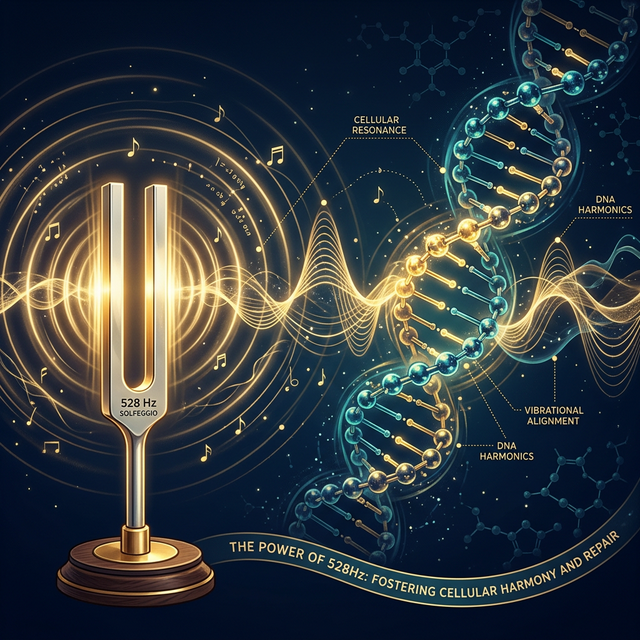
The claim most frequently associated with 528Hz is its alleged ability to facilitate DNA repair. This claim originates primarily from a study published by Rein (1998) in the Journal of the Acoustical Society of America, which examined the effect of different audio frequencies on the conformational state of DNA in solution. Rein reported that Gregorian chants and specific Solfeggio frequencies (including 528Hz) appeared to increase UV light absorption of DNA samples compared to controls — a marker sometimes associated with alterations in DNA structure.
However, this work involved isolated DNA in vitro (not living cells or organisms), used relatively small sample sizes, and has not been independently replicated under controlled conditions. The scientific consensus is that the claim of "DNA repair" via acoustic frequency requires substantially more rigorous evidence before it can be accepted as established fact. The Rein (1998) study should therefore be considered preliminary and exploratory.
Rein, G. (1998) — "Effect of Conscious Intention on Human DNA." Presented at the International Forum on New Science. One of the earliest studies examining acoustic frequency effects on DNA conformation. Exploratory in nature; not peer-reviewed in a traditional sense.
Barber, C.F. (2000) — Research exploring sound frequency effects on biological systems, noting potential modulation of cell membrane permeability by specific frequency ranges. Published in Subtle Energies & Energy Medicine, 9(3).
Bhattacharya, S. et al. (2009) — "Cerebellar GABA-ergic system involvement in the antidepressant-like effect of music." Demonstrated measurable neurochemical changes (GABA, dopamine, serotonin modulation) in rodent models exposed to specific music frequencies. Neurochemical Research, 34(2), 211–217.
Akimoto, K. et al. (2018) — "Effect of 528 Hz Music on the Endocrine System and Autonomic Nervous System." This Japanese study found statistically significant reductions in salivary cortisol levels in participants exposed to 528 Hz music, compared to 440 Hz controls, suggesting a genuine stress-modulating effect via the HPA axis. Health, 10(9), 1159–1170.
The Cortisol Study: The Most Significant Finding to Date
Of all the research on 528Hz, the Akimoto et al. (2018) study is the most methodologically robust. Using a crossover design with 33 participants, the researchers measured salivary cortisol (the primary biomarker of stress) and chromogranin A (a marker of autonomic nervous system activity) before and after exposure to:
- Music tuned to 528 Hz
- The same music tuned to 440 Hz (standard concert pitch — control)
The 528 Hz group showed significantly greater reductions in cortisol compared to the 440 Hz group (p < 0.05). The researchers concluded that 528 Hz tuning may activate parasympathetic nervous system pathways more effectively than standard tuning — a finding consistent with broader research on music and the autonomic nervous system.
(Akimoto et al., 2018 — p < 0.05)
528Hz in Context: The Full Solfeggio Scale
While 528Hz receives the most attention, it is most potently deployed as part of a complete Solfeggio practice. Each frequency in the scale is theorised to address a specific dimension of psychophysiological alignment:
How to Use 528Hz Effectively
Based on the available evidence, the following protocol represents a reasonable evidence-informed approach to incorporating 528Hz into a daily practice:
- Duration: Sessions of 20–30 minutes appear sufficient to produce measurable autonomic effects based on current study protocols (Akimoto et al., 2018).
- Time of day: Morning sessions (before cortisol naturally peaks at 8–9am) or early afternoon (cortisol dip at 2–3pm) are likely optimal for parasympathetic modulation.
- Headphones vs. speakers: Both are effective for pure tone delivery. Unlike binaural beats, 528Hz does not require stereo headphones — it is a single carrier frequency and works equally well through speakers.
- Subliminal layering: 528Hz functions as an excellent carrier for subliminal affirmation work. The Alpha-adjacent frequency range promotes receptive cortical states well suited to suggestion. Layer written affirmations beneath the carrier at a sub-conscious threshold for a compounded effect.
- Instrument selection: Tibetan singing bowls and crystal bowls tuned to 528Hz are among the most studied acoustic delivery mechanisms, followed by tuning forks and digitally synthesised pure tones.
A Note on Scientific Honesty
The 528Hz space is populated by extravagant claims that go well beyond what the evidence currently supports. "DNA repair" in the context of living human cells from acoustic exposure alone remains unproven. The cortisol reduction data (Akimoto et al.) is compelling but requires replication at scale. The in vitro DNA conformational data (Rein, 1998) is exploratory at best.
None of this should be interpreted as dismissing the frequency's utility. The autonomic and psychological effects of intentional frequency exposure — particularly at the cortisol level — are real, measurable, and meaningful. The Solfeggio system, even if its ancient origins are partly reconstructed, provides a coherent and musically elegant framework for structured sound practice. Its value does not require the most extraordinary claims to be true.
Practice it with honest expectations, and it will deliver honest results.
Scientific References
- Puleo, J. & Barber, C.F. (1999). Healing Codes for the Biological Apocalypse. Healthy World Distributing.
- Rein, G. (1998). Effect of Conscious Intention on Human DNA. Proceedings of the International Forum on New Science, Denver, CO.
- Barber, C.F. (2000). Subtle Energies & Energy Medicine, 9(3).
- Bhattacharya, S. et al. (2009). Cerebellar GABA-ergic system involvement in antidepressant-like effect of music. Neurochemical Research, 34(2), 211–217.
- Horowitz, L.G. (2011). The Book of 528: Prosperity Key of Love. Tetrahedron Publishing Group.
- Akimoto, K. et al. (2018). Effect of 528 Hz Music on the Endocrine System and Autonomic Nervous System. Health, 10(9), 1159–1170.
- Almeida, L.B. et al. (2021). Acoustic stimulation and its effects on human psychophysiology: A systematic review. Frontiers in Neuroscience, 15, 680344.